Get Full Government Meeting Transcripts, Videos, & Alerts Forever!
Get email alerts on the Transportation Budget topic
No spam. Unsubscribe anytime.
Metropolitan Council outlines budget trade-offs: loans to MnDOT, free fares pilot for Metro Mobility and a $15 million ABRT bonding ask
Summary
Charlie Zelle, chair of the Metropolitan Council, told the Minnesota Senate Transportation Committee on Jan. 29 that the council seeks short-term authorization to advance reserve funds to MnDOT to coordinate roadway reconstruction with arterial bus rapid transit construction, to make free fares permanent for Metro Mobility-certified riders after a 1¢ pilot, and $15 million in bonding for ABRT capital.
Charlie Zelle, chair of the Metropolitan Council, told the Minnesota Senate Transportation Committee on Jan. 29 that the council is asking the legislature to approve several near-term and capital funding changes tied to the governor's budget.
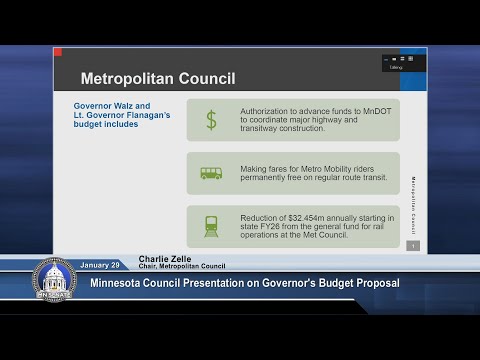
The council’s priorities, Zelle said, include authorization to advance reserve funds to the Minnesota Department of Transportation to allow coordinated highway reconstruction and arterial bus rapid transit (ABRT) construction; a request to make permanent a pilot that essentially makes fares free for Metro Mobility-certified riders; a proposed reduction in the council’s general fund allocation for transit operations; and a $15 million bonding request for ABRT capital. The council also asked to expand its existing right-of-way acquisition loan program (the “Ralph program”) to allow loans for park and trail land acquisitions.
Those steps, Zelle said, are meant to “be a lot more efficient, a lot less disruptive, save the taxpayer’s funding, and frankly, advance really a really important transitway connection, sooner than if we had to wait.” He described the MnDOT advance-funding idea as a near-term, time-limited use of Met Council reserves so MnDOT can reconstruct roadways at the same time ABRT work occurs, reducing duplicate construction and lowering overall costs.
Why it matters
The council presented the package as a mix of timing and policy choices rather than permanent new spending. Zelle emphasized the loan would be short term — “a period of years,” not decades — and the council expects the reserves returned for future capital maintenance. He told senators the approach could lower construction inflation costs and reduce repeated disruptions along major corridors such as Hennepin Avenue.
Key details presented
- Advance funding to MnDOT: The council asked for authorization to advance near-term reserves to MnDOT to align highway reconstruction with ABRT construction. Zelle said delivering projects sooner “actually brings it in at a lesser cost” because construction costs have been rising faster than general inflation.
- Free fares for Metro Mobility-certified riders: The Met Council reported on a pilot that reduced fares for Metro Mobility riders to 1¢ and then effectively allowed free rides; staff said about 75,000 free rides were taken as the program expanded. Charles Carlson, executive director of Metropolitan Transportation Services, said the council tracked rides but could not determine from the available data how many of those trips represented riders who otherwise would have used Metro Mobility paratransit. “We did track the number of rides taken. We did not … have the inferences from the data to draw conclusions about how much money might the state save from this program,” Carlson said. Council staff told the committee the program could produce net savings if even a modest share of trips shifted from Metro Mobility vans to fixed-route service but that the exact dollar savings had not been modeled for the hearing. The council is preparing a legislatively mandated report on the pilot due Feb. 15.
- Reduction in general fund support for rail operations: The presentation said the governor’s proposal reduces general fund support to the Met Council (the figure discussed in committee was roughly $32 million per year). Zelle said the council can manage that reduction in the short term because of a diversified revenue mix, including metropolitan-area sales tax revenue. He warned, however, the reduction could affect long-term plans for expanding ABRT and frequency if reserves are needed later for operations and capital maintenance.
- $15 million ABRT bonding request: Zelle said the council appeared before the Capital Investment Committee seeking $15 million in state bonding toward arterial bus rapid transit capital, including support for the H Line. He told senators roughly $60 million of the H Line had been secured from federal sources, regional solicitation (cited as $25 million) and other prior support; the additional $15 million would help move H Line through Small Starts and toward full federal funding.
- Ralph program expansion: The council asked authority to allow its right-of-way revolving loan fund to be used for parkland and trail acquisitions when local governments need to act quickly to secure land. Senators raised concern that using those funds in conjunction with highway projects could create confusion about condemnation authority for park projects. Zelle and regional staff said the loans would enable local governments to buy opportunities quickly and that the council’s intent was not to change condemnation authorities; the local unit acquiring land would be the acquiring entity.
Questions and federal funding uncertainty
Senators pressed council staff about exposure to federal funding shifts. Council regional staff told the committee the council receives formula operating grants (the council cited roughly $30 million in federal operating funding) and larger capital grants for buses and projects. Mitch (M.) O'Connor (regional staff) and others described three classes of federal exposure: immediate programs that would be at risk if federal payments stopped (the council noted its public housing/Section 8 HRA runs with little reserve and would be immediately vulnerable), reimbursements for work already underway that rely on federal reimbursement, and future discretionary grants that enable expansion or electrification projects. "It would mean people not being able to have rent paid through the section 8 program would be the risk that we are running," a council official said, describing the immediate, high-impact exposure if federal housing funds were halted.
Several senators asked for more precise estimates and for the council to follow up with written figures: the Feb. 15 pilot report on free fares and additional follow-up on the estimated savings from fare changes and the council’s federal funding exposure.
What the council did not ask for and votes
Committee members were told there were no bills or committee votes on the agenda for this hearing; the presentation was informational and framed as requests the council sought from the governor’s budget and from bonding committees.
Context and next steps
Zelle said the council expects to open three new transitways this year, including the Gold Line in March and two arterial BRTs, the Bee Line and the E Line, and that the council is rolling out a “Network Now” program to increase frequency across the system. The council will deliver the Feb. 15 pilot report on free fares and has offered to provide follow-up materials on projected savings, details about how many Metro Mobility-certified riders opted for fixed-route service, and further analysis of federal funding exposures.
The committee took no formal action at the Jan. 29 meeting; senators asked council staff to return data and clarifications as they evaluate related budget and bonding proposals.