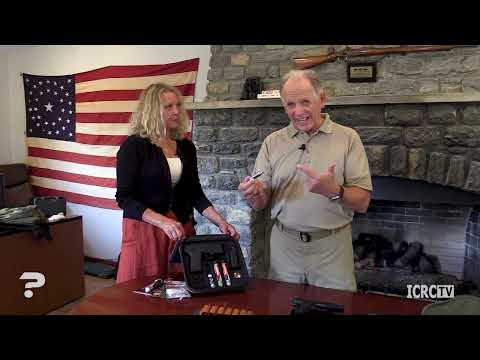
Firearms instructor, local retailer outline how to choose a gun, store it and consider nonlethal options
Loading...
Summary
On a recorded episode of "How Safe Are You?", a shooting-club manager and staff from Vance Outdoors advised viewers on matching firearms to purpose, the limits of different weapon types, nonlethal alternatives and safe-storage choices, and urged training and checking state and local law.
Handy Pridemore, host of the recorded program “How Safe Are You?,” moderated a segment in which a manager of the Indian Hills Shooting Club and staff from Vance Outdoors advised viewers on choosing firearms for home defense, nonlethal alternatives and options for secure storage.
The manager of the Indian Hills Shooting Club (name not specified), a certified firearms instructor, said the primary consideration when buying a firearm is intended use — for example, home defense or concealed carry — and recommended trying guns at a range to ensure a proper fit. “You fall to the level of your training,” the instructor said, urging viewers to get formal training before relying on a firearm.
The program compared three broad firearm types: semi-automatic pistols, revolvers and short-barreled shotguns. The instructor identified a striker-fired semi-automatic pistol (the episode named a P320 as an example) as having advantages for many users because of higher magazine capacity and a quicker trigger, but said “you want a gun that fits your hand” and to shoot the firearm before purchase. The instructor described revolvers as simple and hard to jam but noted a typical revolver holds six rounds and, in a prolonged encounter, may run out of ammunition. On shotguns, the instructor recommended a short-barreled pump shotgun for home defense because it is easy to point and use with two hands; the episode discussed 12-gauge shotguns and noted 20-gauge and .410 versions as alternatives.
The episode also described a market of nonlethal launchers that fire projectiles or pepper cartridges and are powered by a CO2 cartridge. The instructor said law-enforcement trainers recommend loading a concussion (impact) round first, followed by pepper rounds, so the initial hit disorients and the pepper delivers a longer delay to allow escape; the instructor said these devices do not require background checks or permits "to this point," and can be practiced with in a backyard. The instructor characterized one model as a “68 caliber projectile” launcher and said it can incapacitate an intruder long enough to get away.
Retail staff from Vance Outdoors provided an extended overview of safe-storage options. Ray Joseph, of Vance Outdoors, and Lisa Roberson, a lead sales associate at Vance Outdoors, described small bedside lockboxes and biometric cases (the episode mentioned a product called the Lifepod), trunk- or vehicle-mounted cases, welded cabinets and a range of safes with differing fire ratings. An entry-level safe shown in the segment had a roughly 30‑minute fire rating; the program also demonstrated safes with roughly 60‑, 75‑ and 110‑minute fire ratings and noted larger safes can weigh about 1,000 pounds and require planning for where to put them.
The retailer described differences in cabinet construction (rivet seams versus welded seams), electronic versus keyed locks, and more secure doors with lips or repositioning mechanisms that make prying harder. Joseph said buyers should match a safe’s size and fire rating to the number and type of firearms they plan to store and their available space.
Both the instructor and Vance Outdoors staff repeatedly emphasized training and responsible storage. The instructor said that rather than spending a very large amount on a firearm, viewers would be better served spending substantially more on training: “I would much rather you buy a $1,000 gun and spend $9,000 on training,” the instructor said.
On legal points, the instructor told viewers to be aware of state and local laws and said that local rules can sometimes supersede state rules; the instructor also said a shotgun does not require a concealed-carry permit and that carrying a loaded shotgun in a car for self-defense is not permitted (the program did not cite specific statutes for these statements). The episode closed with the repeated advice to choose equipment that fits the user, get training and store firearms securely.
The program did not include formal votes or policy actions.