Get Full Government Meeting Transcripts, Videos, & Alerts Forever!
Get email alerts on the Education Policy topic
No spam. Unsubscribe anytime.
Mount Lebanon board adopts new curriculum and instructional-materials policies amid calls for comprehensive sex education and LGBTQ protections
Summary
The Mount Lebanon Board of School Directors voted to adopt a suite of curriculum- and instructional-materials policies, retiring two older policies, while members of the public urged the district to set a timeline for a comprehensive sex-education policy and clearer protections for LGBTQ students.
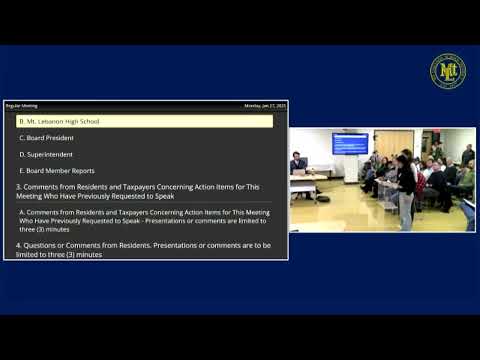
The Mount Lebanon Board of School Directors voted Jan. 27 to adopt a package of curriculum and instructional-materials policies, prompting lengthy public comment urging faster action on a separate comprehensive sex-education policy and clearer policies addressing LGBTQ student safety.
The board approved new policies numbered 102 (academic standards), 105 (curriculum), 105.1 (review of instructional materials by parents, guardians, and students), 105.2 (exemption from instruction), 107 (adoption of planned instruction), 108 (adoption of textbooks), 109 (resource materials), 110 (instructional supplies), 111 (lesson plans) and 119 (current events). The district also retired policies IF (curriculum and parental rights) and IJ (selection of instructional materials and resources). The board voted to adopt the package after discussion and a roll call in which the present members voted in favor; the motion passed.
Why it matters: The newly adopted policies create a district-wide process for reviewing instructional and noncurricular materials, and a formal mechanism for parents and students to request review of materials. Several residents and students who addressed the board said the new rules did not address broader gaps in district policy, especially the absence of a comprehensive sex-education policy and explicit protections for LGBTQ students.
During the meeting, resident Patrick Mannion, identifying himself as a teacher, said the new language “is not nearly as expansive or, pro student as and pro teacher as I would like to see.” Mannion questioned whether the new policy would require teachers to submit every supplemental book or resource that is not part of an already approved curriculum.
Superintendent Dr. Fries responded that the administrative regulations being developed will clarify implementation. “If it’s written in the curriculum and it’s been approved, it’s not going to go through a process because it would already have been through a process,” Dr. Fries said, adding that “anything that is new that you may wanna add … is not going to be a process that we’re gonna utilize anymore.” He said administrative regulations will be presented to staff at professional learning on Feb. 17.
Policy 105.1, the review-by-parents policy, spells out the district’s response process: a written request can be made by a parent or student, the district has 10 days to respond and provide a time and place for review, and the review may be monitored to protect materials from loss or alteration. The policy also preserves an appeal process for reconsideration of materials.
Public comment at the meeting focused heavily on a separate issue: community members and students urged the board to adopt a comprehensive sex-education policy and clear LGBTQ protections more quickly. Several speakers asked for a timeline. Felix Wagon, a fifth-grade student who identified as nonbinary, said, “We should all learn together,” and urged the district to make sex-education “inclusive and up to date.”
Members of a youth advocacy group, other parents and a local physician noted public-health reasons for sex education and urged evidence-based curricula. Dr. Devin Raymaker, an obstetrician-gynecologist, said that students already discuss sexual health among themselves and that formal, age-appropriate instruction is necessary so students “feel safe and have a safe environment to learn.”
Board members said the district is prioritizing a broad curriculum review and alignment work that will take time. Dr. Fries told the room the district plans to present a strategic-plan draft in May and a final draft in June, and that the curriculum council is moving from a grades 6–12 model to a K–12 model to create a six-year program review cycle. Board members stressed competing priorities and limited staff time, while affirming a commitment to the safety and inclusion of students.
The meeting also included a public-record reminder about how the district will handle requests for instructional materials: parents may review materials under district supervision, but may not remove or photocopy the materials; note-taking is allowed. Dr. Fries invited anyone who requested access and did not receive it to contact his office to pursue an appeal.
Votes at a glance
- Policies (item 6a): Adopted — policies 102, 105, 105.1, 105.2, 107, 108, 109, 110, 111, 119; retired IF and IJ. Outcome: approved by roll call (ayes recorded from members present).
- Finance agenda (item 7): Approved — monthly bills list, budgetary transfers for January, unusable equipment list, authorization to join litigation related to a claim against insulin manufacturers and pharmacies, acceptance of the 2023–24 comprehensive financial report and preliminary 2025–26 budget. Outcome: approved by roll call.
- Human resources: Approved — updated personnel report, travel approvals for conferences and two employee discipline resolutions. Outcome: approved by roll call.
- Curriculum and instruction: Approved — 2025–26 school calendar, agreement with TransPerfect Remote Interpreting, and a hearing officer adjudication. Outcome: approved by roll call.
- Facilities: Approved — multi-year extensions for refuse collection, ice melt, and a one-year extension for paper products. Outcome: approved by roll call.
What’s next: Administrative regulations implementing the new policies will be presented to staff Feb. 17 at professional learning. The board’s policy committee will meet again; board members said they expect further policy discussion, including additional items suggested by the public. Several commenters asked the board to publish a timeline for adopting a comprehensive sex-education policy; the board declined to commit to a specific date but said curriculum review and policy work are ongoing.
The meeting closed after an announced executive session on litigation, adjudication and employee-discipline matters. The board’s next discussion meeting is scheduled for Feb. 10, 2025, with the next regular meeting on Feb. 17, 2025.