Get Full Government Meeting Transcripts, Videos, & Alerts Forever!
Get email alerts on the Traffic Calming topic
No spam. Unsubscribe anytime.
NDOT proposes speed cushions, radar signs and bulb-outs for Shepherd Hills Drive; project to go to neighborhood ballot
Summary
The Nashville Department of Transportation on Jan. 27 presented a final design for traffic calming on Shepherd Hills Drive and Spring Branch Drive that would install 10 sets of speed cushions, two radar feedback signs and intersection bulb-outs; the plan will be posted online and go to a six-week neighborhood ballot requiring 66% approval to move to construction.
The Nashville Department of Transportation on Jan. 27 presented a final design for traffic calming on Shepherd Hills Drive and nearby Spring Branch Drive that would install 10 sets of speed cushions, two radar feedback signs and curb-tightening bulb-outs at the Shepherd Hills/Spring Branch intersection, then advance the plan to a six-week neighborhood ballot that requires 66% favorable votes from eligible property owners to proceed to construction.
NDOT facilitator David Grieves said the Neighborhood Street Traffic Calming Program, or NSTC, focuses on residential streets and aims to reduce speeds to improve safety. “The primary goal of this program is speed reduction, and that ties directly into safety,” Grieves said, describing NDOT’s emphasis on engineering countermeasures rather than relying solely on enforcement or education.
Why this matters: Shepherd Hills was selected from more than 500 neighborhood applications and ranked in the top 25 for traffic calming needs, NDOT said. The agency cited a limited pre/post study of vertical measures that showed average speeds falling from 31 mph to 22 mph and the 85th-percentile speeds dropping from 37 mph to 25 mph on treated streets.
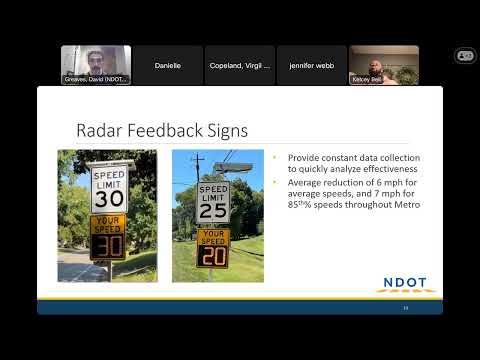
Key elements of the plan - Speed cushions: NDOT proposes 10 sets of cushions spaced along Shepherd Hills and Spring Branch. Shepherd Hills is narrower (about 20–22 feet) and will use two cushions across the lane; Spring Branch is wider and will use three-across configurations that fill roughly 27–28 feet of pavement. Grieves described speed cushions as modular rubber devices designed to target vehicle speeds of about 20–25 mph. - Radar feedback signs: Two radar-equipped feedback signs are recommended for a steep section of Spring Branch where cushions cannot be placed at regular spacing. - Bulb-outs: Intersection tightening (bulb-outs) at Shepherd Hills Drive and Spring Branch Drive is proposed to reduce turning radii to about 20 feet, which NDOT said encourages slower turns.
What remains to be decided NDOT described the design as largely construction-ready but subject to revisions based on tonight’s feedback. The agency will post final plans on Metro’s website shortly before mail ballots are sent. Balloting is open to owners of parcels abutting the project right-of-way; each owner receives one ballot (residential properties, churches and schools are eligible; vacant parcels and operating businesses are not). If the ballot reaches the 66% approval threshold among returned ballots, the project will be placed in the construction queue with an estimated build window of about 8–10 months, a schedule NDOT called “rough.”
Neighborhood concerns discussed Residents asked whether installation would require disturbance of private yards or ditches and whether signs or delineators would be placed in narrow roadside areas. Danielle, a resident who identified herself as living at the corner near 300 Shepherd Hills, asked, “Will that impact or… will they have to do anything with our actual yard or the grass?” Grieves replied, “They shouldn't. No. These aren't anything besides bolt-on materials and striping,” and said signs are typically located off pavement, in the area between pavement edge and property, but exact sign locations are set in the field.
Several residents raised specific concerns about Spring Branch’s lack of shoulder. Grieves confirmed there would be no flexible delineators installed on the pavement associated with the cushion configuration for this project and that the street would not be narrowed. For Spring Branch Drive NDOT proposes three-across cushions to match the pavement width; Shepherd Hills cushions will be two-across.
Sidewalks and other requests Virgil Copeland, a resident at 110 Shepherd Hills, noted he had submitted a request for sidewalks and asked if bollards or a walking path would be included. “This design does not include the creation of a walking path with delineators,” Grieves said, explaining that Shepherd Hills’ pavement width (about 22 feet or less in places) generally precludes adding such features without narrowing vehicle lanes.
Balloting, eligibility and timeline NDOT outlined the ballot process: ballots are mailed as postcards with unique codes, are open for six weeks, and may be completed online or by phone. Owners of multiple properties receive a single ballot; operating businesses and vacant parcels are not eligible to vote. Grieves said construction would follow only if the ballot meets the 66% approval threshold among returns.
Durability and maintenance When asked about lifespan, Grieves said manufacturer warranties typically run 10 years and that cushions are intended as permanent features unless removed for repaving or damaged by heavy equipment or snowplows. An NDOT staff member who described a similar installation on Douglas Avenue said the cushions “really do slow traffic down” and that the street feels safer after installation.
Next steps NDOT will revise plans if needed based on feedback from this meeting, post the final Shepherd Hills plans to Metro’s traffic-calming website, distribute ballot mailers to eligible property owners, and hold the six-week voting window. Grieves provided an email contact (n.trafficcalming@nashville.gov) and said the meeting recording will be posted on Metro’s YouTube channel (Metro News Network).
Limitations of the meeting record NDOT repeatedly noted the meeting is recorded and plans will be posted for visual review; several residents reported connection issues and were unable to view the shared plans during the call. Grieves said the posted plans will show exact cushion and sign locations before ballots are mailed, and residents will have an opportunity to review those details prior to voting.