Get Full Government Meeting Transcripts, Videos, & Alerts Forever!
Get email alerts on the Food Truck Permits topic
No spam. Unsubscribe anytime.
Council begins rewrite of food‑truck rules after fire code, health code and permit conflicts
Summary
Council members and the fire marshal discussed the city’s food‑truck ordinance, overlapping health and fire inspections, a numeric cap on permits and the need to streamline permits and special‑event rules.
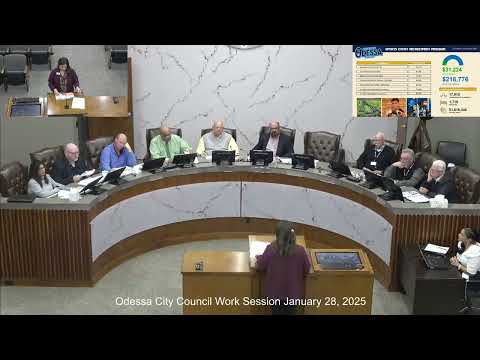
The City Council discussed Odessa’s food‑truck ordinance and permitting process during its Jan. 28 meeting, with the fire marshal describing how recent adoption of the International Fire Code (2021) and a separate fee schedule have shaped inspection requirements and with vendors and council members pressing for a streamlined process.
The fire marshal (unnamed) said the city adopted the International Fire Code 2021 in 2022 and at the same time established a fee schedule for the fire marshal’s office. He told council the newer code includes requirements for mobile food vendors that did not exist in the older 2012 code, notably hood suppression systems for cooking appliances, and that the change prompted the city to coordinate inspections across multiple departments. “At that same time, the city of Odessa adopted a fee schedule for the fire marshal's office,” the fire marshal said.
Under the current city ordinance, staff said, the number of permitted mobile vendors is written as 50 (the ordinance historically had a lower cap of 25). The fire marshal reported the city reached 50 active permits last year by December and said some of the permitting complexity stems from overlapping rules administered by code enforcement, police, the fire marshal and the health department. He described the current local process: an applicant picks up or downloads an application, submits required documentation (location authorization, hold‑harmless and restroom arrangements where applicable), receives a fire inspection, is issued a vendor tag if the truck passes, and then pays permit fees at billing and collections. The tag indicates the vendor was inspected and is permitted to operate for one year.
A number of practical issues emerged in the discussion. A brick‑and‑mortar restaurant owner who uses a truck for occasional special events said he had been required to purchase a year‑long truck permit even when he used the vehicle only for a few hours at city events: “I had me to go up there and buy a freaking permit for a whole year when I only maybe do 1 or 2 special events,” the owner said. Council members and staff noted the ordinance already contains a separate special‑event permit clause and that the health department inspects many vendors during concentrated inspection events (the presenter said vendors sometimes go to the Coliseum for multiday health inspections).
Councilmembers raised other operational questions: whether county permits allow trucks to operate inside city limits (staff said county vendors still need a city permit to operate inside the city), how to classify push carts versus mobile food units under the health code, and how to handle restroom requirements for long‑duration or 24‑hour operations. Staff warned that permitting changes require considering infrastructure such as number of portable toilets and hand‑washing stations at event sites: “If you’re gonna set up for 24 hours, you need a bathroom and you need a sink,” a staff member said.
Staff proposed convening a cross‑department working group — including the fire marshal, health department, code enforcement, police, planning and affected vendors — to review the ordinance, identify unnecessary overlap, align definitions (push cart vs. mobile food unit vs. catering), and create a streamlined permitting path, ideally with online application through the MGO portal once integrations are complete. Council members signaled support for moving quickly and for including brick‑and‑mortar operators who use trucks for occasional special events in the working group.
No ordinance changes were adopted at the meeting; staff were directed to convene the stakeholders and return to council with recommended ordinance amendments and a plan to implement online permitting when MGO is ready.