Get Full Government Meeting Transcripts, Videos, & Alerts Forever!
Get email alerts on the Municipal Audit Finance topic
No spam. Unsubscribe anytime.
Finance staff give audit timeline; council presses for Munis and software fixes
Summary
Finance staff told the council an external auditor will visit in February and the audit team is prioritizing the work; council members and IT staff spent an extended discussion on Munis and other software gaps that slow audits and monthly closes.
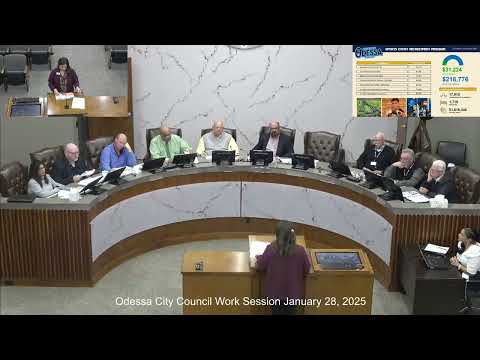
City finance staff updated the Odessa City Council on Jan. 28, 2025, on the status of the municipal audit and described steps the department is taking to accelerate completion while council members and staff debated software implementation and process changes needed to support audits.
Kayla, a finance staff member leading the presentation, said the city’s external auditor, identified as Greg from Weber, has told staff he will dedicate time to the city and is expected to be on site for a week in February; staff said Greg has expressed optimism for finishing work as early as April and no later than June. “He assured us that by the end of January, he is gonna be devoted to the city to get us get our audit on track,” Kayla said. She described a staffing plan that assigns days for three finance staff to focus only on audit work: “Starting next week, we're gonna start having, myself 1 day, Kaylee 1 day, and our controller 1 day, we're shutting our door, and all we're gonna do is audit.”
Kayla told council that some systems remain unavailable after a cyber attack and that a benefits system and certain integrations are still being restored; she said IT and vendors are working on capital‑asset and bank‑reconciliation modules in Munis and that a retired financial director acting as a consultant is assisting the audit effort. Council members repeatedly pressed for ways to shorten the audit schedule and asked whether the city could obtain more consultant time or change staffing priorities to speed completion.
Later in the meeting, Tony, an IT staff member who has assisted on implementations, said the organization’s bigger obstacle is process and organizational clarity rather than software alone. “What our biggest problem is. It's processes. People think that software is supposed to dictate what we do. It doesn't,” Tony said, arguing that departments must map and document business processes before software can be configured to support them. He described repeated issues where departments do not maintain standard operating procedures or clear report definitions, which makes implementing enterprise resource planning modules slow and error prone.
Richard (department leadership), who participated in the discussion, recommended letting each department identify the software that works for its functions and then ensuring those systems communicate with finance: “Munis does work for finance, for payroll, and it's working well. It it's not working well in other areas. ... If the software is not working for them, then they start the process to find a software that works for them.” Council members suggested a modular approach to future software changes, starting with moving billing‑collection functions if required and proceeding piece by piece rather than attempting a single‑step overhaul.
Staff identified specific technical items slowing audits: an out‑of‑service benefits package, incomplete capital‑asset records in Munis, a bank‑reconciliation tool that could not run on an older Munis version, and incomplete MGO (permits/inspection portal) integrations. Council direction included supporting temporary consultant resources and asking finance and IT to present a staged plan for software fixes and process mapping at a future work session.
No formal vote occurred on software procurement or staffing during the meeting; staff committed to follow up with scheduling details for the auditor’s visit and to return with recommendations for modular software and process improvements.