Get Full Government Meeting Transcripts, Videos, & Alerts Forever!
Get email alerts on the Public Safety topic
No spam. Unsubscribe anytime.
Odessa council agrees to let Ector County include city extraterritorial area on May ballot for two ESDs
Summary
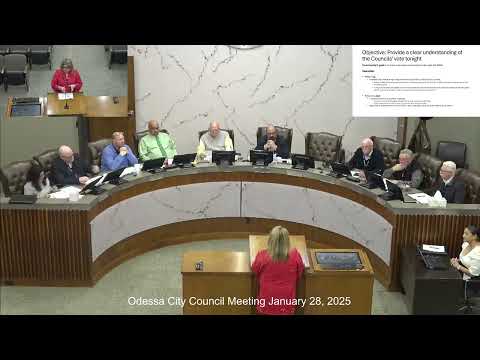
The council voted unanimously to allow the county to include Odessa’s extraterritorial jurisdiction in petitions to place two emergency service districts (one for fire, one for EMS) on the May ballot after local petitioners explained the legal role of the council’s consent.
The City Council of Odessa voted unanimously to participate in elections on petitions to create two Ector County emergency service districts (ESD) — one focused on fire services and one on ambulance/medical services — by granting the county permission to include the city’s extraterritorial jurisdiction (ETJ) in the proposed district boundaries for the May ballot.
Petitioners presented to the council and asked the council to allow the county to include the ETJ on the ballot. A petitioner described the vote as a “technical legal gate” required by state law so the petitions may appear on the May ballot, and said the council’s consent does not constitute an endorsement or a commitment by the city to provide services or funding.
Supporters and residents who spoke during public comment stressed response-time concerns in West Odessa and the broader county, citing personal experiences and statistics offered by petitioners and local educators. A nurse and a representative of Ector County Independent School District described long EMS response times and student transportation distances as part of their reasons for supporting the ESD petitions.
Petitioners and speakers highlighted several points about ESDs as presented to the council: an ESD is a voter-created political subdivision that can levy a property tax (petitioners cited a state ceiling of 10 cents per $100 of taxable value), may collect fees (ambulance charges, false-alarm fees, inspections), and can fund operating and capital expenditures such as stations and vehicles. Petitioners told the council the ESD process would aim to lower response times in parts of the county, improve ISO/PPC ratings in rural areas by addressing hydrants and water accessibility, and provide a reliable funding source for services now delivered by Odessa Fire Rescue (OFR).
Council discussion touched on operational and financial concerns: some members said city fire resources are already stretched and questioned whether a county ESD’s revenue at the cited cap would be sufficient to build and staff new stations. One council member raised concerns about volunteer and equipment shortages, and another urged that the city should seek representation or input into any board that would govern services affecting city operations. Petitioners and other council members emphasized that the council was only granting permission to place the ESD petitions on the ballot; governance, contracting and funding decisions would occur later if voters approve the ESDs and county commissioners appoint ESD commissioners.
Councilman Stoker moved approval for the fire-service ESD (Ector County Emergency Service District No. 1) and the motion passed unanimously. The council then approved a second motion to permit inclusion of the ETJ for the ambulance/medical-service ESD (Ector County Emergency Service District No. 2) and that motion also passed unanimously.
Petitioners said their immediate next steps included signature gathering and public outreach to meet election deadlines. If voters approve an ESD, petitioners said they expected ESD commissioners to approach Odessa about contracting OFR to provide services; any such contract would be negotiated after commissioners are appointed.