Get Full Government Meeting Transcripts, Videos, & Alerts Forever!
Get email alerts on the Infrastructure Audit topic
No spam. Unsubscribe anytime.
Audit finds many "Moving Atlanta Forward" projects stalled in early phases; auditors recommend central oversight
Summary
City auditors told the Transportation Committee Jan. 29 that many Moving Atlanta Forward projects remain in early phases and that program controls, project-level budgeting and the program dashboard need improvement.
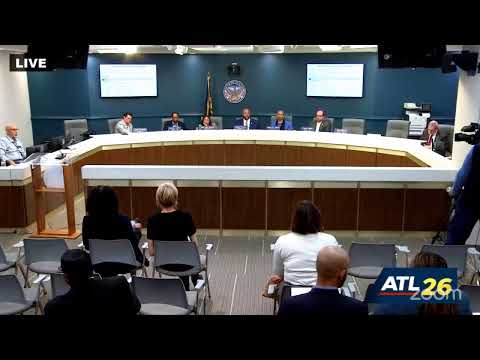
City auditors presented the 2024 annual review of the Moving Atlanta Forward infrastructure program to the Atlanta City Council Transportation Committee on Jan. 29 and recommended a central oversight role and stronger documentation after finding inconsistent implementation and uneven spending across council districts.
"We conducted this audit as required by ordinance 2201369," the auditor reported, saying the review assessed project financials, delivery and whether the program had progressed equitably. The audit found that, of 202 projects planned across the program, 134 had begun as of August 2024, but many projects that had started remained in the planning and scoping phase. Auditors also found that departments were not consistently keeping required documents: risk registers and project management plans were frequently missing, and parks project spending was not organized in Oracle at the project level.
The audit summarized funding sources and structure: the program was authorized for $750 million, funded in part by T-SPLOST and two general-obligation bond measures that together provided roughly $400 million for parks, trails and transportation projects. The bond package also included $36 million in council discretionary funds — $3 million per council member — allocated across projects. Auditors flagged that 45% of spending to date had gone to projects in council districts 6, 8 and 9 and warned that if cost overruns occur earlier in the program, later projects could be scaled back or canceled without clear re-prioritization criteria.
Key findings presented by the audit team included: - Many projects remain in planning and scoping; departments are not consistently implementing the strategic delivery plan's required controls and documentation. - Project-level financial tracking and data validation on the program dashboard need improvement to make the dashboard more useful to stakeholders. - Parks projects were not set up at the project level in Oracle, increasing the risk of data entry or allocation errors.
Auditors recommended that the chief operating officer develop decision criteria for prioritizing projects (including equity considerations), designate a central oversight position (a program manager), require consistent documentation and soft-cost tracking, and improve data verification procedures for the dashboard.
Lashandra Burks, the city chief operating officer, told the committee she and staff had already begun implementing many recommendations. "We have a project manager from our chief strategy officer team who is now beginning to coordinate all of the meetings across the departments," Burks said, adding that the administration had hired Jacobs as a management consultant to help accelerate delivery. Burks also said the city had several projects moving forward since the audit, including multiple fire-station projects and Complete Streets work, and said the administration "accepted all the recommendations" and "partially accepted" one item tied to accounting for T-SPLOST receipts.
Committee members pressed auditors and the COO on timing and equity: several asked for clearer timelines for audit start/completion, for the administration to re-run analyses after council district reapportionment, and for a one-page project list with status and funding for each district. "We are concerned that if earlier projects incur budget overruns, the city may have to decrease the scope or cancel later projects," the auditor said; Burks and council members discussed steps to centralize project management and use design-build approaches to speed delivery.
Motion and vote: The committee voted to accept and file the audit report (vote recorded in committee as 6 ayes, 0 nays). The audit document and the administration's written responses are available on the auditor's website and were entered into the committee record.