Get Full Government Meeting Transcripts, Videos, & Alerts Forever!
Get email alerts on the Pace Program Ordinance topic
No spam. Unsubscribe anytime.
Commission adopts PACE ordinance changes requiring sworn contractor statements, delays operation 60 days
Summary
After industry and provider testimony, the Broward County Commission approved substitute amendments to the county's PACE ordinance requiring contractor sworn statements and price documentation and set a 60‑day delay for operational changes to allow providers time to implement new requirements.
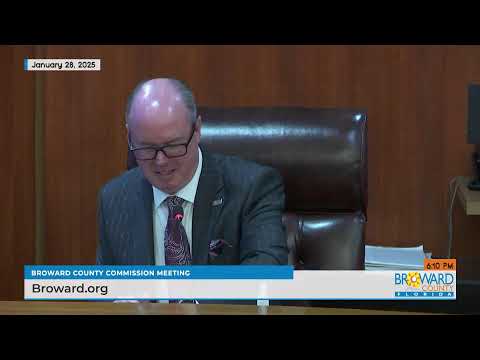
The Broward County Commission on Jan. 28 adopted several amendments to the county's Property Assessed Clean Energy (PACE) ordinance after a lengthy public hearing that included comments from multiple PACE providers, consumer advocates and residents who reported disputed property assessments.
Why it matters: PACE programs allow property owners to finance energy, disaster‑hardening and certain property improvements that are repaid through a county‑collected assessment on property tax bills. Changes to local PACE rules affect how providers underwrite projects, the paperwork contractors must supply, consumer disclosures and how quickly companies can operationalize changes — with consequences for homeowners, lenders and local property tax processes.
What the board approved: The commission approved a substitute to Amendment 1b that shifts primary price‑due‑diligence responsibilities toward contractors but places a stronger documentation requirement on projects: contractors must submit a sworn statement and show work supporting their price (either by using Xactimate, RSMeans or an itemized contractor estimate). The commission also approved Amendment 1c adjusting the ordinance's effective date and — after providers and industry groups asked for time to operationalize the revisions — set a 60‑day delay before the local changes take effect. The board voted unanimously on the procedural waiver (Item 61A) required to proceed directly to public hearing and ultimately on the substitute and timing adjustments.
Industry and consumer positions: PACE providers and trade representatives urged caution over rushed implementation of new language and asked for more time to change their underwriting systems and IT processes. Several provider witnesses asked for 60–90 days; some asked for 90 days. Home Run Financing, Renew Financial, Ygrene and others asked the commission for a definitive operational delay; several asked for 90 days. "We would ask for 90 days to implement that," Home Run Financing's Rachel Hobbs told the board. Several consumer speakers told longer, specific stories of contractors and PACE assessments placed on property tax bills; one speaker said a contract resulted in a $60,000 assessment on a property and a subsequent tax bill of about $11,000 that forced family hardship.
Specific edits approved or negotiated: - Price cap/price‑due‑diligence: The earlier regional cap language was tightened toward a 100% parity concept (contractor prices must not exceed a fair regional price), and substitute 1b imposes a sworn contractor statement and an obligation to document "how the number was reached," allowing Xactimate, RSMeans or itemized contractor bids as allowable documentation. - Attestation vs. sworn statements: The substitute raises the level of formality from simple attestation to a sworn statement (no notarization required as adopted, to ease field implementation), which carries potential penalties for false statements. - Implementation delay: Industry asked for 60–90 days; the board adopted a 60‑day delay so providers can update processes. - Staff protections: Staff proposed additional consumer‑protection items (flags for high‑cost projects, two‑quote requirements, and PACE provider review obligations). The board incorporated core protections into the final language and declined some staff proposals as drafted, while directing staff to refine others with providers.
Consumer protections discussed: County staff urged stronger front‑end provider due diligence rather than only back‑end remedies. Staff proposed requiring provider review of projects exceeding a percentage (proposed 15%) of the property's just market value before the project can be financed, requiring two quotes for high‑cost projects, and requiring an explicit consumer disclosure/rescission right for very large assessments. Commissioners pressed providers about how assessments are repaid (annual tax bill installment or mortgage servicer escrow/amortization) and staff clarified that typical PACE charges are fully amortizing over the agreed term (commonly 20 years) and that homeowners with mortgages can request servicer escrow adjustments to spread the tax assessment into monthly payments.
Votes and outcome: The commission passed the key substitute 1b and the delayed effective date (1c) by unanimous vote. The board also approved a motion directing staff to add a county notice/disclosure for large‑percentage assessments and to continue refinements with providers and the Solid Waste Authority/County staff.
What comes next: Providers must revise forms and underwriting systems to produce and retain the sworn contractor statements and the price documentation the ordinance requires; county staff will finalize implementing forms and outreach materials. Because the board set a 60‑day delay, the ordinance provisions adopted will not be enforced until providers have time to operationalize the new rules. Staff and providers were asked to continue work on a public outreach package (customer disclosures, hotlines and referral procedures) to aid homeowners who report aggressive contractor marketing or disputed assessments.
Ending: The result was a compromise: the commission increased documentation and consumer protections for PACE while giving providers an agreed, limited window to implement operational changes.