Get Full Government Meeting Transcripts, Videos, & Alerts Forever!
Get email alerts on the Waste Management Monarch Hill topic
No spam. Unsubscribe anytime.
Broward commission pauses decision on Monarch Hill land‑use, seeks more study on landfill expansion
Summary
After hours of testimony from municipal officials, residents and Waste Management, the Broward County Commission continued four linked land‑use and landfill items — including a request to raise Monarch Hill's height — to Feb. 25, 2025 for further analysis by the Solid Waste Authority and county staff.
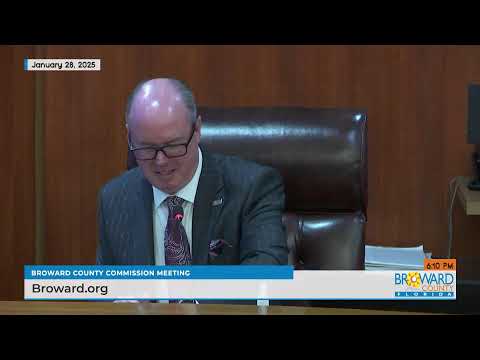
The Broward County Commission on Jan. 28 continued four connected land‑use and ordinance items tied to Waste Management's Monarch Hill facility after several hours of testimony and a lengthy staff briefing. The items were continued to the commission's Feb. 25 meeting so the Solid Waste Authority (SWA) and county staff can provide additional analysis and the public can review updated materials.
Why it matters: Monarch Hill is the county's largest active landfill. Waste Management and county staff said the site needs more permitted airspace to avoid near‑term capacity and emergency response problems; opponents warned that expanding the footprint or increasing the permitted height would prolong local environmental impacts and complicate long‑term planning. The commission's decision to continue the hearings keeps the issue active while the SWA finishes portions of a draft master plan and conducts workshops.
The debate centered on two types of changes proposed by Waste Management: a small‑scale comprehensive‑plan amendment to reclassify 24 acres (currently designated for a former power plant) to industrial use, and an amendment to county code to raise the permitted landfill height in the A‑6 agricultural/disposal district from about 225 feet to 325 feet. Waste Management representatives said the expansions would provide capacity needed for county waste, storm debris after catastrophic events and disposal of construction and demolition (C&D) residuals.
"Ninety percent of the material coming into that landfill on a day‑to‑day basis is not suitable for a waste‑to‑energy plant," said Chris Carey, representing Waste Management, arguing the county still needs local disposal space even if municipal solid waste (household garbage) is reduced. Carey and other Waste Management witnesses also described voluntary commitments: ceasing receipt of municipal solid waste at the site after Oct. 2027, a host‑fee payment stream to the county (Waste Management estimated roughly $5.5 million a year under current conditions, about $122 million over the landfill's remaining life), and an option that would allow the county or the SWA 18 months to negotiate a purchase of the 24 acres if it decided the property should be used for a public purpose.
County environmental staff and Waste Management's environmental manager, Elizabeth Fuller, repeatedly told the commission that current monitoring shows compliance with applicable environmental standards at the permitted boundary wells and that engineering reviews completed so far do not show an unacceptable risk from a vertical increase. "I can tell you with certainty that currently we are in compliance with those rules, statutes and regulations," Fuller said. Waste Management also said it had retained SCS Engineers to perform preliminary analyses that concluded additional settlement or groundwater impacts were unlikely if the vertical expansion were permitted and constructed under standard regulatory oversight.
Residents and local elected officials from Deerfield Beach and Coconut Creek disagreed. Deerfield planning director Eric Power and Deerfield city manager Rodney Brimlow said the proposed expansion would worsen long‑running impacts on air quality, traffic, nearby parks and property values; dozens of residents, several of them older adults and homeowners who described odor and health concerns, urged denial or more time for alternatives. Dr. Hillel Cohen, a public‑health academic, warned of long‑term risks from leachate and particular contaminants noted as PFAS or "forever chemicals," saying the proposed expansion could increase groundwater exposures if containment or liners failed.
County staff, including Assistant County Administrator Kevin Kelleher, framed the choice as a countywide capacity decision: Broward generates large volumes of C&D material and has statutory responsibility to assure disposal capacity for residents, municipalities and emergency response. Staff noted that current county recycling and diversion rates reduce but do not eliminate the need for disposal; the county has a landfill in its unincorporated area and limited options outside the county.
What the commission did: After public testimony and extended discussion, the commission voted unanimously to continue public hearings on Items 57–60 to the meeting of Feb. 25, 2025, at 10:00 a.m., to allow the Solid Waste Authority and county staff to present additional analyses and the draft master‑plan materials in workshops scheduled earlier in February. The continuance keeps the applications active; it does not approve the land‑use or height changes and preserves the ability of the board to act later.
What commissioners and others said: Mayor Beam Farr, who opened the hearing, told the public the decision involves a regional responsibility to ensure capacity for waste and disaster response. "We have that responsibility, not only for our immediate needs, but for the foreseeable future and also for unforeseen catastrophic events like hurricanes," Farr said. Mayor Mike Ryan, chair of the Solid Waste Authority's executive committee, urged deferral so the SWA can finish its master‑plan workshops and provide a joint recommendation. "We are not weighing in on the merits of the loop," Ryan said; "it is purely an issue of deferral." Opponents said deferral is insufficient and sought a permanent limit on height and stricter local controls.
Next steps: The commission asked the SWA to present a focused update at the Feb. 10 and Feb. 25 workshops and to provide any technical recommendations on how the county and the SWA might meet disposal needs while minimizing community impacts. County staff will also supply additional backup on modeled groundwater and gas outcomes, host‑fee estimates, traffic projections and the option/purchase mechanics that Waste Management proposed. The Feb. 25 continuance preserves public comment rights but requires new testimony if the record changes in the interim.
Ending note: The hearing drew elected officials and dozens of residents from municipalities adjacent to Monarch Hill and underscored the tradeoffs between near‑term disposal capacity and long‑term land‑use and environmental stewardship that the county must resolve.