Get Full Government Meeting Transcripts, Videos, & Alerts Forever!
Get email alerts on the Street Closures Events topic
No spam. Unsubscribe anytime.
Council committee moves forward with International Street Fair closure; members debate returning street-closure approvals to council
Summary
The Transportation Committee advanced the International Street Fair street-closure request on Jan. 27 and debated whether the city should end omnibus annual approvals of event closures and instead require individual applications and council review.
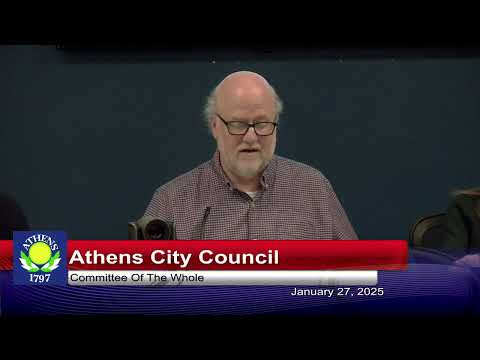
The Transportation Committee of the Athens City Council on Jan. 27 advanced the International Street Fair street-closure request and spent extensive time debating whether the city should stop approving a single, annual omnibus ordinance of all expected street closures and instead review each petition individually.
Member Spieltjes, Transportation Committee chair, explained that the administration's deputy service safety director, Andrew Czczyki, prepared a detailed application form for event organizers and that the administration will continue to coordinate logistics (meter bagging, electrical needs, coordination with staff) once council approves closures. Spieltjes said the administration will submit draft legislation to council on behalf of the administration for city-run initiatives such as Halloween and the Athens Community Arts and Music Festival.
Several council members and public speakers disagreed about the workload implications of returning to individual approvals. Alan Swank (4th Ward) and others argued that approving every closure individually is an inefficient use of council time and that the administration is better positioned to vet technical requirements such as electricity and meter bagging. Jessica Thomas and Member McCarrie said splitting closures into individual items gives each event an opportunity to justify itself and allows new or smaller events to be considered; Thomas noted the administrative checklist does not replace council's role in approving closures and that the checklist primarily documents logistical needs rather than granting the administration authority to approve events.
Business impacts and public notice were central concerns. Michael Wood (community member) and other speakers said some closures can hurt retail businesses; multiple participants suggested requiring event organizers to provide business outreach or public notice (Chamber of Commerce, Visitors Bureau, local media) as part of the application so affected businesses have an opportunity to object. Council members discussed the timeline for approvals: items are introduced in committee, then must go through three readings, followed by a 30-day period under the city's legislative process.
Deputy Service Safety Director Andrew Czczyki (administration) told the committee the form is intended to document logistical needs (electricity, meter-bagging, law-enforcement presence) and is not itself an administrative approval of the event. He said the administration will continue to assist organizers with planning and coordinate city staff for closures and reopenings.
Outcome and next steps: the committee agreed to take up the International Street Fair next week for first reading (the form was reported as submitted). Committee members also discussed creating a working group or a policy that would set deadlines for applications and require organizers to follow the form; several members suggested an administrative review before the event reaches council so council's review focuses on the street-closure decision rather than operational readiness.
Why it matters: returning to item-by-item council consideration changes how events will be scheduled and assessed and shifts the balance of responsibility between administration and elected officials. Business owners, event organizers and residents could see different timelines and notification processes depending on whether council adopts a block-approval approach or individualized review.
Details from the meeting: - Application: Deputy Service Safety Director Andrew Czczyki created a multi-page event application covering electrical needs, sound, insurance and meter-bagging; organizers must complete it to request a closure. - Administrative role: administration will review and coordinate logistics but does not grant final approval; council retains legal authority to close streets. - Public notice: multiple speakers asked for required outreach to businesses and public notice through the Chamber of Commerce or Visitors Bureau. - Legislative process: items typically require introduction in committee, three readings and a 30-day period before becoming final; exceptions require suspension of rules.
No formal vote was recorded on a policy change; the International Street Fair closure request will be considered next week for first reading.