Get Full Government Meeting Transcripts, Videos, & Alerts Forever!
Get email alerts on the Floodplain Stormwater topic
No spam. Unsubscribe anytime.
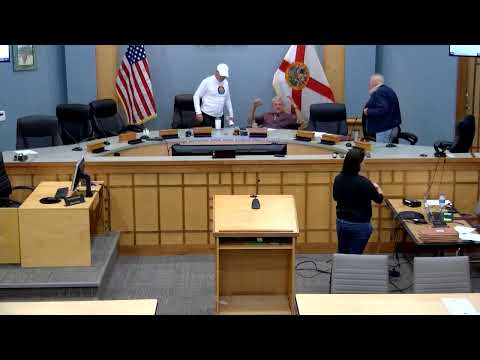
Walton County floodplain manager outlines stormwater rules, watershed plan for coastal dune lakes
Summary
Tracy Goodhart, Walton County floodplain manager, told the Coastal Dune Lake Advisory Board that the county participates in the National Flood Insurance Program’s Community Rating System and currently holds a Class 6 rating, which yields about a 20% discount on active NFIP policies.
Tracy Goodhart, Walton County floodplain manager, told the Coastal Dune Lake Advisory Board that the county participates in the National Flood Insurance Program’s Community Rating System and currently holds a Class 6 rating, which yields about a 20% discount on active NFIP policies.
Goodhart said the county is mid-cycle in a 2025 CRS audit and is pursuing a watershed master plan and other activities intended to improve resiliency and move Walton County toward a Class 4 rating, which she said would correspond to roughly a 30% discount. "The community rating system is a voluntary program and it provides a framework that improves overall flood plain management," Goodhart said.
The presentation laid out how floodplain management, long-range planning and regulations interact with site-level stormwater requirements inside the county’s Coastal Dune Lake Protection Zone. Goodhart summarized current local standards: new development or redevelopment within the protection zone must preserve 60% of the 300-foot preservation area; clearing of native vegetation in that area cannot exceed 50%; no construction or clearing is allowed within 100 feet of the mean high water line; and seawalls, bulkheads, revetments and riprap are prohibited in the protection zone.
Goodhart described impervious-surface limits meant to protect dune-lake hydrology. She said the county’s code treats small, low-impact builds as "de minimis" (generally under 3% impervious or 250 square feet) but larger footprints, slab-on-grade foundations or increases in impervious surface require engineered stormwater plans. "New development or redevelopment requiring a stormwater plan must meet 150% of the required treatment volume," she said. She also said detention and retention basins in the zone are expected to be designed to handle a 10-year storm and to meet the county’s specified runoff and rainfall treatment metrics (transcript phrasing: treat 1.5 runoff and 0.75 inches of rainfall; figures in transcript are technical and were described in the meeting as engineering standards).
Board members asked about long-term maintenance and inspections. Goodhart said privately owned stormwater systems remain the property owner’s responsibility after permitting and construction; county staff review designs during permitting but do not perform routine inspections of private systems absent a code-enforcement case. She noted some stormwater systems have finite life expectancies and expressed a preference for nature-based solutions when feasible.
Goodhart also introduced a new county tool that can be accessed via the Walton County floodplain management web page or a QR code. The tool provides parcel-level flood-zone designation, base flood elevation, FEMA flood insurance rate map details, evacuation zone, storm surge susceptibility, zoning and (where available) finished-construction elevation certificates for insured properties.
During follow-up discussion the board identified several staff follow-ups and outreach priorities: verifying where the county’s white-sand ordinance applies relative to dune-lake lots (Goodhart said she would research the rule and send text to the board), exploring whether the Coastal Dune Lakes could be designated Outstanding Florida Waterways (board members suggested contacting Friends of Lake Powell for their experience), and asking regional utilities for an update on past septic-conversion grants and whether similar funding can be sought for other lakefront areas.
The meeting also covered routine business and local projects: approval of minutes from the prior meeting and the appointment of officers (Jeff remained chair and Dave Lovell offered to serve as vice chair; a secretary was named during the motion). Board members reported on Camp Creek access improvements, a planned kayak/canoe rack, an Oyster Lake beautification replanting effort, and a private citizen’s purchase of a narrow beachfront strip at Oyster Lake with deed restrictions preventing future construction.
Votes at a glance: the board approved minutes from the prior meeting by voice vote; and approved a motion to appoint officers (chair and vice chair and secretary as stated in the motion) by voice vote. Individual roll-call tallies were not recorded in the transcript.
Why it matters: the rules and projects discussed affect how new development and redevelopment are permitted in Walton County’s coastal dune lake areas, influence homeowners’ flood insurance costs through the CRS score, and guide capital and outreach work intended to protect dune-lake hydrology and coastal resilience.
The board directed staff to provide written follow-ups on the white-sand rule language, septic-conversion grant opportunities and an update from regional utilities; staff also said it will circulate the new flood-risk mapping tool and relevant ordinance excerpts to the advisory board members.
The advisory board ended the meeting after routine announcements and scheduling for the year’s education series and Coastal Dune Lake Week events.