Get Full Government Meeting Transcripts, Videos, & Alerts Forever!
Get email alerts on the Freedom Of Information Act topic
No spam. Unsubscribe anytime.
Champaign County board receives FOIA and Open Meetings refresher; officials urged to use county email, forward requests
Summary
Assistant State's Attorney Andrew Mueller briefed the Champaign County Board on Illinois FOIA and OMA requirements at a Jan. 28 study session, stressing 5-business-day response deadlines, training deadlines for board members and best practices for email and social media.
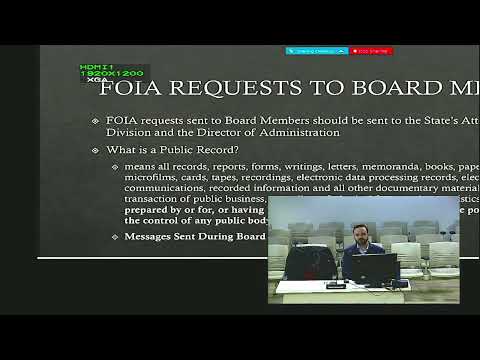
Andrew Mueller, an assistant state’s attorney and the FOIA officer for the Champaign County State’s Attorney’s Office, gave a presentation on the Illinois Freedom of Information Act (FOIA) and the Open Meetings Act (OMA) during a County Board study session on Jan. 28 in the Brookens Administrative Center in Urbana.
Mueller summarized key legal obligations and practical steps for board members and staff, including deadlines, exemptions, and special conditions that can apply to FOIA requests. “Under FOIA, all records in the custody or possession of a public body are presumed to be open to inspection or copying,” Mueller said, adding that “any public body that asserts that a record is exempt from disclosure has the burden of proving by clear and convincing evidence that it is exempt.”
The presentation reviewed several frequently used rules: board members who receive FOIA requests should promptly forward them to the County’s Director of Administration and the State’s Attorney’s Office so the county can meet statutory timelines; FOIA responses are due within five business days for most requests; a requester has 60 days after receiving a response to appeal to the Public Access Counselor (PAC) in the Illinois Attorney General’s office; and board members must complete the AG’s FOIA/OMA electronic training within 90 days of taking office and file the training certificate with the county (Mueller said he will circulate the training link and the presentation after the meeting).
Mueller outlined common exemptions and special conditions. He noted that records covered by other federal or state laws (for example HIPAA or juvenile court statutes), records that would interfere with pending law enforcement proceedings, and bid or proposal materials prior to a final award can be withheld or redacted where the statute allows. He also explained two procedural doctrines that can limit disclosure: voluminous requests (generally those that would compile more than 500 pages or five categories of records over 20 business days) and unduly burdensome requests (requests so broad that fulfilling them would disrupt departmental operations). For either, agencies must generally offer the requester an opportunity to narrow the request.
Mueller gave specific thresholds the county may invoke for recurrent requesters: 50 requests in the prior 12 months, 15 requests in 30 days, or seven requests in seven days (news media and academic requesters are excluded from that count). He also described the FOIA commercial-purpose test and said that requests made to any board member start the statutory clock, not only requests sent to an official FOIA officer. “That’s why it’s very important that you get it to the State’s Attorney’s Office and the Director of Administration as soon as possible,” he said.
Board members asked practical questions about email, text messages and social media. Mueller said messages sent by public officials during a meeting are presumed to be public records and that using a county email account is the safest practice because the county’s IT system archives those messages and manages retention under the Local Records Act. Mueller said personal handwritten notes are generally not public records, while formal memoranda, policy documents and other departmental records are. He also said county staff will obtain disposal certificates from the Illinois Secretary of State when records are lawfully destroyed, and those certificates can be cited in response to FOIA requests for older records that no longer exist.
Mueller addressed social media and campaign accounts: posts and messages on an account used to represent a board member in their official capacity are treated as public records; campaign accounts are generally separate unless the official uses them for government business. He advised against deleting government posts and recommended using a code of conduct for comments rather than routinely censoring replies.
Michelle (identified in the meeting as a county staff member) emphasized the ethical dimension of FOIA compliance: “FOIA hinges on ethics. ... It’s all contingent on the person being ethical and honest,” she said, urging board members to cooperate and provide requested materials promptly.
Mueller recommended practical steps to reduce risk: forward any FOIA-like inquiry to countyfoia@champaigncountyil.gov; avoid carrying out public business through private email or private social accounts; set an out-of-office message directing FOIA requests to the county FOIA address if you will be unavailable; and complete the AG’s FOIA/OMA training within 90 days of assuming office. He said the county saw a higher volume of FOIA requests last year and that the county will circulate the presentation slides and training links.
No formal actions or votes were taken on the topic; the session’s next agenda item was other business.
The county staff said they will distribute the presentation slides and links to the Attorney General’s online training, and board members were reminded to file training certificates as required.