Get Full Government Meeting Transcripts, Videos, & Alerts Forever!
Get email alerts on the Capital Improvement Plan topic
No spam. Unsubscribe anytime.
Story County supervisors review five-year CIP, weigh new conservation bond funding and cleanup of project records
Summary
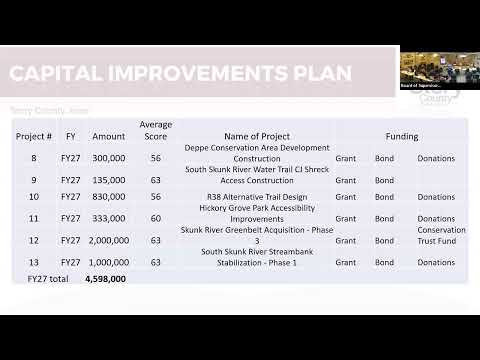
The Story County Board of Supervisors reviewed a draft five-year Capital Improvement Plan (CIP) at a meeting where staff walked the board through project schedules, funding sources and new scoring introduced for the 2025 cycle.
The Story County Board of Supervisors reviewed a draft five-year Capital Improvement Plan (CIP) at a meeting where staff walked the board through project schedules, funding sources and new scoring introduced for the 2025 cycle.
The review focused on how the Story County Water and Land Legacy Bond — a newly approved funding stream — affects prioritization of projects, particularly conservation items, and on corrections staff must make to the CIP document before the budget process. Staff said 27 new proposals were submitted for this cycle and that 24 of those came from conservation, prompting discussion about whether the committee scores should be applied now that the bond has passed.
Why it matters: The bond adds a large, dedicated funding source for conservation projects and can change which items the county funds from the general fund. Supervisors asked staff to be explicit in the CIP about which phases are design versus construction, to stop labeling completed work as “removed,” and to correct funding-source tags (for example, moving some items from “general fund” to TIF or to bond/grant lines).
Staff overview and scoring: County presenters told the board the county adopted a capital improvements plan policy in fall 2024 that established a scoring committee and scoring criteria. Each project was scored on a 275-point scale and the packet shows average scores; projects with no score were below the threshold for scoring. Staff emphasized the schedule in the CIP is dynamic and amounts are estimates intended to guide budget decisions.
Project-status and labeling corrections: Supervisors pointed out many line items in the packet had been struck through and labeled “remove,” but staff confirmed most of those items are completed phases and should instead be labeled “completed” or “contracted,” not removed. The board directed staff to correct those notations so the CIP record reflects completed work rather than canceled projects.
Funding clarifications and examples: Staff and supervisors walked through several specific items to clarify funding sources and timing: - Depie Conservation Area: Staff said $100,000 had been appropriated previously (FY24) as match for a grant; of that balance, $15,000 remains in FY25, $15,000 was moved to FY26 and the remaining $70,000 is shown in FY27. The board noted that previously appropriated general-fund amounts remain unless formally reallocated. - TELK/TELK phase 4 (restroom/parking/storage): Staff and supervisors agreed $100,000 for design belongs in TIF (tax increment financing), not the general fund. Construction in later years is expected to include bond, grant and TIF funding. - South 11th storage: Staff listed the project at $126,200 and said roughly 30% of that is likely to occur in the current fiscal year, with the remainder in the next year. - Debris site/temporary disaster debris: Cost estimates in the packet were unclear; staff said they will return with more accurate numbers after consulting operational staff. - Skunk River trails and R38 alternate trail: A higher-cost estimate (roughly $8,000,000) is in the CIP to cover design, construction and potential land acquisition for the alternative trail; staff said external partners and grants are expected to be part of the financing and that an alliance has verbally committed to covering up to one-quarter of the current estimate. - McFarland Park center: The packet shows $20,000,000 as a long-term estimate for a potential new McFarland Park Center; staff said bond and grants are expected to supply the majority of capital costs while operating impacts remain subject to later decisions.
Board directions and next steps: The board asked staff to - update the CIP text to use consistent phase language (for example, label items as “design” or “construction/phase 2,” rather than repeating project names across years in ways that confuse status), - correct “removed” markings to “completed” where applicable, - fix and document funding-source tags (general fund vs. TIF vs. bond vs. grant), and - return with clarified cost and timing figures for items with uncertain estimates, notably the debris site and any temporary disaster-debris expenses.
Staff said the CIP will be used as guidance during upcoming budget sessions and that finalized funding decisions and any operating impacts for bond projects would come later in the annual budget and through required approvals by the Board of Supervisors.
The board did not take any formal votes on CIP items at the meeting; staff will circulate corrected copies and follow up in the budget process.