Get Full Government Meeting Transcripts, Videos, & Alerts Forever!
Get email alerts on the Education Finance topic
No spam. Unsubscribe anytime.
Minnesota superintendents tell Senate a string of recent mandates, funding shifts could force major cuts
Summary
District leaders told the Senate Education Finance Committee on Jan. 29 that changes to compensatory funding, winding down summer unemployment payments, new paid‑leave rules and underfunded Read Act requirements are converging to leave many districts facing layoffs, program reductions and deep strain on small and rural systems.
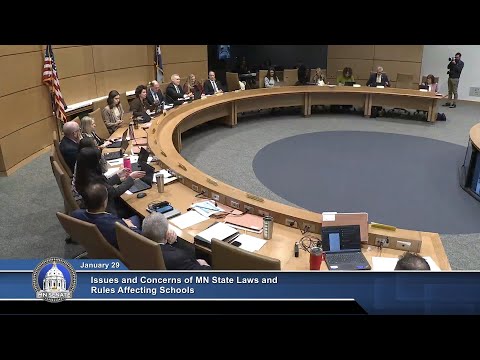
Members of the Minnesota Senate Education Finance Committee heard from more than two dozen superintendents, board members and finance officers on Jan. 29 in St. Paul who warned that several recent laws and funding changes together threaten district budgets and classroom services.
At the hearing, superintendents gave district‑level figures for losses they expect if the Legislature does not act to extend or fully fund recent program changes. Examples included a projected $323,574 drop in compensatory aid for Braham Public Schools, a $5.5 million cut for one large suburban district tied to a new compensatory formula, and district estimates of hundreds of thousands to millions of dollars in added costs tied to unemployment and paid‑leave changes.
The speakers said the impact would be felt across operations: fewer interventionists and social workers, deeper class‑size increases, cuts to elective and career‑technical offerings and, for smaller districts, loss of entire teacher positions.
Many testifiers urged the committee to extend a “hold harmless” for compensatory aid while the Department of Education finalizes the new calculation. “Hold harmless. Truly hold us harmless, please,” said Ken Gagner, superintendent of Braham Public Schools, describing a sudden, large drop his district learned about the day before the hearing. Several other superintendents testified that delays in the state forecast and ambiguity about which data will count are forcing districts to plan staffing reductions in early spring.
Leaders also described operational impacts from a set of recent workforce laws. Multiple districts credited a summer‑work unemployment benefit with enabling them to retain paraprofessionals and food service workers, but warned that funding for that benefit is scheduled to end; Cromwell‑Wright Schools told the committee that summer 2024 unemployment payments for about 10 paras and other hourly staff totaled roughly $54,000 for that small district. Districts urged the Legislature to continue reimbursement or provide levy authority so summer programming and staffing do not collapse.
Paid family and medical leave and expanded use of employer‑sponsored sick and safe time (ESST) were described as additional new costs. District 196 (Rosemount‑Apple Valley‑Eagan) estimated that extending paid leave as proposed would increase its payroll tax liability by several million dollars; other districts reported substitute‑cost and coverage pressures tied to longer leave windows.
Implementation of the Read Act and associated professional‑learning requirements also surfaced repeatedly. Several superintendents said districts have already spent substantial sums to train teachers and adopt new English language arts materials but that the available state reimbursements and implementation timelines do not fully cover the cost or time required. Rosemary Schools reported roughly $1.6 million in curriculum purchases and an additional $265,000 in training and stipends; districts said LETRS training timelines (reported in testimony as 100+ hours of synchronous plus asynchronous work) make local scheduling difficult and increase administrative burden.
Witnesses emphasized equity and geographic distortions in the current funding system: many Greater Minnesota and rural districts do not pass operating referendums as often as metro districts and therefore cannot backfill state shortfalls; several requested increased equalization for operating referenda, expansion of local optional revenue, and a seasonal‑recreation tax replacement aid to account for vacation properties in tourism regions.
Committee co‑chairs acknowledged the range of concerns and said staff will continue to examine the unemployment account balance and compensatory calculations as the Legislature prepares the forecast and omnibus education finance language. The chairs signaled additional hearings on federal funding risks and the broader forecast article.
District leaders asked lawmakers to prioritize forecast adjustments, targeted hold‑harmless language for compensatory aid, continued summer unemployment reimbursement, and funding to cover Read Act implementation costs so districts can avoid layoffs and program cuts.