Get Full Government Meeting Transcripts, Videos, & Alerts Forever!
Get email alerts on the Transit And Transportation topic
No spam. Unsubscribe anytime.
Metropolitan Council seeks state bonding for H Line bus rapid transit, wastewater repairs and parks match
Summary
Metropolitan Council Chair Charlie Zelle told the Senate Capital Investment Committee on Jan. 28 that the governor is recommending $15 million in bonding for the H Line arterial bus rapid transit, $4.6 million for municipal inflow-and-infiltration grants, and $2.3 million for regional parks and trails.
Metropolitan Council Chair Charlie Zelle told the Senate Capital Investment Committee on Jan. 28 that the governor is recommending three targeted capital allocations for the Twin Cities region: $15 million in state bonding for the H Line arterial bus rapid transit (ABRT) capital program; $4.6 million for an inflow-and-infiltration (I&I) wastewater grant program; and $2.3 million for the regional parks and trails bonding program.
Zelle said the $15 million would build on roughly $60 million already secured for the H Line and help position the project to match future federal grants. "This additional $15,000,000 could be really helpful matching funds for future federal grants," Zelle said, noting $25 million in federal funds have already been committed through the regional solicitation.
The H Line, an east-west arterial BRT route, would run from Minneapolis through the University of Minnesota corridor to the Sun Ray Shopping Center in St. Paul, a future multimodal connection point with the Gold Line. Zelle described ABRT lines as lower-cost, high-frequency transit on arterial streets and said the Met Council has several ABRT routes in operation (A, C, D) and planning (including F, G and H). He told senators ridership on enhanced arterial bus service is strong and that earlier capital investments permit better planning and improve the prospects for federal matching grants.
Senators asked about the timing and trade-offs in the governor's broader transportation proposals. Senator Dibble asked how the capital request squares with a proposed reduction in Metro Transit's general fund allocation under the governor's budget. Zelle said the capital proposal is part of a 25-year financial forecast that separates capital sourcing (local, state, federal) from operations funding and that the anticipated operating revenue from local sales taxes and other sources supports near-term operations despite reductions in the general fund allocation. "We believe there's enough kind of operating revenue that we count on to cover and make the system sustainable in the near term," Zelle said.
Senator Pratt and others pressed Zelle on a separate proposal discussed in committee and other hearings: a temporary loan from Met Council reserves to the Minnesota Department of Transportation for roadway projects so MnDOT can build projects ready for transit. Zelle described the arrangement as a loan, not a grant, intended to allow coordinated construction so roadway projects are built to accommodate future transit without duplicative disruptions. He said the loans would be repaid to Met Council and could be structured with a reasonable interest charge to MnDOT.
On wastewater, Zelle described the I&I grant program as a longstanding, matching-grant program to help municipalities reduce stormwater intrusion and leakage in sewer systems. The proposal calls for $4.6 million in state funds to continue awards to eligible municipalities. Zelle said 80 cities and townships are currently identified as eligible under the program's formula (for example, if flow rates are within 20% of an allowable limit). He added the program has been popular and that demand exceeds available funding.
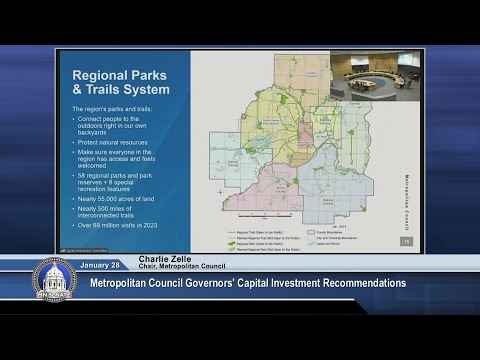
For parks, Zelle said the governor's recommendation of $2.3 million would be paired with Met Council regional matching (two-thirds match) and distributed by formula to metropolitan implementing agencies. He noted the council's match would add approximately $1.53 million in regional funds drawn from a small property tax levy the council administers.
Zelle and senators agreed to continue detailed review in committee and in Transportation Committee hearings.
For the record, Zelle was joined by Metro Council staff including Hannah Pallmeyer and Metro Transit experts who answered technical questions during the session.
The presentations moved on after questions; senators signaled they planned additional review and follow-up hearings on the Met Council budget in Transportation Committee.