Get Full Government Meeting Transcripts, Videos, & Alerts Forever!
Get email alerts on the School Funding topic
No spam. Unsubscribe anytime.
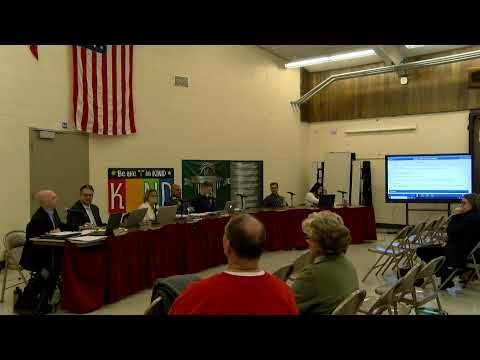
Nordonia Hills board sends 5-mill continuing operating levy to May ballot after rejecting 8-year emergency measure
Summary
After public comment and committee reports on transportation, facilities and scheduling, the Nordonia Hills City School District Board voted 4-1 to put a 5-mill continuing operating levy on the May ballot and rejected an 8-year emergency levy.
The Nordonia Hills City School District Board of Education voted 4-1 on Jan. 28 to place a 5-mill continuing operating levy on the May ballot after rejecting an 8-year emergency levy that failed unanimously.
The board’s decision follows two hours of staff presentations and committee reports outlining budget shortfalls and possible cost-saving options, and more than an hour of public comment largely urging a continuing levy. Superintendent Wright told the board the district is already deficit-spending and warned that ‘‘that’s when our cash balance is below 0. That’s when we can’t make payroll.’’
Why it matters: A continuing operating levy would become a permanent source of local revenue unless voters later repeal it; an emergency levy would have provided a time-limited infusion and required renewal after the specified term. Public commenters and several board members argued continuity is needed for stable, long-term planning, while some board members had supported the emergency option as a politically smaller ask.
What the board heard and debated: Administrators and committee chairs presented possible savings and structural changes the district is studying. The transportation committee reported that eliminating high-school busing could reduce contracted transportation expenditures by roughly $170,000 but would likely forfeit $80,000–$90,000 in state reimbursement, yielding a smaller net savings. The facilities committee reviewed classroom counts, ADA and preschool obligations, utility costs by building and potential long-term savings from consolidation; speakers cautioned those savings depend primarily on staff reductions rather than utilities alone. The middle-school team presented scheduling alternatives and estimated up to $880,000 in potential annual savings under certain staffing reductions, while noting educational tradeoffs tied to the team-planning model. The high-school scheduling committee reported an expected enrollment drop next year of about 85 students and said that could equate to roughly three full-time teacher positions.
Public comment: More than a dozen residents spoke during open forum. Several public commenters urged the board to seek a continuing levy rather than an emergency measure. Andrew Stein said he was ‘‘urging the school board to support continuing operating levy’’ because an eight-year emergency measure could create a funding cliff when it expires. Dave Sterling appealed to support for staff, saying, ‘‘Now just give them the resources to do what they already are so good at doing.’’ Other speakers called for unified board messaging and a strong community outreach push before the May vote.
Votes at a glance - Resolution: 8-year emergency levy (approx. $7,300,000 / 4.95 mills). Result: failed (0 yes, 5 no). Recorded votes: Kearney: No; Larmer: No; McKinley: No; Tidmore: No; Vodich: No. - Resolution: 5-mill continuing operating levy (May ballot). Result: approved to place on ballot (4 yes, 1 no). Recorded votes: Larmer: Yes; Tidmore: Yes; Kearney: No; McKinley: Yes; Vodich: Yes. - Resolution: 4.5-mil operating + 0.5-mil permanent improvement (combined). Result: failed (vote recorded as No by the board members present). - Consent and personnel items: donations accepted; certified and classified personnel changes approved; then-and-now emergency certifications approved; financial/communications committee (FACT) appointments approved. Votes for consent and personnel items were taken by roll call and passed as recorded in the minutes.
What’s next: The district will place the approved 5-mill continuing levy on the May ballot and continue committee work on transportation, building utilization, middle- and high-school scheduling, and budget efficiencies. The board scheduled its next regular meeting for Feb. 18, 2025. Administrators said committees will continue analyzing the operational implications and return with more detailed figures before finalizing final budget recommendations.
Context and limits: Staff repeatedly emphasized that most recurring savings will come from personnel adjustments, whether through attrition, voluntary buyouts or reductions in force, and that some decisions hinge on contractual terms and legal obligations (for example, state transportation minimums and federal preschool mandates). Officials also cautioned that state and federal reimbursement formulas affect net savings from changes such as reducing routes.
The board’s actions set a public vote in May; the exact levy language, millage statement and ballot day materials will be finalized by the treasurer and legal staff and communicated to voters ahead of the ballot filing deadline.