Get Full Government Meeting Transcripts, Videos, & Alerts Forever!
Get email alerts on the Water Rates topic
No spam. Unsubscribe anytime.
San Mateo County proposes steep rate increases for CSA 11 water system to shore up finances
Summary
County staff presented a plan to raise CSA 11 water rates sharply over five years after projecting persistent operating deficits and low reserves; the Board of Supervisors will set a public hearing and Prop 218 notices are planned.
Christophe Lise, deputy director of public works for San Mateo County, outlined a proposal to raise rates for County Service Area (CSA) 11’s water system to address mounting operating deficits and a thin reserve.
Lise told attendees that CSA 11 serves 102 connections — about 80 residential, 13 commercial and nine institutional accounts (including the fire station, the school and the church) — and that the system’s current recurring revenues come solely from water sales and meter service charges. He said the district’s fund reserve totaled $28,133 as of June 30 of last year and that, under current rates, the county projects a five-year reserve shortfall that could reach roughly $300,000 if rates remain unchanged.
The plan presented would phase in increases over five years, beginning July 1, 2025, and is intended to bring revenues in line with rising costs, repay an outstanding loan of about $58,800 (plus accrued interest) dating from a 2011 outage, establish a minimum reserve equal to 50% of operating and maintenance costs plus 3% of the system value (approximately $150,000), and fund a meter replacement program and longer-term capital needs.
Background: why the proposal matters
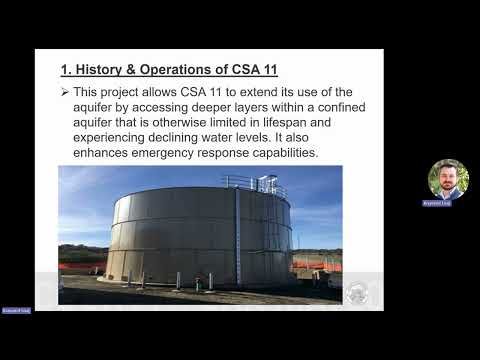
CSA 11 was formed after a Board of Supervisors resolution requesting LAFCO proceedings (Oct. 13, 1987) and a subsequent board resolution (Jan. 12; transcript did not specify year) establishing CSA 11 under Government Code section 25210. The County Planning Commission approved the coastal development permit for the system on Oct. 10, 1990. County staff said the system was built because many private wells at the time were shallow and showed nitrate and bacterial contamination; construction finished in 1992 at about $1.3 million with multiple funding sources, including a California Department of Water Resources (DWR) grant (~$400,000) and a DWR loan (~$296,000) that was paid off in 2012. A 2018 supply-and-storage project, funded in part by a DWR Proposition 84 grant (~$700,000) and county general fund support (~$1,376,000), added a deeper well and a second 140,000-gallon treated storage tank to extend system capacity.
What staff presented
Lise said the county contracts with Bracewell Engineering Incorporated to operate CSA 11 (and CSA 7 in La Honda) because the county does not employ a state-certified operator. He listed routine compliance and operations tasks performed by the operator: monthly water-surface-elevation monitoring for three wells, monthly and annual distribution sampling and testing, bimonthly meter reads, an annual consumer confidence report, alarm and tank monitoring, and annual backflow inspection and certification for roughly 102 backflow devices.
Staff showed a five-year projection that assumes operating expenses of about $123,600 next fiscal year and flat revenue of roughly $73,680 at current rates, producing an immediate $50,000 deficit and shrinking reserves. Under the proposed rate schedule, revenue rises each year; staff projected reaching the target reserve (about $150,000) within the multi-year plan.
Key proposed rates and fees (as presented by staff)
- Billing: customers are billed bimonthly (the presentation translated figures to monthly equivalents for comparison). One billing unit = 748 gallons. - Overall schedule (percent increases): 50% on July 1, 2025; 30% on July 1, 2026; 25% on July 1, 2027; 15% on July 1, 2028; 3% on July 1, 2029. - Example: a typical monthly bill based on 10 units of use was shown as $54.90 under current rates and would be about $85.40 monthly under the first-year increase (the bimonthly statement would reflect double those monthly figures). - Tiered usage rates (per unit) and meter charges: tier 1 (0–11 units) would rise from $2.69 to $4.40 per unit on July 1, 2025, and to $5.25 on July 1, 2026, with subsequent increases in future years; the monthly meter service charge for a 5/8-by-3/4-inch meter was shown increasing from $28.00 to $36.40 (July 2025), $45.50 (July 2026), $56.88 (July 2027), $68.26 (July 2028) and $70.31 (July 2029). - Connection and other fees: proposed increases to connection charges (example: 5/8–3/4-inch connection buy‑in was listed at $15,538 currently; staff said the buy‑in is updated annually using a construction cost index and that the 2025 buy‑in number was not yet available), service connection charges, meter deposits, bulk water permit fees and miscellaneous administrative fees.
Staff emphasized the tiered structure is intended to encourage conservation and noted that even after the proposed increases, CSA 11’s per-connection cost would remain lower than nearby, larger systems because CSA 11 serves only about 102 connections (staff compared it to nearby districts with thousands of connections).
Alternatives discussed
Lise reviewed options the county has considered for service provision: continue Department of Public Works (DPW) operations (current approach), contract all operations and administration to a private firm (which would require transferring the state permit to the new operator), conversion to a community-based and operated water system (LAFCO told staff any community-based operator must demonstrate sufficient financial resources), shared services with nearby agencies (staff said CSA 11 is isolated and nearby water systems have shown no interest), or acquisition by another system (no interest identified). Lise cautioned that converting operations or transferring permit authority adds complexity and regulatory steps because the Division of Drinking Water regulates permits and certified operators.
Timeline and next steps
Staff said they will ask the Board of Supervisors to set the public hearing date for April 8 (the presentation noted the hearing is scheduled for 9 a.m. at the new county office building, 500 County Center, first floor). Around Feb. 3 staff will send Proposition 218 notices to property owners and customers (noting Prop 218 requires a 45-day notice period before the hearing). The April 8 hearing is when the board would consider adopting the rates “pending no majority protest,” per staff. Lise also provided an emergency response phone number monitored by Bracewell 24/7 for no-water or low-pressure events, main breaks, faulty backflow devices and murky water; billing and administrative questions were directed to Public Works’ main number.
What was not decided
No new rates have been adopted in the meeting excerpt provided; the Board of Supervisors had not yet held the public hearing and no vote or final action on rates was recorded in the transcript. The exact buy‑in amount for 2025, updated buy‑in methodology outputs and the county’s formal decision on potential alternative service providers remain unfinalized or “not specified” in the provided presentation.
Ending
County staff said handouts summarizing the proposal were available at the meeting and that the full materials will be posted on the county website. The plan now moves to the Board of Supervisors for a public hearing process required under Proposition 218.