Get Full Government Meeting Transcripts, Videos, & Alerts Forever!
Get email alerts on the Housing Supply Affordability topic
No spam. Unsubscribe anytime.
Lawmakers hear unified warnings that Minnesota faces a nearly 100,000‑unit housing shortfall and falling affordability
Summary
Industry groups, local officials and researchers told the Committee on Housing and Homelessness Prevention that Minnesota is undersupplied by roughly 100,000 homes, pushing median prices and rents beyond many households' reach and forcing policy fixes on zoning, infrastructure and program rollout.
Mark Foster, vice president of legislative and political affairs at Housing First Minnesota, told the Committee on Housing and Homelessness Prevention that Minnesota is facing a deep supply shortfall that is making homeownership and rental housing less affordable.
"Today, statewide, we are nearly a hundred thousand units short of a healthy housing market," Foster said, and he warned that the homes being built are increasingly unattainable: "The median new single family detached house has now gone north of $530,000 in the state." Foster and other presenters said zoning and local approval processes — especially heavy reliance on negotiated planned unit developments (PUDs) — add cost and delay to new housing.
The committee heard similar data and experiences from a cross‑section of stakeholders. Elizabeth Wafel, speaking for the Coalition of Greater Minnesota Cities, told lawmakers that many smaller cities can show land for development but lack the infrastructure, developer interest and market economics to build: "It costs more to build a unit of housing ... than it can be sold for or rented for in the case of apartments," Wafel said. She also told the committee that the Greater Minnesota Infrastructure grant program passed in 2023 "still hasn't rolled out" and that cities need the funding to be released more quickly.
Minnesota Housing staff told the committee they expect to release an RFP for the Greater Minnesota Infrastructure program in the current quarter and typically run a roughly 60‑day application window, but warned that scoring, contracting and the timing of awards could push many projects past the current construction season.
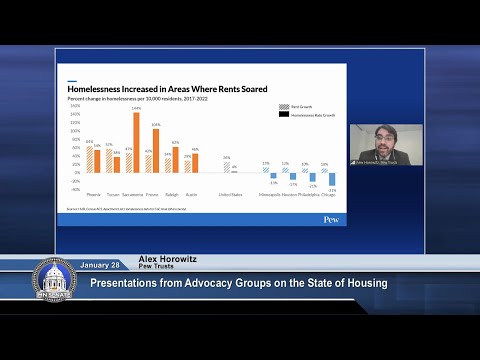
Presenters gave consistent descriptions of the scale and impacts of the shortfall. Paul Edgar of Minnesota Realtors highlighted shrinking inventory and affordability metrics for homebuyers: Minnesota ended 2024 with a housing affordability index below 100, meaning a median family does not have enough income to qualify for a mortgage on a median‑priced home. Alex Horowitz of The Pew Charitable Trusts summarized national research showing restrictive local zoning is a primary cause of constrained supply and described jurisdictions where easing rules and reducing parking requirements led to increased housing production and moderated rent growth.
Speakers representing the rental sector reported distinct operational pressures. Cecil Smith of the Minnesota Multi‑Housing Association said owners and managers face rising insurance and property tax bills and increased security costs tied to public‑safety incidents, factors that squeeze operating margins and complicate underwriting for new construction. Smith also said multifamily permitting and the pipeline are weakening and forecast fewer deliveries in 2025–26.
Builders and contractors told the committee that building‑code complexity, workforce shortages and volatile material costs — including potential impacts from tariffs on lumber — further raise the cost of bringing units online. Grace Kelleher of the Builders Association of Minnesota and builder Casey Sharmack described a need for streamlined permitting and broader adoption of consistent inspection approaches.
Throughout the hearing, witnesses and committee members emphasized a range of policy responses under consideration: speeding rollout of infrastructure grants, updating zoning and approval processes to allow smaller lots and more housing types, supporting workforce development, preserving and expanding rental affordability programs, and aligning state financing tools with Greater Minnesota markets.
No formal votes or committee actions were recorded during the hearing.
Ending: Committee chairs thanked presenters and said the testimony underscored the need to pursue multiple policy and funding tactics to increase housing supply and preserve affordability across the state.