Get Full Government Meeting Transcripts, Videos, & Alerts Forever!
Get email alerts on the Dam Rehabilitation topic
No spam. Unsubscribe anytime.
Springfield officials outline major rehabilitation of Upper Van Horn Dam; work will require reservoir drawdown
Summary
City staff and consultants presented a design-and-permitting plan for the Upper Van Horn Dam on Jan. 28, 2025, saying the project responds to a dam safety order and will require a temporary drawdown, tree removal, culvert replacement, and multiple state and federal permits before construction can proceed.
SPRINGFIELD — City staff and consultants on Jan. 28 presented plans to rehabilitate the Upper Van Horn Dam on Armoury Street, saying the work responds to an order from the Massachusetts Office of Dam Safety and will require drawing down the upper reservoir and multiple regulatory approvals before construction can begin.
"We received a dam and seawall grant to get into the design and permitting and construction documents to renovate the Upper Van Horn Dam," said Laura Walsh, project manager for the Parks Department, introducing the project to the Springfield Conservation Commission that evening. Walsh said the work so far has focused on design, agency outreach and the permitting process under the Massachusetts Environmental Policy Act (MEPA).
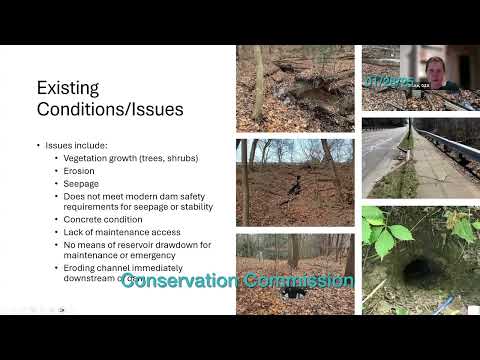
City and consultant presenters told the commission the embankment — the steep, tree-covered slope you pass on Armoury Street — has multiple stability and drainage failures, including animal burrows and erosion gullies, and "does not meet dam safety requirements for seepage or stability," according to the presentation. Consultants said the dam was originally built in the 1850s and last had major rehabilitation in the 1950s.
The consultants from GZA and city staff outlined a conceptual rehabilitation that would remove trees and woody vegetation from the embankment, regrade slopes from about 1 vertical to 2 horizontal toward a flatter slope (the team described moving toward roughly 3 on 1), add mass and stability berms, repair or replace failing drainage and pipe connections, replace the degraded spillway chute, install new toe drains and riprap where needed, and provide new maintenance access and roadway safety improvements along Armoury Street. Presenters said the work also would create controlled outlet points and a siphon to allow emergency or maintenance drawdown in the future.
"Because the dam is so steep and because there's been drainage system failures, there's scour holes and erosion gullies," a consultant said, describing failed clay pipes and perched headwalls. The team said one failing culvert on the slope is presently a 6-inch-diameter clay pipe and would be replaced with a larger enclosed culvert and a relocated headwall to prevent open flowing water across the dam surface.
The presenters said the Massachusetts Office of Dam Safety has the dam listed in "poor condition" and has issued a dam safety order requiring the city to bring the facility back into good condition. The project team said the rehabilitation is intended to reduce risks to downstream life and property, including Bay State Medical Center immediately downstream of the two Van Horn reservoirs.
Regulatory and permitting path: the team said it has filed an expanded environmental notification form and is preparing a single environmental impact report under MEPA. Additional permits the project will require include a Department of Environmental Protection (DEP) Section 401 water-quality certification, a U.S. Army Corps of Engineers Section 404 authorization, and an Office of Dam Safety (Chapter 253) permit. The presenters said they intend to file the single environmental impact report for public distribution in late February or mid-March 2025; that filing will open a 37-day public comment period after publication in the Environmental Monitor.
The project-team presenters said they plan to use the Wetlands Protection Act's limited-project provisions (the presentation cited filing under 310 CMR 10.53 limited-project provisions) because the scale and safety needs of the dam rehabilitation mean the project cannot practicably meet every standard for bank alteration and stream crossing. "We will be filing the project as a limited project specifically under 310 CMR 10.53," a presenter said, adding that the filing will document efforts to meet performance standards where practicable.
On aquatic resources and fisheries, presenters said Upper Van Horn Reservoir will need to be drawn down during construction, leaving only a small residual pool in places because the reservoir reaches about 20 feet in depth in some areas. "There is a short-term adverse effect to the fish, but there's a long-term benefit of saving the reservoir and saving the fisheries habitat," the team said, reporting on discussions with MassWildlife. The presenters said MassWildlife advised against fish salvaging and relocation because it is prohibited in Massachusetts, and did not recommend active restocking after construction given the proximity of Lower Van Horn and bird predation; MassWildlife told the project team it expected fish populations would rebound naturally over time, though the agency did not give a specific timeline.
Stormwater and roadway work: because Armoury Street's existing stormwater outfalls currently discharge onto the dam face and cause erosion, presenters said they will replace or upgrade the street drainage with deep-sump, hooded catch basins, reroute the under-road collection system with accessible manholes, and relocate outlets to avoid embankment erosion. Proposed access roads on the dam were described as porous pavement or a similar permeable surface to reduce stormwater impacts.
Funding and schedule: city staff said the current work is funded by a dam-and-seawall grant covering design and permitting; construction will depend on additional grant awards and formal bidding. The team said the city will continue to seek funding from state grant programs and expects the project to follow additional departmental review — including coordination with the Department of Public Works and the city's capital-assets office — before going to construction.
Commission response and next steps: commissioners asked questions about fish restocking and requested the presentation slides for their offices. Frank, a commission participant who identified himself by first name in the meeting record, said he expected the commission and the city to advocate for restocking; presenters noted MassWildlife's guidance discouraging active restocking in this case. The presenters asked the commission for early input prior to the notice-of-intent filing and said they would send the single environmental impact report link and distribution list (NEPA distribution) to the commission when filed.
Votes at a glance: the commission continued the certificate-of-compliance item for 149 Winterset Bridal because the applicant's representative was not present; no formal vote was taken on that matter. The meeting concluded with a motion to adjourn that the commission approved by roll call (see vote record).