Get Full Government Meeting Transcripts, Videos, & Alerts Forever!
Get email alerts on the Housing Supply Rv Ordinance topic
No spam. Unsubscribe anytime.
Lane County adopts code change allowing rental recreational vehicles on qualifying rural lots under SB 1013
Summary
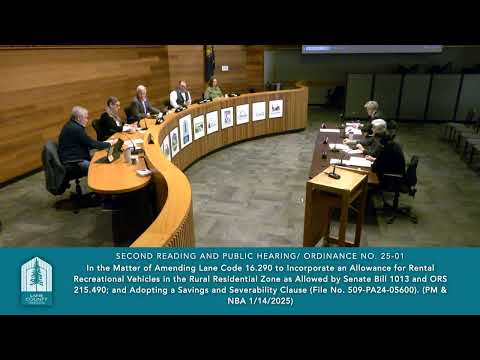
The Board of County Commissioners adopted Ordinance 2501 (5‑0) to amend Lane Code 16.290 to allow rental recreational vehicles (RVs) as long as statutory and county standards are met; the board closed the public hearing and approved the second reading.
The Lane County Board of Commissioners adopted Ordinance 2501 on Jan. 28, 2025, to amend Lane Code 16.290 and incorporate standards to allow rental recreational vehicles (RVs) on qualifying rural residential lots in compliance with Senate Bill 1013 and ORS 215.490. The board approved the ordinance on a roll‑call vote, 5‑0, at the second reading.
Staff planner Rachel Sersliff summarized the staff report and the planning commission recommendation. Senate Bill 1013 (effective Jan. 1, 2024) allows siting of RVs on rural residential lots where a single‑family dwelling is the owner’s primary residence, provided minimal statutory conditions are met. Staff’s draft code incorporated required criteria (owner‑occupied primary dwelling, no vacation occupancy, essential services provided to the RV, no other dwelling on the parcel) and the board’s earlier policy direction on optional standards.
Key standards included in the adopted code: - A written rental agreement between owner and tenant; - A 10‑foot setback between the rental RV and other structures for fire‑safety separation; - Requirement that the RV be placed on a parking pad to limit erosion/runoff; - A 30‑foot setback from adjoining farm and forest properties for compatibility and safety; - Requirement that the RV contain or have access to a toilet and sink (no shower required); - A restrictive covenant recorded to prohibit vacation occupancy and notify future owners; - Prohibition on establishing rental RVs in mapped floodplain areas (staff concluded floodplain regulation’s elevation/anchoring requirements are incompatible with the statutory definition of a mobile RV).
Sersliff told the board that about 650 properties could be affected if the board chose to prohibit rental RVs in the floodplain; staff refined that estimate in the presentation and explained the safety and regulatory incompatibility rationale: floodplain elevation anchoring would render an RV structurally immobile, which conflicts with the mobile‑RV definition in SB 1013.
The board opened the public hearing, heard no additional testimony in Harris Hall or online on the ordinance after staff’s presentation, closed the evidentiary hearing and moved to adopt the ordinance. Vice Chair Ryan Senega moved the second reading and adoption; Commissioner Buck seconded. The ordinance passed on a roll call vote (Senega: yes; Trigger: yes; Buck: yes; Farr: yes; Chair Lovell: yes). The ordinance will take effect 30 days after adoption unless appealed to the Land Use Board of Appeals under ORS chapter 197.
Staff and building‑division representatives said implementation details — such as inspection and building‑permit processes and building‑permit fees associated with utility hookups — will be worked out with the building official; staff offered to return with specifics if the board wanted those operational details. The board directed staff to proceed with implementation consistent with the newly adopted code.