Get Full Government Meeting Transcripts, Videos, & Alerts Forever!
Get email alerts on the State Legislation topic
No spam. Unsubscribe anytime.
Spokane County staff flags GMA extension, public defense funding and short-line rail bills as priorities for 2025 session
Summary
Mike Burgess, a county staff member, told the Spokane County Board of Commissioners at a Jan. 28 briefing that staff had elevated a Growth Management Act timeline extension, a public-defense funding bill and a short-line rail tax-incentive bill as higher priorities for the 2025 Washington legislative session.
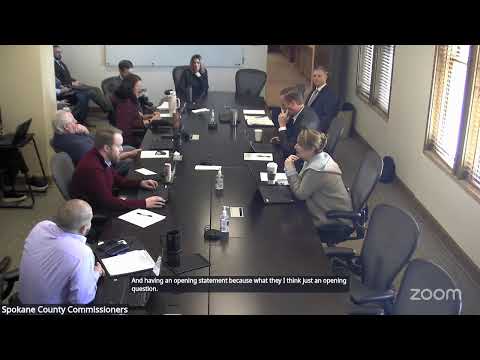
Mike Burgess, a county staff member, told the Spokane County Board of Commissioners at a Jan. 28 briefing that several bills introduced in the 2025 Washington legislative session could affect county operations and budgets and that staff had added three as higher priorities on the county’s tracking list.
"We're pretty much almost exclusively in committee hearings right now," Burgess said, describing the early-session committee calendar and the difficulty bills with fiscal notes will face this year.
Burgess described three new items he planned to elevate to a higher priority: Senate bill 5558 (an extension tied to Growth Management Act timelines for some counties); a public defense funding bill (listed on staff materials as bill 5404); and a short-line rail tax incentive package (reported as bill 1058/1058 report on the list). He told commissioners he expected the GMA extension to receive at least a senate hearing and that he had labeled the county’s position on the item as support on his internal bill list.
Why it matters: Each bill could affect county planning or finances. The GMA-related bill would alter comp-plan timelines for counties that sought later update dates. The public defense proposal is intended to address what supporters call a state shortfall for indigent defense and carries a large fiscal note; Burgess cited estimates ranging from about $350 million to $500 million. The short-line rail measure would create business-and-occupation and other tax credits to encourage privately funded upgrades to short-line track — potentially benefiting county-owned assets such as the Geiger Spur.
On the Growth Management Act issue, Burgess said some counties previously received six-month extensions tied to legislative amendments (noting the climate element added in prior sessions as a rationale others used). He also said sponsor lists on the senate version include former county commissioners and members representing counties on the multi-county list; he said he had started outreach to the other counties to encourage them to sign on.
Burgess also summarized a public-defense bill being advanced by WASAC priorities that would provide additional state funding for indigent defense and include reporting requirements and anti-supplanting language. "This is the bill to get at the lack of commitment the state has made to indigent defense," Burgess said, adding that the proposed funding is substantial though not sufficient to make counties whole.
On freight-rail incentives, Burgess said supporters include short-line operators, ports and economic-development agencies and that the measure creates tax credits and exemptions for donated materials, maintenance, modernization and new construction on short-line track. "I don't see a downside to it," he said; commissioners noted Spokane County’s ownership of the Geiger Spur as a potential local benefit.
Other bills discussed on the list included House Bill 1218 (competency evaluations), House Bill 1258 (911 funding), the $100 million law-enforcement grant program (Senate Bill 1435 and a house companion), and County Auditor bill 5154, which drew opposing testimony from auditors and county officials. Burgess said the auditor bill had generated conflicting testimony before a committee chair and that affected counties—including Thurston County representatives—were organizing opposition. He reported the county had signed on in opposition to the auditor bill alongside other counties.
Commissioner discussion and staff directions: Commissioners asked staff to draft a proposed distribution formula for the 911 funding bill to share with committee members; Burgess requested the commissioners provide specifics about a preferred distribution if they wanted staff to present alternatives. Burgess also said he would communicate the county’s bill priorities and positions to members of the county’s legislative delegation unless commissioners objected.
Next steps: Burgess said the senate hearing schedules were expected soon and that the policy committee cutoff was Feb. 21. He asked commissioners to advise on whether staff should formally present or seek sponsors for particular items and to approve outreach to other counties and legislators.
Ending: Burgess told commissioners he would follow up with more details, coordinate with other counties, and report back after hearings were posted.