Get Full Government Meeting Transcripts, Videos, & Alerts Forever!
Get email alerts on the Mn Department Of Health Budget topic
No spam. Unsubscribe anytime.
Minnesota Department of Health outlines governor’s budget priorities: infectious disease, operating adjustments and multiple fee changes
Summary
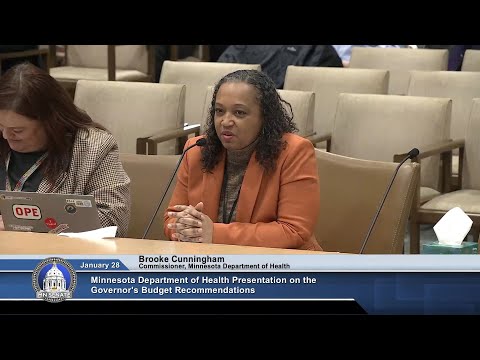
Commissioner Brooke Cunningham told the Senate Health and Human Services Committee on Jan. 28 that Minnesota’s public health system faces rising demand and shrinking per-capita local public‑health capacity, and she urged sustained state funding to preserve infectious‑disease response and other programs.
Commissioner Brooke Cunningham told the Senate Health and Human Services Committee on Jan. 28 that Minnesota’s public health system faces rising demand and shrinking per-capita local public-health capacity, and she urged sustained state funding to preserve infectious-disease response and other programs.
“At MDH, our mission is to protect, maintain, and improve the health of all Minnesotans,” Commissioner Brooke Cunningham said in opening remarks. She said the department works across many areas beyond infectious disease, including clean water, newborn screening, WIC, chronic disease prevention and the statewide trauma system.
Cunningham told senators the state’s public-health investment is small relative to total health spending: local public-health departments collectively manage roughly $400 million statewide while public- and private-sector health-care spending totals about $66.8 billion. She said the number of local public-health FTEs per 100,000 people has declined — from about 59 to 46 — and that federal grant reductions have left gaps in core programs.
Key MDH proposals presented to the committee included:
- Infectious disease response funding (to sustain disease investigation, lab testing and outbreak response); the department said it needs to offset declines in federal funding and to sustain rapid response capacity for measles, avian influenza (H5N1), seasonal influenza, RSV, tick-borne and other zoonotic threats.
- An operating adjustment request to cover rising personnel, IT and fixed costs; portions would come from the general fund and the Health Care Access Fund.
- A set of fee-funded increases and technical changes across programs that regulate health care facilities, environmental health and public safety: assisted living licensing, engineering plan review fees for health-care construction, HMO application and renewal fees, food/pool/lodging fees, radioactive materials and x‑ray inspection fees, asbestos permit fees and public-water and well-management fees. MDH said many of those fees have not been updated for years and that higher workload and complexity have increased costs for plan review and inspections.
- Shifting some cannabis and substance-use prevention grant funding to local and tribal public-health departments (budget-neutral within MDH) to strengthen locally led prevention work while preserving $3 million for discretionary treatment/recovery grants.
- Extending and converting advisory groups (for newborn hearing detection and the state trauma advisory council) and changing the maternal-child health task force into a permanent advisory committee.
- PFAS biomonitoring work with firefighter cohorts and additional time to complete an ongoing project that will develop biomonitoring protocols.
Cunningham and her staff fielded multiple questions from senators about the potential impacts of federal grant pauses, the calculation behind public-health return-on-investment figures and the proposed fee increases. Some senators said rising fees for regulated facilities could increase operating costs downstream for providers and urged the department to minimize fee increases where possible; others emphasized that investing in prevention reduces downstream health-care costs.
The MDH presentation covered many program-specific proposals and asked the committee to review supporting change pages and slides. Lawmakers asked MDH staff to provide additional detail on the Health Care Access Fund shares and citations for some of the cost‑benefit statistics they cited.
Ending: Committee members thanked MDH for the overview and requested follow-up information on federal grant impacts, the department’s fee schedules, and the evidence cited for return-on-investment estimates. No legislative actions occurred at the hearing.