
State Water Board adopts statewide cost-reporting policy for municipal stormwater permits; reporting to begin FY 2026-27
Get AI-powered insights, summaries, and transcripts
Sign Up Free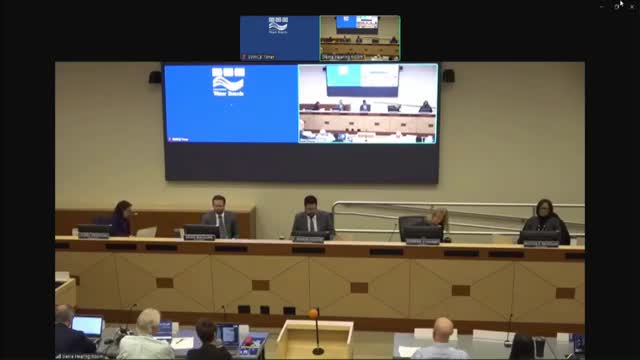
Summary
The State Water Resources Control Board on Jan. 22 adopted a Water Quality Control Policy standardizing cost reporting for municipal stormwater permits, calling for machine-readable reporting and a statewide data portal.
The State Water Resources Control Board on Jan. 22 adopted a Water Quality Control Policy to standardize cost reporting for municipal stormwater (MS4) permits, instituting statewide categories and a data portal for machine-readable cost reporting. The board approved the policy and associated resolution unanimously after a multiyear development process that included a 6-month beta test.
Amanda McGee, senior engineering geologist in the Division of Water Quality, summarized the policy’s goals: improve consistency and transparency of stormwater implementation costs, help estimate costs for new permit requirements, and provide standardized data to inform funding and permit decisions. McGee said the policy responds to a 2018 California State Auditor recommendation and was developed with stakeholder input in multiple public comment rounds.
Key components and implementation timeline - A statewide cost reporting framework with categories and subcategories for permit elements (with simplified reporting for traditional Phase 2 MS4s). Several subcategories were clarified or removed after comment. The policy clarifies that structural best management practice (BMP) cost reporting applies only to public permittee-owned projects and no longer requires BMP surface area or volumetric loading rate. Routine street-sweeping costs must be reported when performed to meet permit requirements; the policy requests swept area reported as curb miles and allows debris reported by weight or volume. - Funding-source reporting: permittees may report relative contributions (percentages) by funding source rather than exact dollar amounts to address concerns about unknowns while maintaining transparency. - The policy prohibits using reported permit-implementation costs as a surrogate for compliance or to justify noncompliance; staff added language to make that explicit. - The policy will be incorporated into future or reissued municipal MS4 permits; the board plans to issue Water Code §13383 orders later in 2025 to require Phase 1 permittees to report using the framework. A cost data portal is expected to open early in 2026; the first required reporting period is fiscal year 2026–27 (cost tracking beginning July 1, 2026) with reports due in late 2027 concurrent with annual reports.
McGee described the development process: an initial draft released Aug. 17, 2023, a 6-month beta test with 11 volunteer municipal permittees, a revised draft released May 9, 2024, and a public hearing June 4, 2024. She said staff will publish a cost accounting and reporting guidance document as a living resource and revise it following adoption and implementation experience.
Public comment and board discussion Representatives from environmental and permittee groups praised staff outreach and sought clarifications. Sean Bothwell, executive director of California Coastkeeper Alliance, said staff struck a reasonable balance between detail and reporting burden and urged that reported costs and funding sources be reconcilable: “When I do a budget and get my budget approved by the board, my board wants to know what we're spending and where the funding is coming from.” Bothwell asked that estimates based on “best professional judgment” remain subject to public requests for supporting documentation; staff said the guidance will address documentation and disclosure practices.
Karen Cowan (representing permittee interests) thanked staff for beta-testing and said an upcoming tool will help convert permittees’ existing accounting systems to the state data portal. Board members expressed support for adoption while proposing an early implementation check-in: the adopting resolution requires staff to review the policy after collecting five years of data, and the board requested an informational check-in after one to two years to assess initial reporting and implementation.
Regional permitting differences and crosswalks McGee noted regional differences in existing reporting formats. For three regions (San Francisco, Central Coast, Los Angeles), staff will issue region-specific §13383 orders with crosswalk tables to map local permit requirements to the new framework to reduce duplicative reporting. For other regions, staff said the new framework will align with existing permit requirements or be the only required format.
Board action and next steps A motion to adopt the policy and associated resolution passed unanimously. Staff will (1) finalize the cost-accounting guidance document, (2) begin issuing §13383 orders for Phase 1 permittees, (3) open the cost data portal in early 2026 for registration, and (4) require the first reports for FY 2026–27 due in late 2027. Staff also committed to a formal review after five years of collected data, and the board asked staff to provide an informational update after about one to two years of implementation.
Ending: Board members said standardized cost data can help clarify the scale of stormwater program costs and potential funding gaps, and can inform permit design and funding decisions once reliable reporting is established.