Get Full Government Meeting Transcripts, Videos, & Alerts Forever!
Get email alerts on the Education Finance topic
No spam. Unsubscribe anytime.
Committee adopts amendment to let student‑support funding cover transportation, training and some technology; Senate file 133 laid over as amended
Summary
Senate Education Finance adopted an A1 amendment to Senate File 133 on Jan. 28 to broaden allowable uses of student support personnel aid, then laid the bill over as amended for possible inclusion in an omnibus package. Witnesses from rural co‑ops and school counselors offered contrasting views on flexibility vs. protecting licensed positions.
ST. PAUL, Minn. — The Senate Education Finance Committee on Jan. 28 adopted an amendment to Senate File 133 that expands how student support personnel aid may be used and laid the bill over as amended for possible inclusion in an omnibus education bill.
Senate File 133, as amended by the committee's A1 amendment, adds allowable uses for the aid to include necessary transportation between school sites for student support personnel, professional training for those staff, and technology upgrades tied to the roles. The amendment also clarified that funding may be used for ‘‘an individual whose work duties primarily consist of activities that reduce chronic student absenteeism.’’
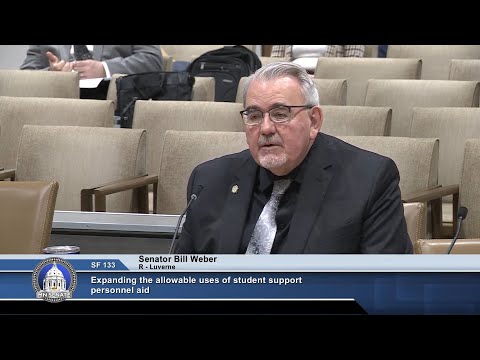
Senator Weber, who presented the bill and said the changes respond to feedback from rural service cooperatives and school districts, described the amendment as a response to practical barriers. "There was enough money provided for that they could hire 20 additional people. The problem is... they couldn't afford to hire 20 additional people because the only way that they could spend the money that was allocated was for salaries," Weber said, describing travel, training and technology as material costs in rural districts.
Dr. Amber Bruns, clinical director of behavioral health services at the Southwest West Central Service Cooperative, told the committee the cooperative supports the amendment. She said members sometimes travel large distances to serve widely dispersed districts and that average monthly travel mileage per staff can be large. "By expanding the use of these funds to minimize our transportation, professional development, and technology expenses, this bill reinforces the importance of shared services in optimizing efficiency and equity across all regions," Bruns said.
Noel Schmidt, superintendent of Rock Ridge Schools, and Mesabi East superintendent Jeff Burgess described operating realities in rural districts: staff are often required to travel between multiple sites, training needs for counselors and psychologists differ from classroom professional development, and technology costs for specialty staff are real and recurring. Burgess asked the committee to allow districts to use aid to maintain positions that otherwise would be eliminated, noting that statutory restrictions tied eligibility to pre‑existing staff counts have limited the ability of some districts to access the funding.
Several witnesses urged caution about broadening allowed uses. Julia Messenger, a licensed clinical social worker and a regional representative of the Minnesota School Social Workers Association, warned that diluting funds across broader staffing or non‑licensed roles could undermine the legislation's original goal of increasing licensed student support personnel. "Student support personnel have been connected to this work for many years and were licensed professionals with expertise to address the complexity of chronic absenteeism," Messenger testified, urging that the funding preserve licensed teams to respond to complex needs.
Caitlin Snyder of Education Minnesota cautioned the committee about workforce and bargaining implications of substituting non‑licensed roles for licensed counselors and social workers, saying many of the titles mentioned by pilots — Promise Fellows, deans, AmeriCorps — would not be part of educator bargaining units and could have less job security and higher turnover. She urged that legislators protect a focus on increasing licensed personnel and cited upcoming increases to per‑pupil funding and investments for multilingual and special education as part of the wider funding picture.
After debate, the committee approved the A1 amendment on a voice vote with no opposition recorded and laid Senate File 133 over as amended for possible inclusion in an omnibus bill. Committee chair Senator Kunish said the bill would be considered later in the session as lawmakers review the full range of education funding needs.
Written and oral supporters for the amendment included rural cooperative representatives and several superintendents; opponents urged the committee to ensure the funds remain targeted to licensed student support personnel and cautioned against diluting the original intent of 2023 student support personnel funding.
The committee's action does not make law; the amendment and bill will be considered later as part of the Legislature's budget and omnibus process.