Get Full Government Meeting Transcripts, Videos, & Alerts Forever!
Get email alerts on the Wage Theft Ordinance topic
No spam. Unsubscribe anytime.
Committee reopens discussion on wage-theft ordinance amendments; key changes include committee makeup, complaint flow and removal of permit condition
Summary
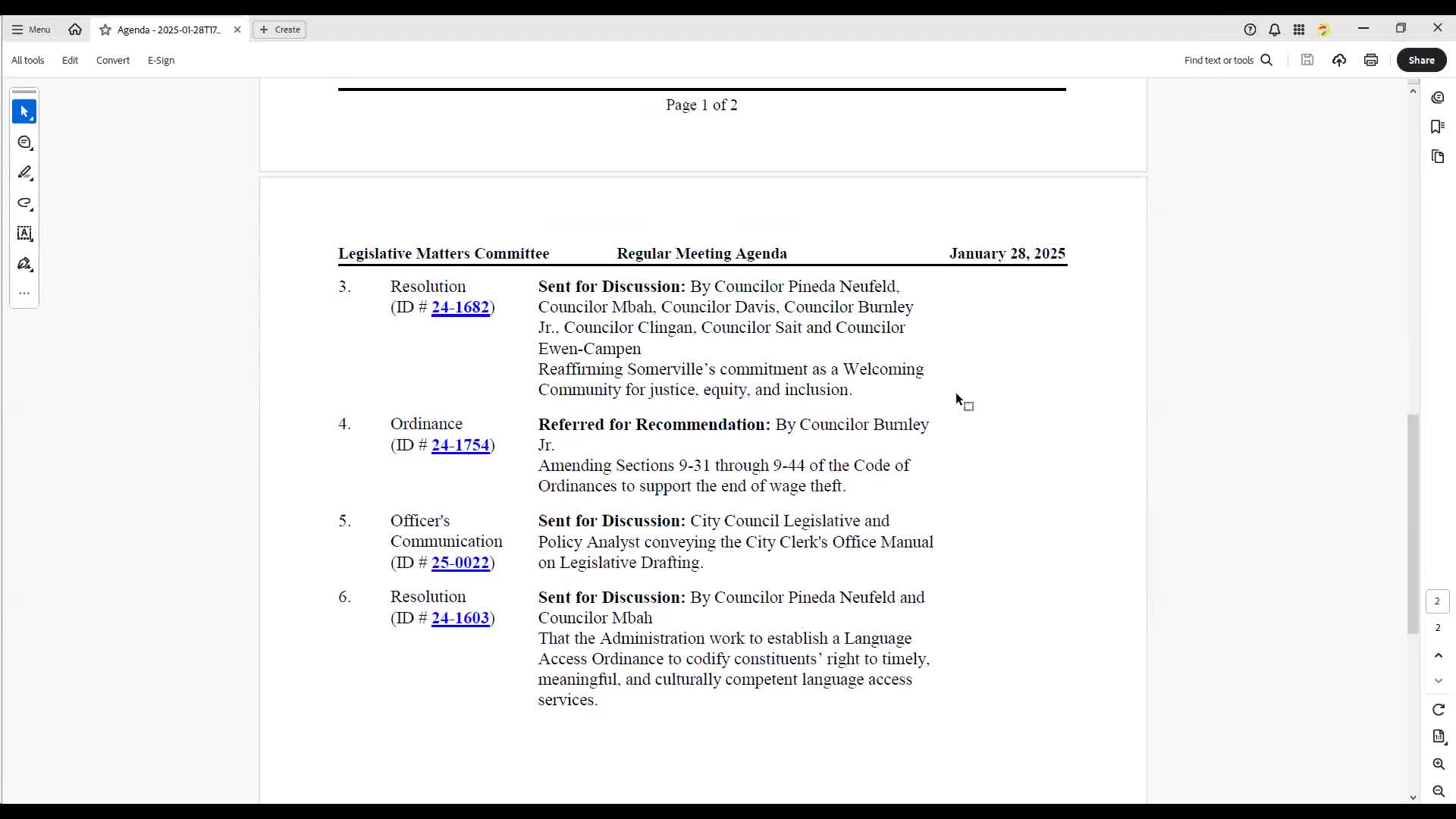
The Somerville Committee on Legislative Matters began a detailed review on Jan. 28 of proposed amendments to ordinance 24-1754, which would amend sections 9-31 through 9-44 of the City Code to strengthen the city's response to wage-theft complaints.
The Somerville Committee on Legislative Matters began a detailed review on Jan. 28 of proposed amendments to ordinance 24-1754, which would amend sections 9-31 through 9-44 of the City Code to strengthen the city's response to wage-theft complaints.
The administration and staff described four principal changes in the draft: (1) moving from a model that named specific organizations to fill seats on the Wage Theft Advisory Committee toward a standardized structure of nine members (including the council president or designee and the mayor or designee plus representatives from unions, nonprofit/advocacy organizations and local business organizations); (2) clarifying the committee's role as a convener and tracker of complaints rather than a primary enforcement body; (3) removing a section that would have conditioned major building permits on wage-theft compliance because the law department advised that building-code rules preempt such permit conditions; and (4) editing and consolidating statutory citations to reduce internal inconsistencies.
Administration and staff emphasized that the Wage Theft Advisory Committee is intended to receive and document complaints, assist with outreach and packaging of complaints, and forward complaints to the appropriate enforcing authority ' typically the Massachusetts Attorney General's Office or the U.S. Department of Labor ' then track the outcomes so city licensing or procurement bodies can act on final administrative or judicial determinations.
Councilors pressed several topics: Councilor Scott said existing state and federal enforcement mechanisms have been insufficient and argued for local mechanisms that help shepherd complaints to enforcement authorities and preserve local remedies such as contract sanctions. Committee members asked for clarification on the sanctions language in what is now section 937(e) (sanctions for violations) and whether the revision broadened or narrowed the city's ability to revoke or suspend city contracts, require wage bonds, or impose conditions on future contracts; staff said the draft consolidates references to Mass. General Laws and applicable U.S. code sections into section 931a for clarity, and the city attorney said he would provide a follow-up memorandum on the legal interpretation of the sanctions language.
Staff said the city plans to hire a staff person to support the Wage Theft Advisory Committee; the position has not been posted but economic development is working with human resources to post it soon. Committee members asked that the position include outreach and recruitment responsibilities, and staff said the role would be larger than a clerical secretary and would include education, complaint intake and tracking.
Members also discussed quorum problems arising from the previous model of named organizations (several organizations no longer exist or declined to participate) and kept the drafting's proposed staggered terms to ensure continuity. The committee did not vote on the ordinance but kept the item in committee for further work and requested a legal opinion on the sanctions language and additional drafting edits.
Next steps recorded by staff: the law department will review and return a clarification about the sanctions clause; staff will prepare a revised redline that consolidates statutory citations; economic development/HR will post the support position and report back on timing; committee members may submit drafting comments to the legislative analyst.