Get Full Government Meeting Transcripts, Videos, & Alerts Forever!
Get email alerts on the Legislative Drafting Manual topic
No spam. Unsubscribe anytime.
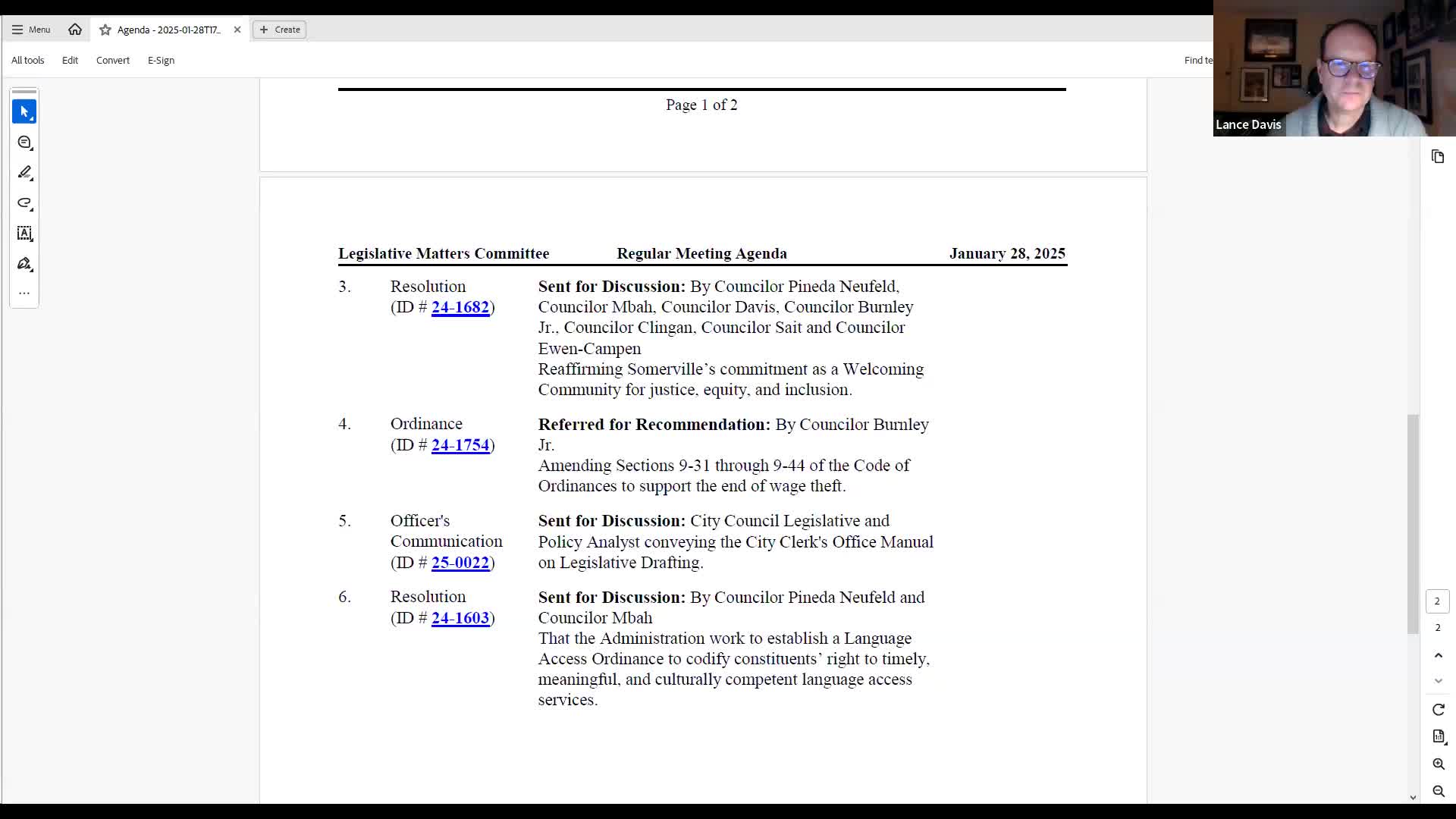
Somerville legislative drafting manual presented to committee; staff guidance to streamline ordinance submissions
Summary
The committee on legislative matters heard a detailed presentation on a new City Clerk's Office legislative drafting manual and guidance on five components of quality legislation; the committee marked the item as work complete.
The Somerville Committee on Legislative Matters received a follow-up presentation on Jan. 28 on a new City Clerk's Office legislative drafting manual intended to standardize and improve ordinance submissions.
Bridal Salisbury, the city's legislative and policy analyst, told the committee the manual and companion guidance focus on five components of quality legislation: necessity, effectiveness, practicality, legality and equity. Salisbury said those tests are intended to help councilors and staff determine whether a proposed ordinance should be drafted, whether it can achieve its aims if implemented, how much staff time and budget it will require, whether the city and council have legal authority, and whether it will disproportionately affect particular groups.
Salisbury said the manual clarifies the distinction between ordinances and programmatic or policy responses, and that some problems may be better addressed through non-legislative interventions. She repeatedly emphasized that the city attorney's office is the final authority on legal questions and that preemption by state or federal law or existing statutory schemes can limit what municipalities may do.
Chair Lance Davis and other committee members thanked Salisbury for the presentation and noted the manual will help the committee when it reviews petitions and ordinance drafts. The committee recorded the item as work completed and advised councilors and staff to use the manual and consult Salisbury when preparing or revising legislation.
Salisbury urged members to read the manual and to contact her with drafting questions; she also said many of the drafting edits in the manual are stylistic and intended to reduce internal inconsistencies in citations and phrasing.
The committee agreed the manual will be a practical reference for future ordinance drafting and that staff and serving councilors should coordinate when questions about scope, authority or enforcement arise.