Get Full Government Meeting Transcripts, Videos, & Alerts Forever!
Get email alerts on the Deep Fake Obscenity topic
No spam. Unsubscribe anytime.
Committee narrows deep‑fake obscenity bill, expands scope to adults and minors and removes affirmative‑defense carve-outs
Summary
The committee amended House Bill 1351 to replace the term “minor” with “individual” so the deep‑fake obscenity provisions apply to adults as well as minors, removed affirmative‑defense language, and approved the bill as amended by unanimous vote of members present.
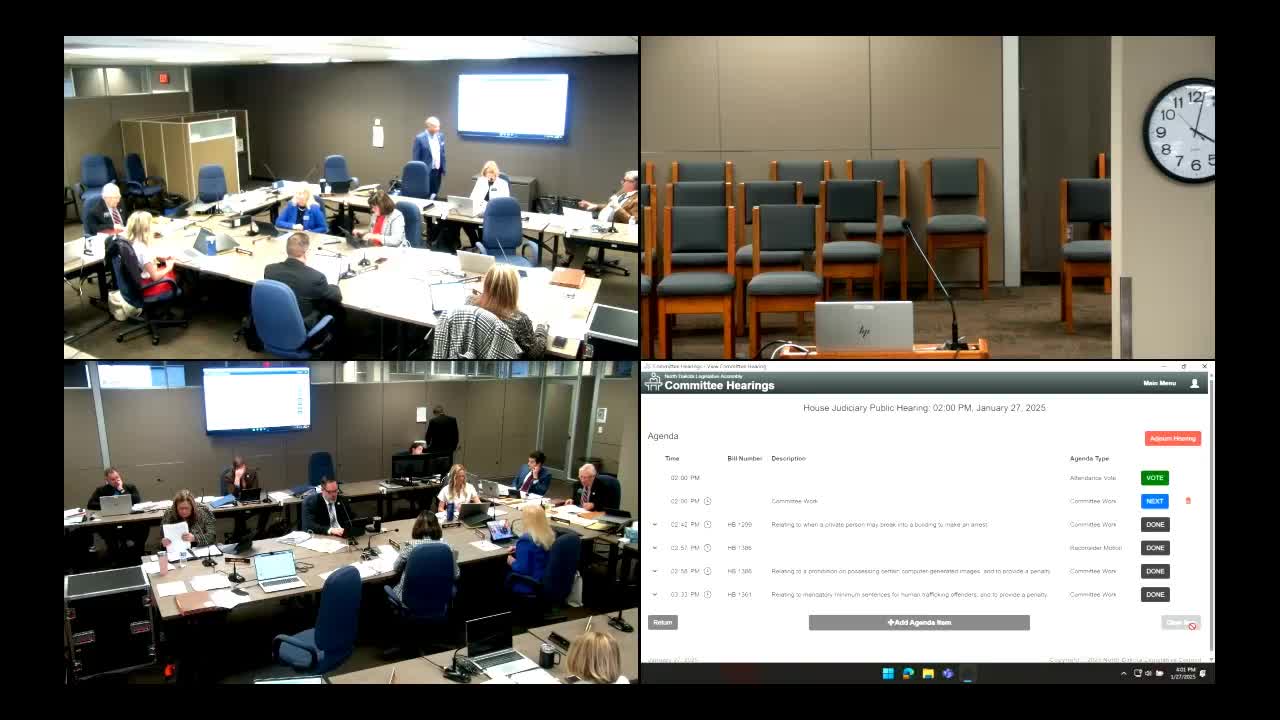
The House Judiciary Committee on the record amended House Bill 1351 — described at the hearing as an obscenity‑control measure addressing deep‑fake sexual imagery — and then recommended the bill for passage as amended.
Representative Satrim proposed changing the bill’s language so that places where the bill said “minor” would read “individual,” extending the bill’s reach to adults as well as minors. The committee adopted that change 11–0. Members then debated removing affirmative defenses that would allow a defendant to assert, for example, that a depiction had serious literary, artistic, political or scientific value or was created for a legitimate professional purpose. A first attempt to remove part of those defenses failed on an initial vote; the committee later voted to reconsider and then, on reconsideration, approved removing the entire subsection that contained the affirmative defenses by roll call 7–4.
Committee members discussed whether the bill covered only children or also adults and whether the legislative language should borrow from a prior bill addressing non‑child deep fakes. The amended bill applies to individuals generally and includes civil remedies, including compensatory and exemplary (punitive) damages, and criminal penalties where specified. Committee discussion referenced that section 1 contains the main new offenses and noted the penalty language includes a class A misdemeanor in one location; the bill also creates a civil cause of action for identifiable victims.
After amendments were adopted, the committee voted to recommend the bill for passage as amended by roll call, 11–0 with three absent. Representative Johnston agreed to carry the bill on the floor.