Get Full Government Meeting Transcripts, Videos, & Alerts Forever!
Get email alerts on the Human Trafficking topic
No spam. Unsubscribe anytime.
Committee backs mandatory minimums for some human‑trafficking felonies amid concerns about victims
Summary
The House Judiciary Committee recommended passage of House Bill 1361, setting mandatory minimum prison terms for certain trafficking-related felonies — 40 years for class double-A, 15 years for class A and 7 years for class B — after a divisive debate on victim protections and sentencing discretion.
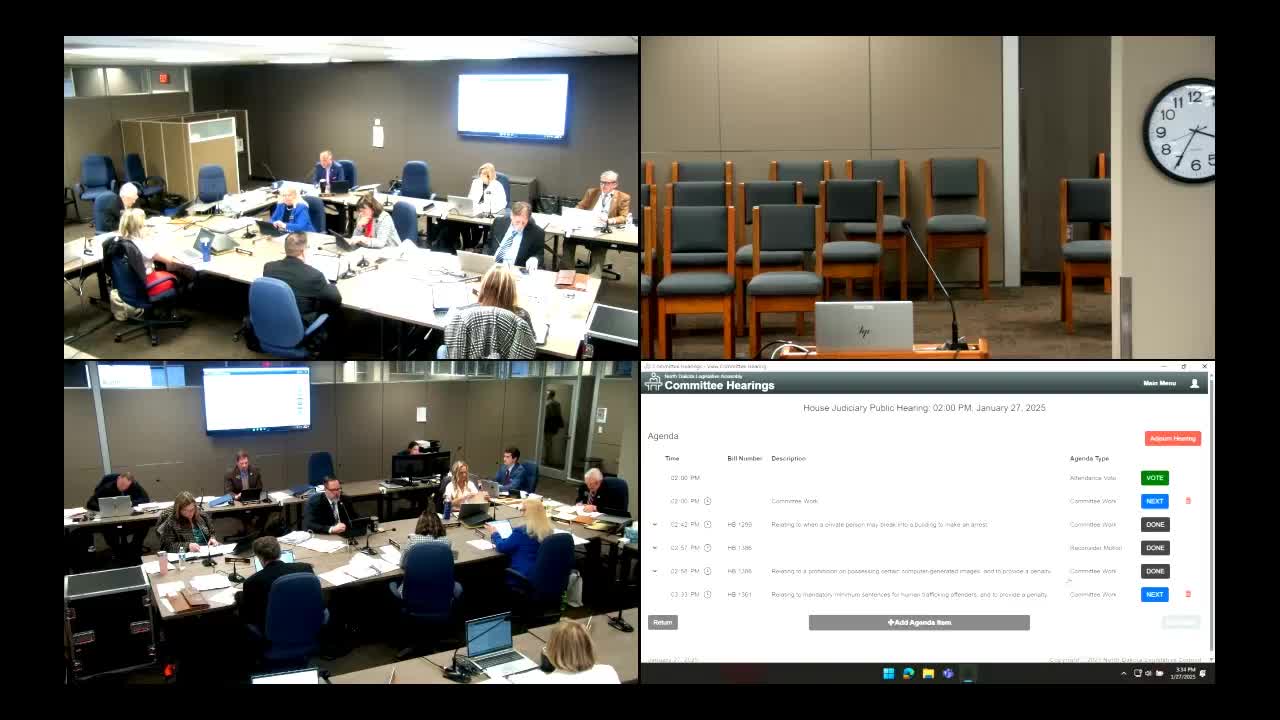
The House Judiciary Committee voted to recommend passage of House Bill 1361, a bill that would set mandatory minimum sentences for a range of trafficking-related felonies.
Representative Johnston, sponsor of the bill, framed it as addressing serious trafficking offenses already classified in chapter 12.1-41 and said many current maximums are severe but lack a guaranteed minimum term. Committee materials distributed during the hearing listed proposed mandatory minimums: 40 years for a class double-A felony, 15 years for a class A felony and 7 years for a class B felony. Members contrasted those proposed minimums with current maximum penalties (double-A: up to life; A: up to 20 years; B: up to 10 years) and noted some aggravating circumstances can add years.
Committee debate focused on two main concerns: whether mandatory minimums would limit prosecutors' and judges' ability to account for victims who were coerced into criminal acts, and whether mandatory minimums push prosecutors to pursue lesser charges rather than the trafficking charges the bill targets. Representative McLeod, Representative Vetter and others raised examples of trafficking victims who later cooperated or were themselves prosecuted; they urged caution. Representative Johnston and backers said the bill addresses lenient outcomes for serious offenders and that prosecutorial discretion remains.
The committee also noted a fiscal note exists on the bill but without dollar figures for appropriations. After debate Representative McLeod moved a do-pass recommendation, seconded by Representative Wolff. The motion carried 6–5 with three members absent. Representative Hoberson agreed to carry the bill on the floor.