Get Full Government Meeting Transcripts, Videos, & Alerts Forever!
Get email alerts on the Corrections topic
No spam. Unsubscribe anytime.
Committee hears bill to clarify when state must pay counties for housing DOC inmates; DOC and sheriffs seek wording fixes
Summary
House Bill 1344 would clarify when the Department of Corrections must pay county jails for housing inmates sentenced to state custody when state facilities are full; DOC and sheriff representatives discussed contract language and the payment trigger.
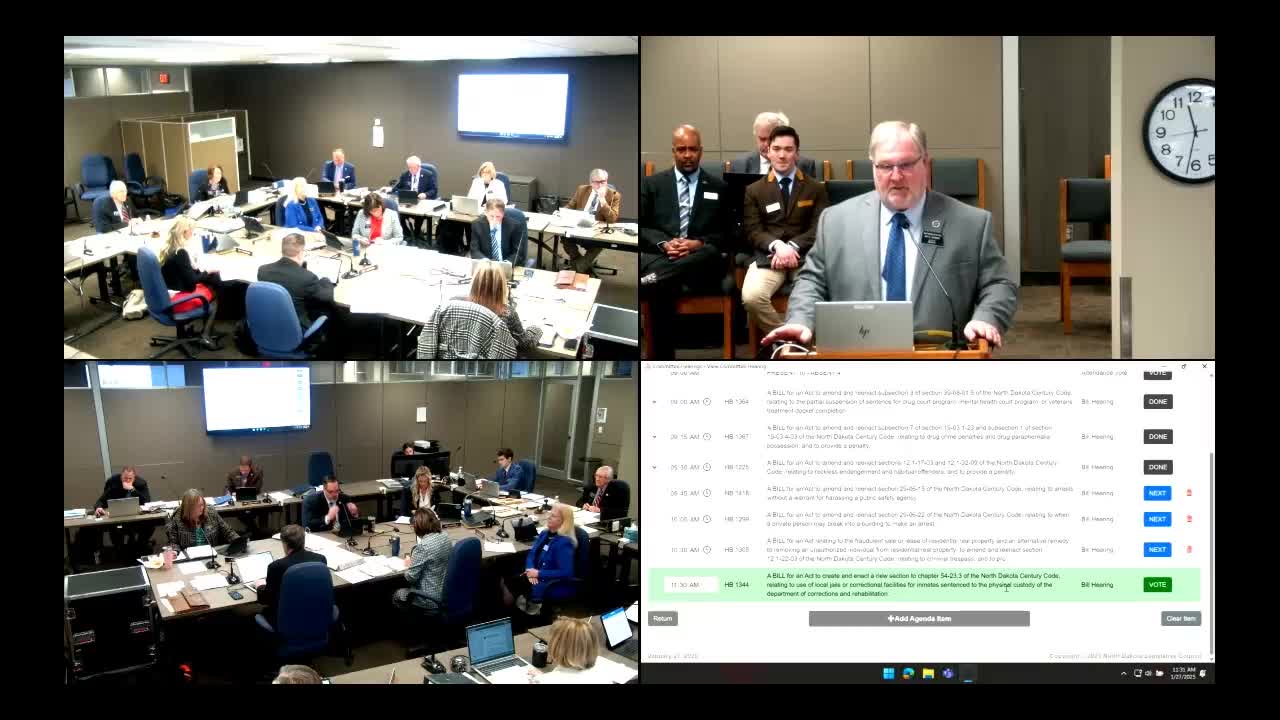
The House Judiciary Committee held a hearing on House Bill 1344, which would create statutory language clarifying use of local jails or correctional facilities to house inmates sentenced to the custody of the Department of Corrections and Rehabilitation (DOCR) when state facilities lack capacity.
Representative Pat Heinert, sponsor, said the bill corrects wording and clarifies payments and contracting when DOCR uses county jails to house sentenced inmates. Major Trent Wongen of the Burleigh‑Morton Detention Center testified in support, describing existing agreements under which county jails have housed DOCR inmates — including short‑term sentenced inmates, parole holds, deferred‑admissions inmates awaiting space, and inmates completing programming — and said DOCR currently compensates counties for those days. Wongen said county charges vary by facility and can be about $75–$120 per inmate per day; Burleigh County’s current rate is $100 per day.
Colby Braun, director of the Department of Corrections and Rehabilitation, provided neutral testimony and asked the committee to clarify the bill’s triggering event for payments. Braun said current practice uses a scheduling calendar that lets counties book transport dates and that the department has been working with counties to manage overcrowding without invoking prioritization. He and sheriff representatives asked for clearer language to distinguish a DOCR denial of admission due to no bed space from other scheduling or sentencing events; committee members likewise questioned whether agreements should be executed with the county commission or with the jail administrator.
Donnell Presky of the North Dakota Association of Counties and the Sheriffs Association said the bill simply clarifies the obligation of the state to pay counties when DOCR is out of space; he said without the clarification, counties could be left paying for state‑sentenced inmates. Committee members requested technical edits — including changing “shall” to “may” in one clause and clarifying whose signature is required for an agreement — and DOC staff and sheriffs said they would work with the sponsor on amendments. The committee did not take a vote.