Get Full Government Meeting Transcripts, Videos, & Alerts Forever!
Get email alerts on the Property Rights topic
No spam. Unsubscribe anytime.
Landlords, title companies and prosecutors debate new squatting code; sponsor says bill mirrors Florida law
Summary
House Bill 1305 would create criminal trespass and a statutory process allowing sheriffs to remove alleged unauthorized occupants from residences; landlords and title‑industry witnesses supported the measure, while the Land Title Association recommended striking one section; prosecutors urged additional work on sheriff duties and safeguards.
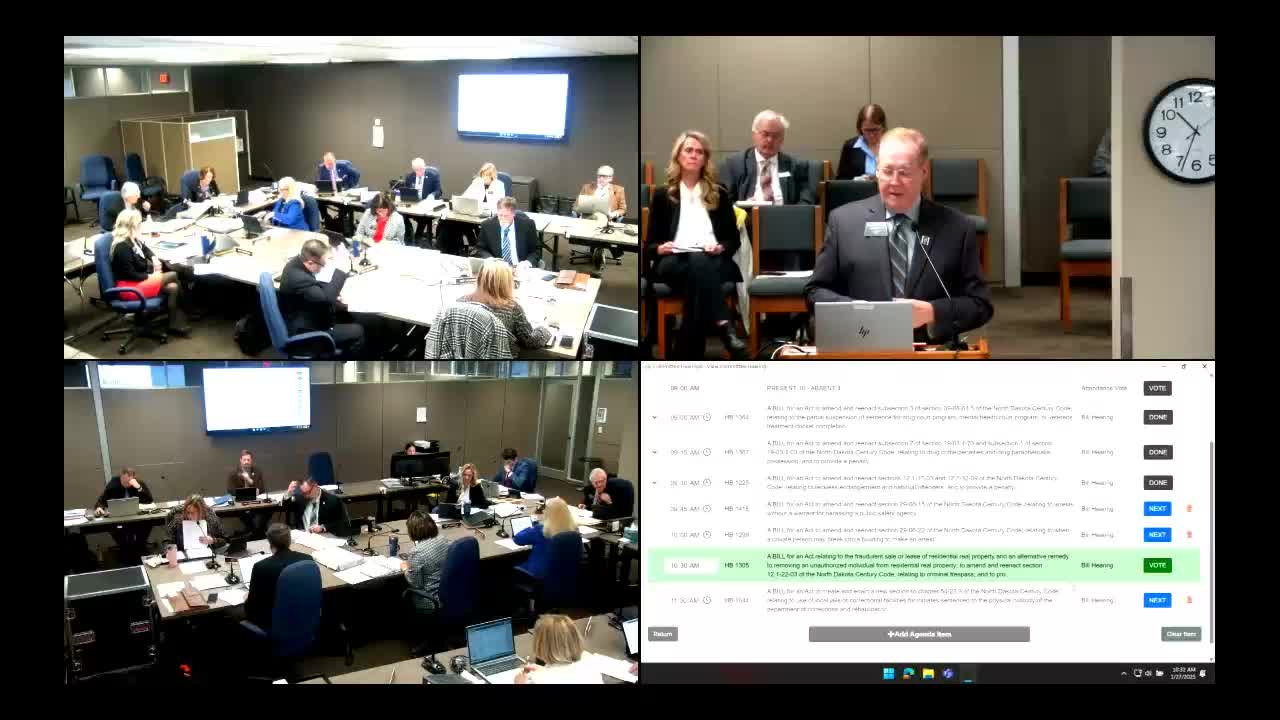
Representative Jim Casper introduced House Bill 1305, a comprehensive proposal intended to address what supporters described as “squatting” — unauthorized occupancy of residential property — by creating criminal trespass offenses and a statutory process for owners or landlords to prompt sheriff action.
Casper said the bill is patterned on a 2024 Florida law and would create new criminal trespass offenses, define procedures for owners to request sheriff investigation and removal, and provide a civil remedy for people who say they were wrongfully accused. He told the committee the measure is meant to give property owners a faster, clearer tool than current eviction processes that can take weeks.
Jeremy Petron of the North Dakota Apartment Association supported the bill, saying landlords now rely on a three‑day notice and eviction process that can be slow and costly and that the bill would provide a tool to address illegal activity or damage while owners await a court date. John Ward of the North Dakota Land Title Association urged the committee to remove section 2, arguing that criminal exposure for certain third parties involved in title or advertising transactions could have unintended consequences; he asked that drafters work with the sponsor.
Rosa Larson, Ward County state’s attorney, said prosecutors were not opposed to addressing squatters but asked that the committee table the bill to give stakeholders — including sheriffs and county officials — time to resolve concerns about the burdens placed on law enforcement, definitions such as "immediate family," and immunity or liability for sheriffs who carry out removals.
Committee members asked questions about overlap with existing eviction law, civil procedures for possessions left behind, and whether sheriffs could be required to act without a court order. Casper and witnesses said the bill is intended to provide a quicker path to remove unauthorized occupants and that the statutory scheme includes documentation and safeguards. The committee did not take final action; stakeholders agreed to continue drafting and discussions.