Get Full Government Meeting Transcripts, Videos, & Alerts Forever!
Get email alerts on the Ai Generated Content topic
No spam. Unsubscribe anytime.
Committee reopens, amends bill to clarify "minor" and remove highest felony enhancement for certain materials
Summary
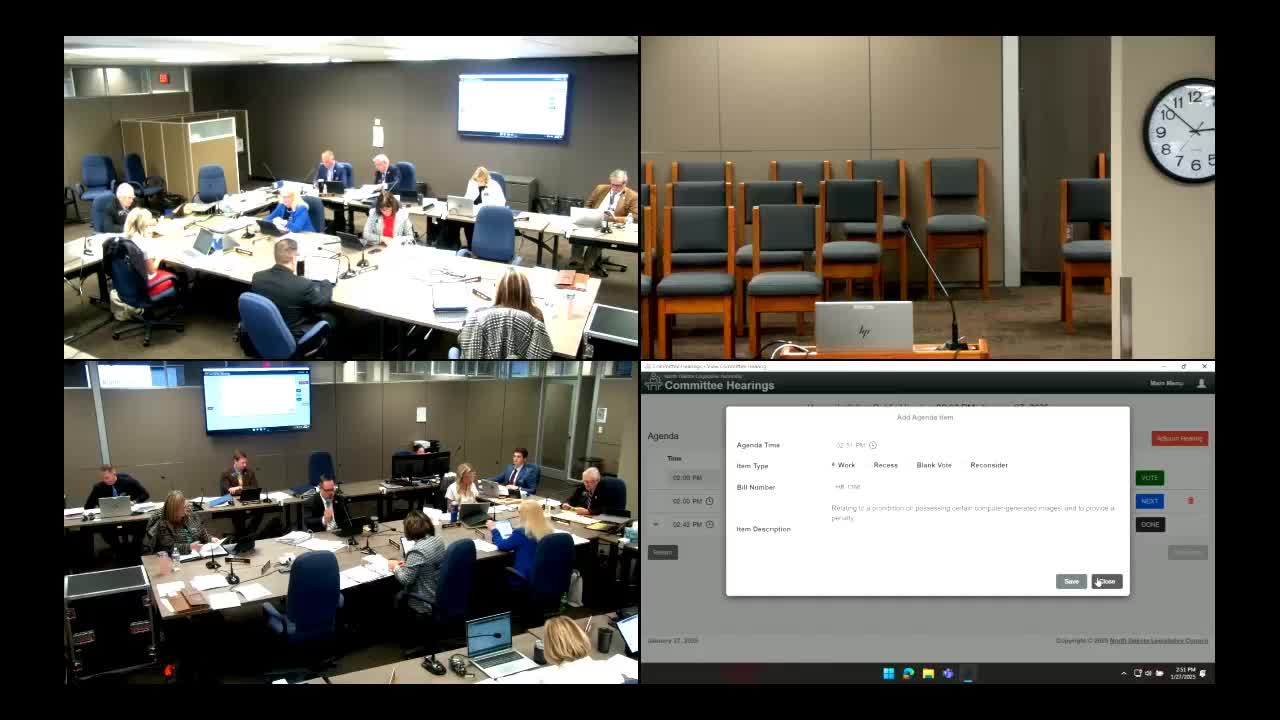
The House Judiciary Committee voted to reconsider House Bill 1386, adopted an amendment clarifying the definition of “minor” to include persons under 18 and computer-generated images that appear under 18, removed certain felony enhancement language, and sent the bill out with a do pass as amended recommendation (7–4).
The House Judiciary Committee voted to reconsider House Bill 1386 and, after debate and amendment, approved the bill as amended and advanced it with a do-pass recommendation.
On reconsideration, Representative Olsen moved to reopen consideration of HB 1386; the motion was seconded and passed on a roll call vote of 11–0. Representative Olson then explained a proposed amendment developed with legislative counsel that reworked the bill’s definition of “minor.” The adopted definition makes clear that for the bill’s purposes “minor” means an individual under 18 years of age or a computer-generated image created or adapted to appear to depict an individual under 18 by face, likeness or other distinguishing characteristics. Committee members referenced consultation with the Attorney General’s office during the drafting.
The committee also debated penalty language that previously elevated possession of certain materials depicting very young children to a class A felony. Members split over whether possession of computer-generated images that appear to depict infants or toddlers should carry the same enhancement as offenses involving real victims. Representative Wolff and others expressed concern about removing the higher penalty for materials depicting infants/toddlers; Representative Vetter and several others pressed for removing an Internet/online waiver and for clearer definitions. The committee removed lines 8–12 on page 3 (a subsection relating to an Internet waiver) by a 6–5 vote.
A later amendment that revised the definition of “minor” (page 1, lines 11–13 in the amendment) passed 11–0. After final debate, Representative Olsen moved a motion for “do pass as amended”; the motion passed 7–4 with three members absent. Representative Olsen will continue as bill carrier.
The record shows committee deliberations focused on: how to treat computer-generated images versus real-victim materials, whether obscenity or other code chapters better capture this conduct, and whether to preserve or remove specific affirmative defenses and online-waiver language. Members repeatedly emphasized the newness of AI-generated content and concerns about drafting language that will be resilient as technology evolves.
Votes at a glance: Motion to reconsider HB 1386 — passed 11–0; Motion to remove page 3 lines 8–12 (Internet waiver) — passed 6–5; Amendment redefining “minor” — passed 11–0; Final do pass as amended — passed 7–4 (3 absent).