Get Full Government Meeting Transcripts, Videos, & Alerts Forever!
Get email alerts on the Public Safety topic
No spam. Unsubscribe anytime.
Panel approves tougher reckless‑endangerment language and change to habitual‑offender standard; fiscal note draws scrutiny
Summary
House Bill 1225 would add a class B felony when a firearm is intentionally used in reckless‑endangerment scenarios and change habitual‑offender language to count out‑of‑state felonies; the committee approved the bill as amended and re‑referred it to Appropriations after questions over a $13 million fiscal note.
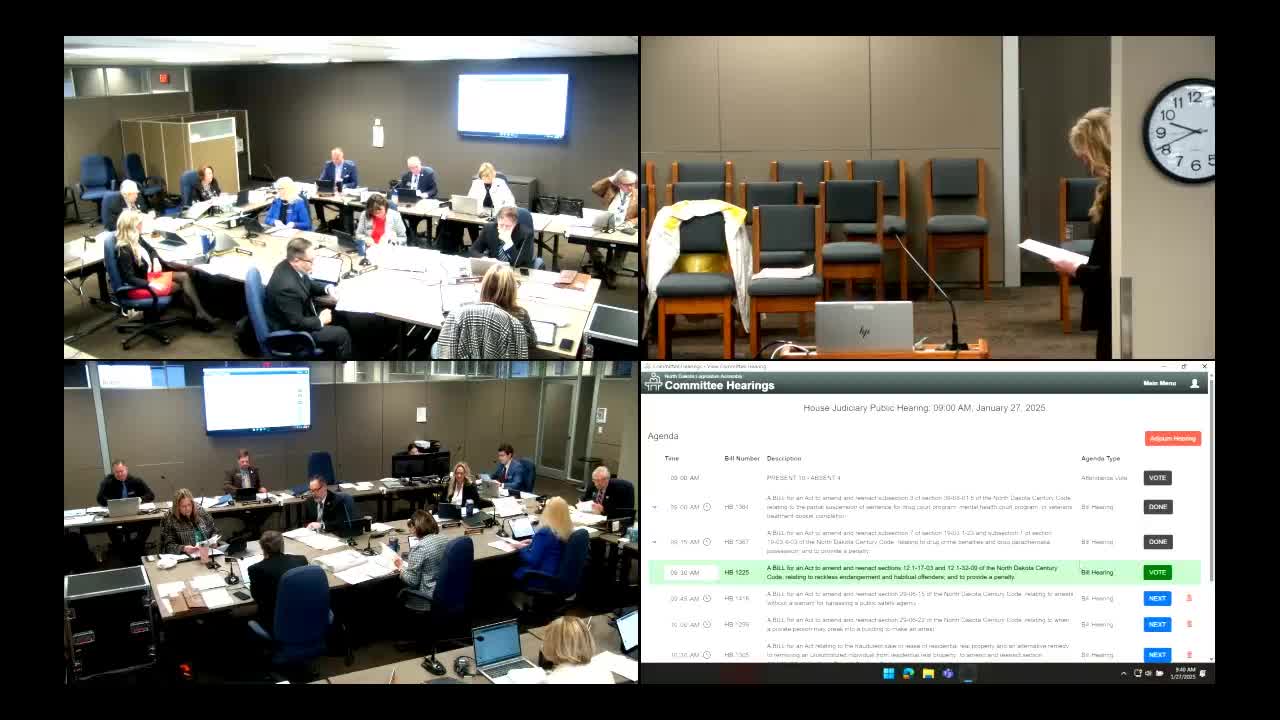
The House Judiciary Committee voted to advance House Bill 1225 as amended after lengthy discussion about penalties and a large fiscal estimate. The bill would (1) add a class B felony to the reckless‑endangerment statute when a firearm is discharged or a dangerous weapon is used intentionally in a manner demonstrating extreme indifference to human life and (2) change the habitual‑offender statute’s cross‑reference so out‑of‑state felonies can be counted when they exceed 360 days.
Rosa Larson, Ward County state’s attorney, said the bill is aimed at shootings that occur in crowds, drive‑by shootings and other incidents where proving intent to kill a specific person — the standard for attempted murder — is not feasible. Larson told the committee the class B felony would require proof of intentional use of a firearm and carries a mandatory four‑year sentence when the firearm element is present.
Representative Vedder moved an amendment to keep language adding discharge of a firearm and also insert “or use another dangerous weapon”; the committee adopted that amendment. Members debated whether to cover vehicles and other weapons; Larson said the state would consider “dangerous weapon” language if the committee preferred.
Discussion shifted to a fiscal note that several committee members read aloud as $13,000,000. Larson said she did not know who produced that figure but acknowledged the Department of Corrections had provided a fiscal estimate. Representative Carls and others said the large fiscal amount would affect their vote. Representative Satrim expressed concern that sentencing increases without programming and treatment upstream may worsen recidivism.
After debate the committee voted 7–6 with 1 absent to give a do‑pass as amended recommendation and re‑refer the bill to Appropriations. Committee members said Appropriations will examine the fiscal note and any needed appropriations; the bill’s sponsor will carry the measure back after that committee review.