Get Full Government Meeting Transcripts, Videos, & Alerts Forever!
Get email alerts on the Criminal Justice topic
No spam. Unsubscribe anytime.
House Judiciary panel advances bill to clear third-offense DUI from driving records after drug‑court graduation
Summary
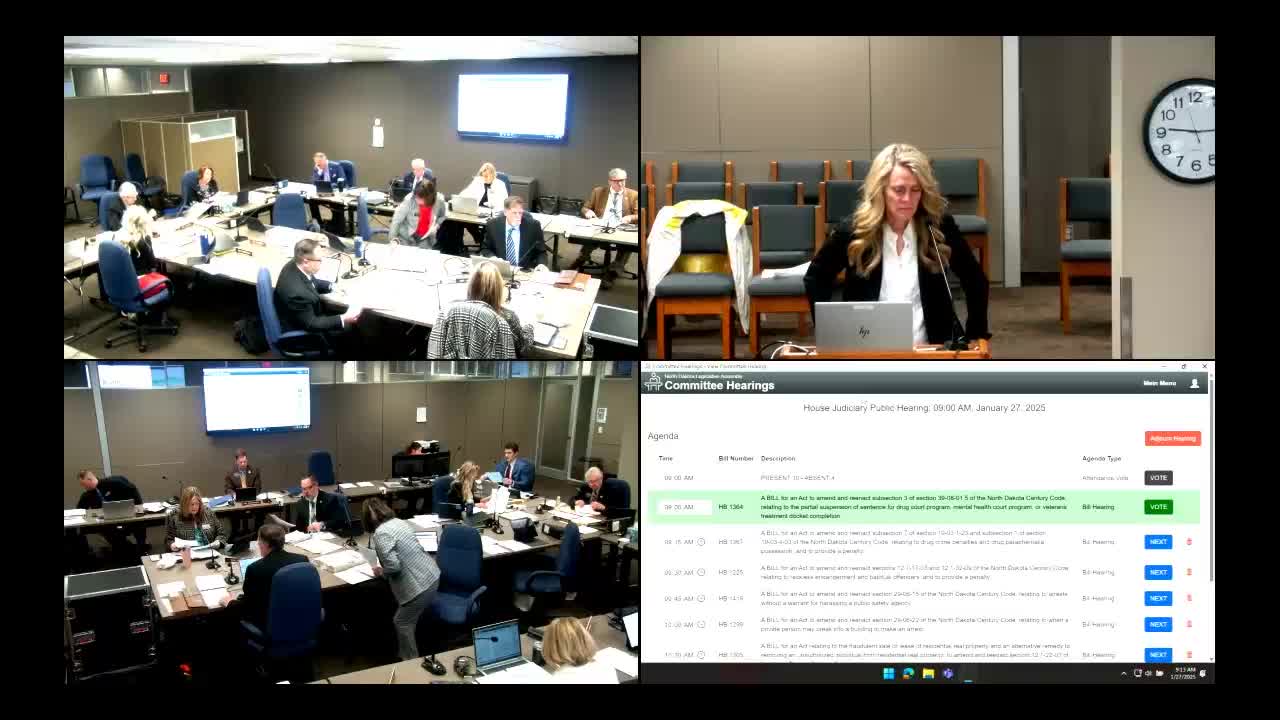
The House Judiciary Committee voted to give amended do‑pass recommendation to House Bill 1364, which would let a court order the Department of Transportation to remove a third‑offense DUI from an individual’s driving record after successful completion of a drug‑court program.
The House Judiciary Committee voted to give amended do‑pass recommendation to House Bill 1364, which would let a court order the Department of Transportation to remove a third‑offense DUI from an individual’s driving record after successful completion of a drug‑court program.
Rosa Larson, Ward County state’s attorney, told the committee the bill “is being brought on behalf of the North Dakota State’s Attorneys Association” and that the requested change would make dismissal and sealing of the court record “carry through to the driver’s license aspect as well.” Larson said current state law dismisses and seals some third‑offense misdemeanor DUI cases after successful drug‑court completion but that the DMV record still shows the conviction, which she said causes “negative consequences” for graduates.
Larson and committee members discussed federal rules that apply to holders of commercial driver’s licenses. Larson explained that 49 C.F.R. provisions prohibit “masking” — changing or reducing an offense for CDL holders so it does not appear on driving records — and said those federal rules would disqualify most CDL holders from receiving the benefit. “If somebody with a CDL had a DUI … they would be disqualified under 49 CFR,” Larson said.
Testimony in support came from Travis Fink, executive director of the Commission on Legal Counsel for Indigence, and Jonathan Byers, lobbyist for the North Dakota State’s Attorneys Association. Both urged passage; Byers said the association sought a do‑pass recommendation.
The committee adopted a proposed amendment by roll call and then voted 10–3 (1 absent, not voting) to give do‑pass recommendation as amended. Representative Olson moved the do‑pass recommendation as amended and Representative Johnston seconded.
Supporters said the bill is narrowly drawn to benefit only third‑offense misdemeanor DUIs that already qualify for drug court and are dismissed under current law. Some members raised policy concerns about whether erasing the third offense could affect later enhancements if a graduate reoffends; Larson said current statute treats the third‑offense dismissal as limited to that offense.
The committee record shows the amendment passed unanimously by roll call 12–0 with two members absent before the do‑pass vote. Representative Hoverson agreed to serve as bill carrier.
The bill now proceeds to the next committee referenced by the House procedure for further consideration.