Get Full Government Meeting Transcripts, Videos, & Alerts Forever!
Get email alerts on the Mental Health Emergency Procedures topic
No spam. Unsubscribe anytime.
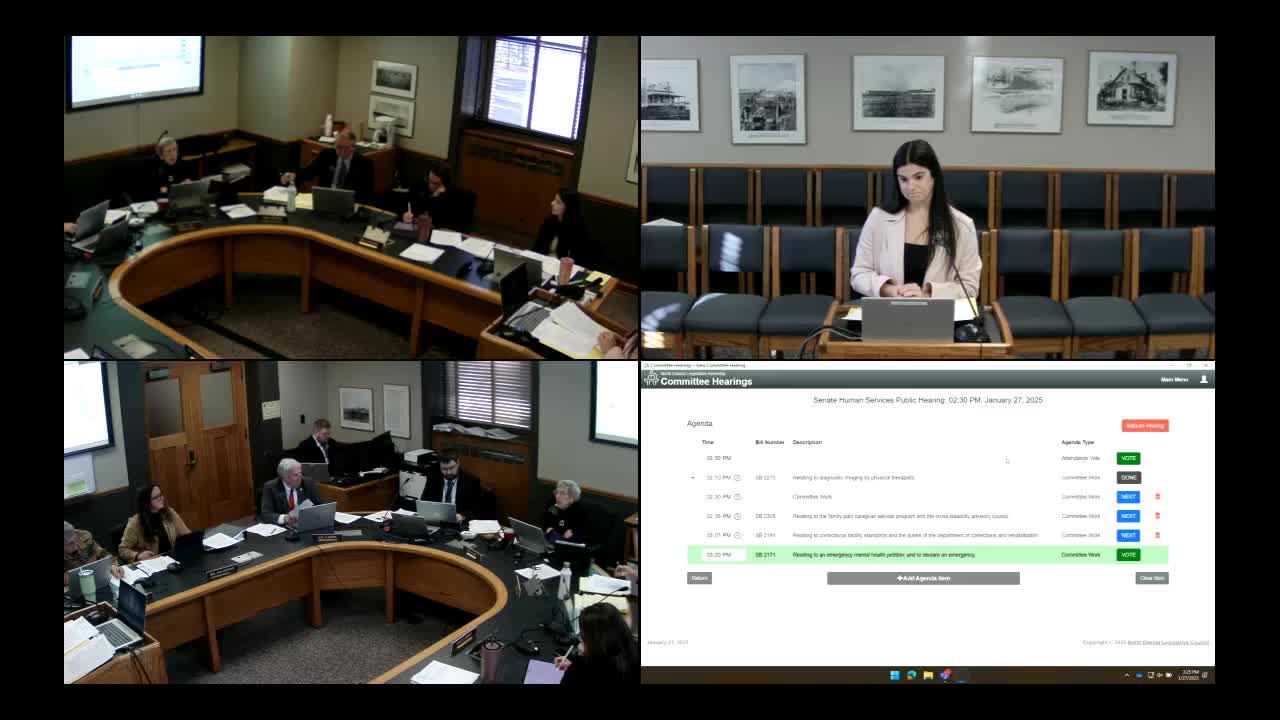
Senate committee narrows emergency civil‑hold timeline to 72 hours and advances bill 6‑0
Summary
The Senate Human Services Committee amended a bill to make the emergency evaluation period a flat 72 hours after admission, voted to reconsider earlier action and approved a due‑pass as amended recommendation by a 6‑0 roll call.
The Senate Human Services Committee amended language on a bill addressing emergency civil‑hold procedures so that the required evaluation period reads as a flat 72 hours after admission and voted the bill out of committee by unanimous roll calls.
Committee discussion focused on whether the statute should retain separate 24‑hour and 72‑hour timelines or move to a single 72‑hour period. Advocates and hospital representatives raised concerns that 24 hours can be too short when transport or medical stabilization is required, while others worried that longer holds without clear criteria could unduly restrict an individual’s rights.
Victoria (staff) described draft language that would remove the bifurcation and require the superintendent or director to “require an immediate examination of the subject within 72 hours after admission.” After debate, Senator Roars moved to reconsider the committee’s earlier action and Senator Hogan seconded; a roll‑call vote recorded Senators Lee, Weston, Roars, Hogan, Van Oosten and Clemens each voting “Aye,” and the motion to reconsider passed 6‑0 on the record.
The committee then debated the amendment that applied 72 hours uniformly, including holidays and weekends, and moved the amendment. The committee voted by roll call — Senators Lee, Weston, Roars, Hogan, Van Oosten and Clemens recorded “Aye” — and the amendment carried 6‑0. Senator Roars then moved a “do pass as amended” recommendation and Senator Van Olsteen seconded; the committee recorded a 6‑0 roll call in favor and reported the bill out of committee as amended.
Speakers asked procedural questions about when the statutory clock begins (the department said the timelines start upon “admission” to the receiving facility) and about transportation costs and liability during interstate or intercity transfers; department staff said county transportation rules and other statutory provisions apply and that they would follow up on logistics.
Ending: The committee adopted the amendment and moved the bill forward unanimously; staff said they would refine statutory language and provide updated drafting for the next session steps.