Get Full Government Meeting Transcripts, Videos, & Alerts Forever!
Get email alerts on the Healthcare Access Dental topic
No spam. Unsubscribe anytime.
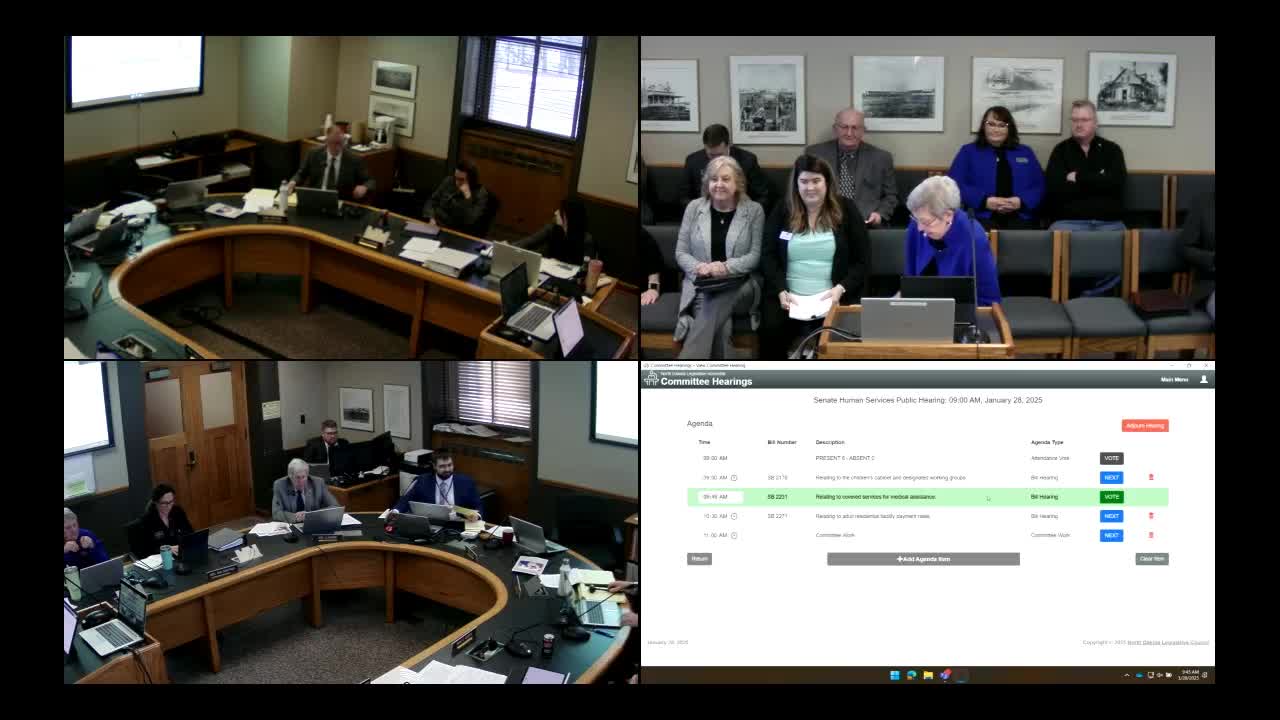
Health centers and clinics press Senate for Medicaid dental, ABA expansion in SB 2231 hearing
Summary
Senator Judy Lee told the Senate Human Services Committee she will seek an amendment to SB 2231 to add certain medical assistance benefits including adult dental treatment and broader ABA coverage.
Senator Judy Lee opened the hearing on Senate Bill 2231, which would amend covered services for medical assistance. She told the committee she intends to offer an amendment to add medically necessary dental services for adults and to expand applied behavioral analysis (ABA) coverage beyond current limits.
Kim Kuhlman, policy and partnership manager for the Community Healthcare Association of the Dakotas (CHaD), testified in support of the bill if amended to add adult dental treatment for Medicaid expansion beneficiaries. “Currently over 34,000 North Dakotans covered by Medicaid expansion do not have dental coverage,” Kuhlman said, citing CHaD data on dental access and emergency visits for tooth pain. She told the committee that community health centers delivered 11,912 dental patients with more than 25,000 visits in 2023 and that lack of dental coverage drives costly emergency room and urgent care visits.
Nadine Bowe, chief executive officer of Northland Health Centers, described local steps to expand dental access in underserved communities and urged sustainable Medicaid reimbursement to recruit and retain dental staff. Tammy King of Bridging the Dental Gap, which operates an 8‑operatory clinic in Bismarck, described routine patient confusion about coverage and provided examples of treatment plans delayed or canceled when patients move between North Dakota Medicaid and Medicaid expansion. King told the committee her clinic treats patients statewide and that 55% of Bridging patients receive North Dakota Medicaid.
Morris Hardy, director of Dakota Central Human Service Zone, and other zone directors said limited local dental providers accepting Medicaid force long transports for foster children and special‑needs cases, costing staff time and education days for children. Hardy said some zones drive up to two hours each way to obtain Medicaid dental services for foster children.
Witnesses asked the committee to amend SB 2231 to include dental treatment for adults covered by Medicaid expansion and to consider a clear payer approach — either as a carve‑out or through the Department of Health and Human Services — so providers and patients have a single enrollment and reimbursement pathway. Several speakers noted a fiscal note on the bill that showed a modest direct cost for the bill’s narrow scope but said full adult dental coverage would involve larger ongoing federal‑state matching funds and program design.
Committee members asked about provider capacity, reimbursement levels and whether adding coverage would quickly expand the dental workforce; witnesses said increased reimbursement and predictable program design would help health centers and clinics expand services but that workforce shortages remain a constraint in some rural areas.
The committee closed the hearing; sponsors and stakeholders indicated they will work on an amendment to add adult dental treatment to the bill and to clarify ABA coverage language.