Get Full Government Meeting Transcripts, Videos, & Alerts Forever!
Get email alerts on the Long Term Care Capacity topic
No spam. Unsubscribe anytime.
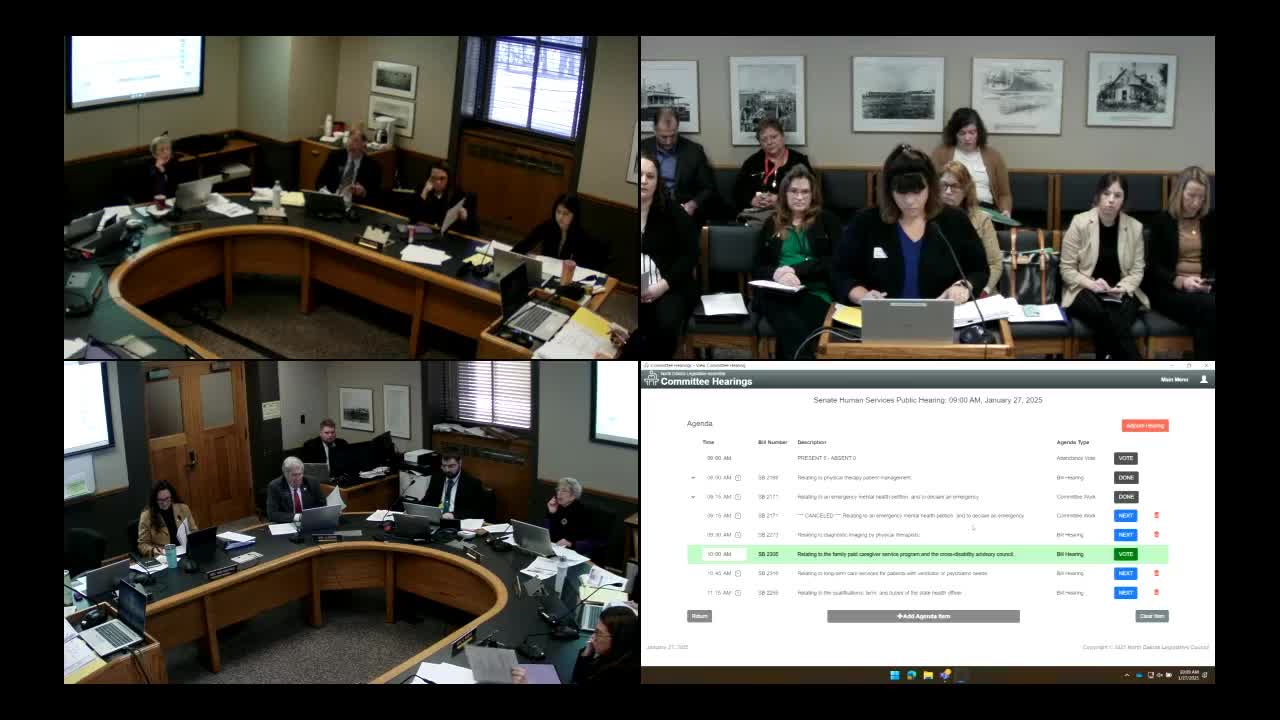
Lawmakers hear calls to expand in‑state long‑term care capacity for ventilator and psychiatric patients
Summary
Senate Bill 2316 would require the state to secure regional long‑term care capacity for people with ventilator dependence or severe psychiatric needs; supporters argued the change would keep patients closer to home, while providers flagged workforce and cost constraints.
Senate Bill 2316, introduced to address gaps in long‑term care capacity for patients with ventilator dependence or high psychiatric needs, drew testimony from family advocates, providers and the Department of Health and Human Services about availability, costs and workforce challenges.
Sponsor Sen. Tim Mathern, D‑Fargo, said the bill aims to keep citizens who require specialized long‑term nursing care closer to their home communities by creating a regional approach to capacity and by considering reimbursement changes to make local care financially viable.
Sen. Tim Mathern, sponsor: “I introduced the bill for 3 main reasons. 1, my conversations suggest that some nursing homes are not able or not willing to care for some individuals who are from their community. 2nd, I know some individuals with complex healthcare needs are left at institutions like the state hospital, private hospitals, or referred out of state even though they have loved ones in their community … 3rd, I believe your committee, the Department of Health and Human Services, and our private nursing home providers could arrive at a manner to keep our citizens within a reasonable distance of their home community.”
Family members and a Bismarck resident who shared a recent personal case described difficulties finding in‑state placement after Medicare coverage ended, and said reimbursement rates do not support facilities in keeping permanent staff needed for ventilator care.
Providers and the North Dakota Long Term Care Association testified neutrally that nursing facilities already can negotiate higher rates to cover intensive needs when needed but face a critical shortage of nurses, respiratory therapists and trained staff. Facility administrators emphasized the complexity and cost of supplies, equipment rental and around‑the‑clock staffing required by ventilator‑dependent residents.
Nikki Wagner, North Dakota Long Term Care Association: “Facilities statewide have the flexibility to negotiate higher rates for individuals with complex care needs when the required resources are available. Instead of creating four regional centers, this process ensures individuals have the freedom to choose a facility if they are capable of meeting their unique needs.”
DHHS Executive Director of Medical Services Sarah Acre provided neutral fiscal guidance: the department already pays for out‑of‑state care when services are not available in North Dakota; a preliminary estimate for a contracting approach reserving beds for North Dakota Medicaid members was about $1.5 million in the 2025‑27 biennium (department estimate), though final costs depend on contract design and whether beds are reserved for Medicaid members only.
Committee members asked for counts of ventilator‑dependent individuals in state facilities and for comparison of in‑home HCBS options; DHHS said it could provide those data. No committee vote occurred during the hearing.
Why it matters: Testimony demonstrated both urgent family need for local capacity and provider concerns about reimbursement and staffing. The bill would require further fiscal and operational design work to translate the concept into practice.