Get Full Government Meeting Transcripts, Videos, & Alerts Forever!
Get email alerts on the Education Restroom Policy topic
No spam. Unsubscribe anytime.
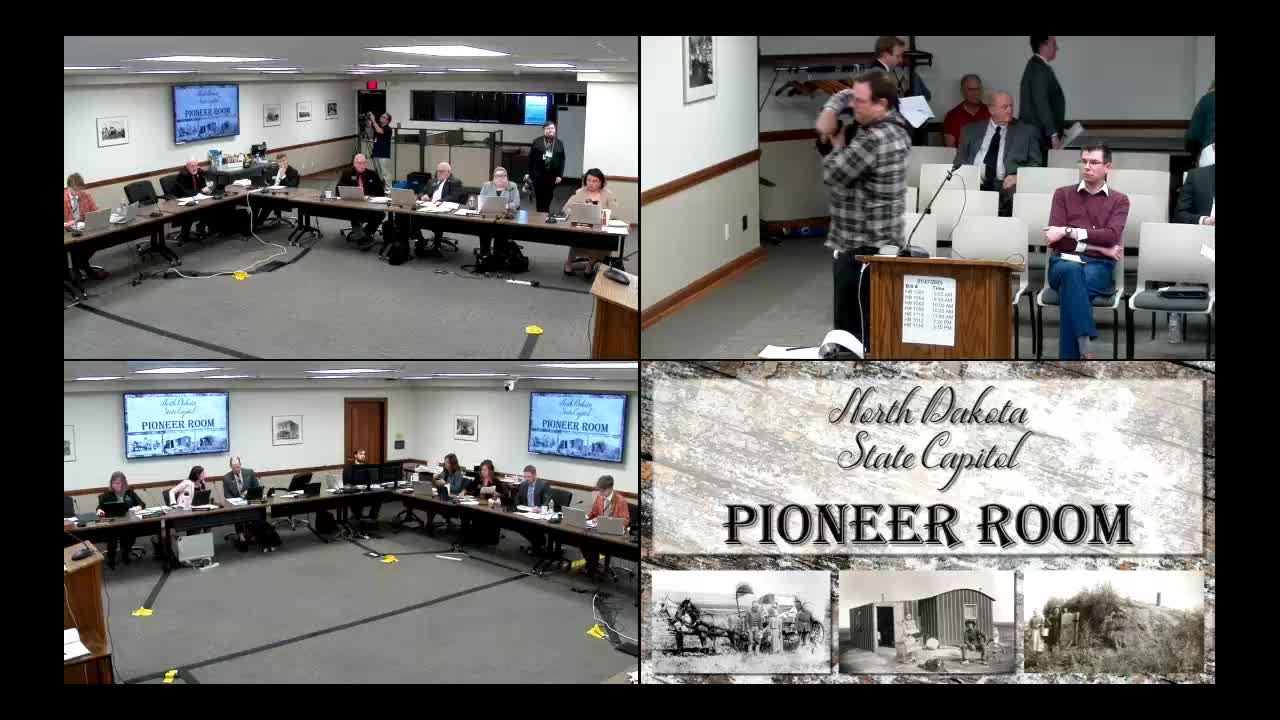
Committee hears heated debate over bill adding penalties to transgender student restroom law
Summary
Representative Bill Tweit introduced House Bill 1144 to add enforcement authority and civil penalties to the 2023 restroom-use statute in North Dakota law and asked the committee to require the attorney general to investigate and to allow courts to assess civil penalties for noncompliance.
Representative Bill Tweit, sponsor of House Bill 1144, told the House Human Services Committee the measure is intended to add enforcement “teeth” to a statute enacted in 2023 (House Bill 1522) that he said lacked penalties for noncompliance. Tweit said the 2023 law is already codified in the North Dakota Century Code at section 15.1-06-21 and that HB1144 would add a role for the attorney general to investigate alleged violations and allow courts to assess civil penalties. “Our kids are important,” Tweit said, urging the committee to consider inserting “shall” in several places to require enforcement.
Supporters who spoke in favor of the bill echoed Tweit’s call for enforceable remedies. Mark Jortsman, executive director of North Dakota Family Alliance Legislative Action, said a superintendent in eastern North Dakota declared he would not comply with the 2023 statute and that there had been no consequence. Lanny Kenner, a private citizen, said schools should maintain separate boys’ and girls’ restrooms and locker rooms.
Opponents argued HB1144 would extend a statute that, they said, already conflicts with federal law and constitutional protections. Cody Schuler of the American Civil Liberties Union of North Dakota told the committee that the earlier law “is already unconstitutional and already violating the civil rights of our students,” citing U.S. Supreme Court precedent in Bostock v. Clayton County and federal civil-rights law as grounds for that view. Schuler recommended a do-not-pass vote and said federal law generally takes precedence over state statutes in this area.
Several witnesses focused on practical and legal complications. Claire Ness, chief deputy attorney general, said the attorney general’s office had not received a fiscal note request for the bill and warned the enforcement tasks in HB1144 could be resource intensive. She estimated the office might need additional civil litigation resources to investigate allegations across roughly 514 public schools in 167 districts and said the office had no ready protocol for carrying out statewide compliance inspections.
Representative Austin Foss, testifying in opposition in his capacity as an architect, argued the bill could conflict with school safety and building considerations. Foss promoted single-use (single-occupancy) restroom designs as a safety improvement that reduces bullying and vandalism, and he said a statutory ban on those designs — which opponents said HB1144 could be interpreted to do in some cases — would be counterproductive. He described single-use facilities as improving supervision, reducing opportunities for group-based misconduct and lowering vandalism.
Committee members asked several procedural and legal questions. Representative Freilich asked whether any lawsuits had followed the 2023 law; Schuler said he was not aware of any filed complaints or court actions at that time. Representative Davis asked Ness how the attorney general’s office would perform investigations; Ness said investigations would use standard civil-litigation tools including subpoenas and, where necessary, on-site inspections and depositions. Ness and committee members discussed that potential enforcement would require funding and staffing that had not been budgeted.
The hearing record includes both organized support for HB1144 and opposition testimony from civil-rights advocates and other witnesses. The committee closed the hearing on House Bill 1144 without recording a committee vote during this session.