Get Full Government Meeting Transcripts, Videos, & Alerts Forever!
Get email alerts on the Health Care Regulation topic
No spam. Unsubscribe anytime.
Senate committee backs bill adding informed‑consent language to North Dakota Physical Therapy law
Summary
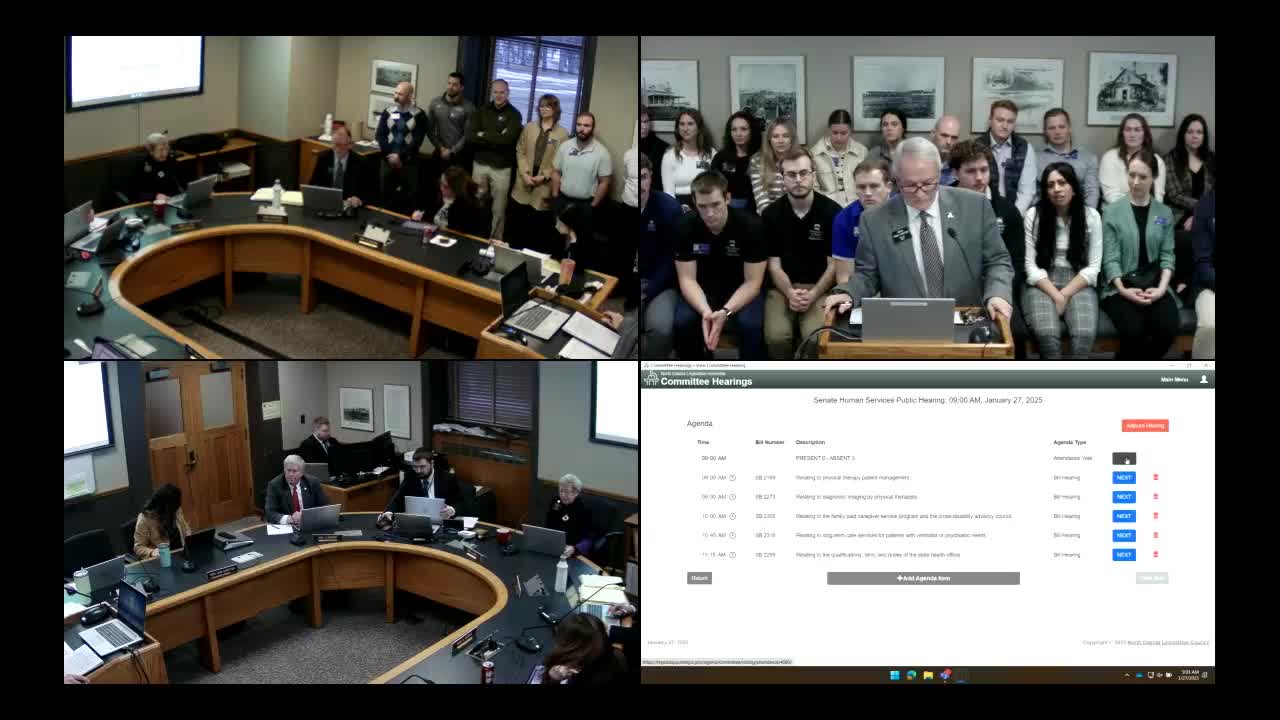
The Senate Human Services Committee gave Senate Bill 2169 a do‑pass recommendation after testimony from physical therapy educators and students urging the committee to add explicit informed‑consent language to the state’s Physical Therapy Practice Act.
The Senate Human Services Committee voted to give Senate Bill 2169 a do‑pass recommendation after supporters told the committee the bill would remove ambiguity in practice by adding an explicit informed‑consent requirement to the North Dakota Physical Therapy Practice Act.
The bill would add standard patient informed‑consent language to chapter 43‑26.1 of the North Dakota Century Code. Sponsor Sen. Randy Burckhardt, R‑Minot, told the committee the change would align state law with national model language used by the Federation of State Boards of Physical Therapy.
Sen. Randy Burckhardt, sponsor: “This adds the standard patient informed consent to the North Dakota Physical Therapy Act, chapter 43‑26.1 of the North Dakota Century Code.”
Corbin Olson, a third‑year physical therapy student at the University of Mary, told the committee physical therapists are trained to work in a “land of gray” but that informed consent should be unambiguous: “As physical therapy students, we are trained to operate in the land of gray … however, we recognize that there’s no room for ambiguity when it comes to informed consent.” Olson and faculty testified that most clinics already obtain informed consent, but codifying it in statute would ensure that practice statewide.
Committee member Sen. Rohrs asked whether informed consent is already common. Dr. Heather Lundin, associate professor at the University of Mary, replied that written consent is typically obtained at initial evaluations in many clinics but not uniformly thereafter, and that the bill would make the expectation explicit.
After brief committee discussion the committee chair called for a motion. Sen. Rohrs moved a do‑pass; Sen. Van Oosten seconded the motion. The roll call recorded unanimous approval.
Votes at a glance: Motion — Do pass. Mover: Sen. Rohrs. Second: Sen. Van Oosten. Tally — Yes: 6; No: 0; Abstain: 0. Outcome — Approved by committee.
The bill will move to the Senate calendar and, if passed by the Senate, would go to the House where the House Human Services Committee is expected to hear it.
Why it matters: Supporters said the change is technical but important to protect patients and remove any ambiguity about consent for hands‑on physical therapy treatment. Opponents were not recorded at the hearing.