Get Full Government Meeting Transcripts, Videos, & Alerts Forever!
Get email alerts on the Water Supply Red River Valley topic
No spam. Unsubscribe anytime.
Lawmakers hear updates on Red River Valley Water Supply project funding, schedule and assurances
Summary
Officials and local mayors told the Appropriations — Education and Environment Division that the Red River Valley Water Supply project is advancing, outlined state and local funding shares, described steps to protect small users, and answered lawmakers’ questions on drought assurances and capacity. No committee vote was recorded at the hearing.
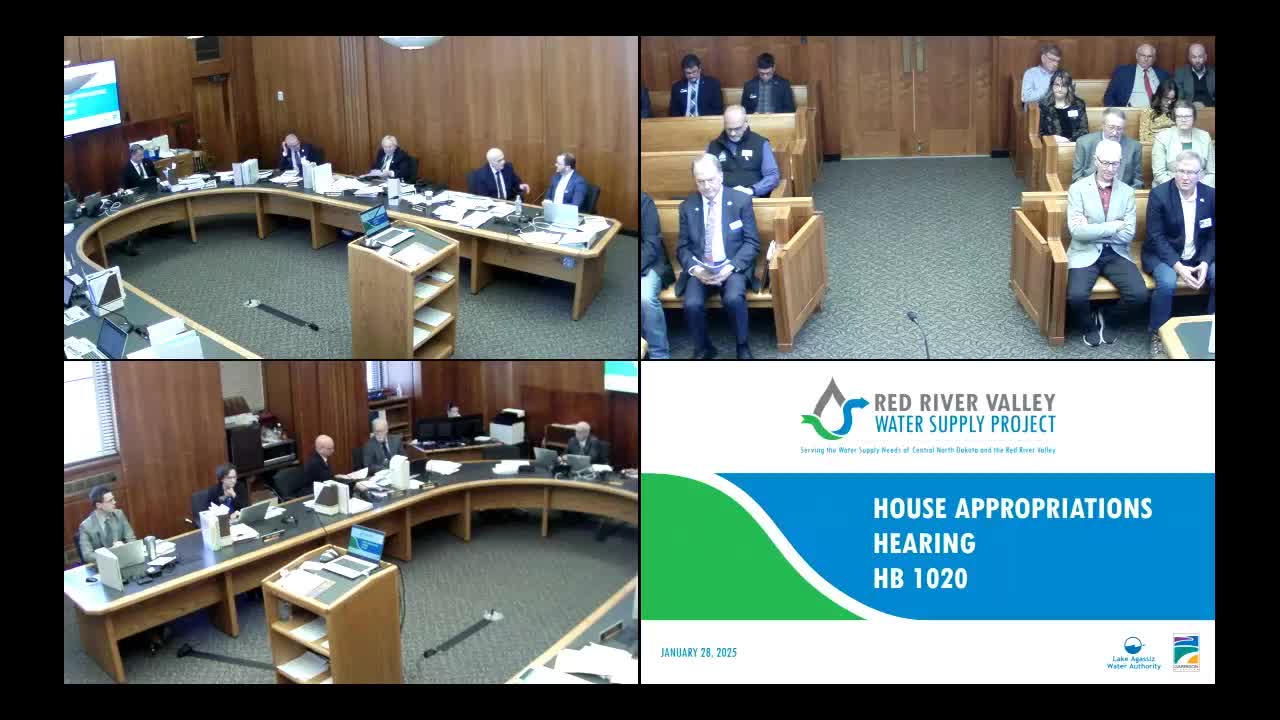
The Appropriations — Education and Environment Division opened a public hearing on House Bill 1020 to receive updates Thursday on the Red River Valley Water Supply project, presenters said.
Garrison Diversion Conservancy District and Lake Agassiz Water Authority leaders described the project’s technical scope, a near-term construction schedule and financing plans, and answered questions about drought assurances and long-term capacity.
Speakers told the committee the project will move water from the Missouri River via the McCluskey Canal, with pipeline segments already under contract. "It's a 25 miles. It's a pretty long length of pipe that we have to put in and it's a 7 foot pipe 15 feet below the ground," said Tim Mahoney, mayor of Fargo and chairman of the Lake Agassiz Water Authority. Mahoney and others described the system as an "emergency water supply" that some communities also view as an economic-development driver.
Bernie Dardis, mayor of West Fargo and a LAWA board member, summarized the project's state financing: he said Senate Bill 2020 (2023) appropriated $180 million for the current biennium and that the project assumes a 75% state / 25% local cost share. Dardis also said the project plan uses a 2% water infrastructure revolving fund loan and that the state request/obligation figure discussed by presenters was about $193 million. He and consultant Sean Gaddy told lawmakers that accelerating the schedule — for example by pre-procuring pipe and adjusting contracting strategies for facilities — could reduce inflation exposure and potentially shave roughly $40–$50 million from projected inflationary costs, depending on how many years are removed from the current build schedule.
Lawmakers asked about drought protections for upstream users. "The lowest flow ever observed in the Missouri River in a drought situation was 13,000 cubic feet per second. This project at full bore is 165 cubic feet per second. You can't even measure it on a river gauge," said Duane Duque, general manager of Garrison Diversion, adding the project "won't endanger anybody else that's already using the river in North Dakota."
Committee members also pressed presenters on redundancy and potential additional phases. Mahoney said an alternate intake (described as "Phase 2") would be a separate, optional work stream and estimated that full Phase 2 construction could cost about $200 million; he characterized that work as a contingency if the McCluskey Canal intake were unavailable. Garrison staff said the installed pipeline capacity is being designed to deliver about 165 cubic feet per second; they also said facility modifications, upsized pipe in spots and additional work could increase delivery capacity in the future, but would require further construction and expense.
Presenters described policies intended to reduce risk for small users. Mahoney described an "assurance policy" under which larger users such as Fargo and Grand Forks will initially accept some of the distribution burden so small systems can join the project without an immediate large capital outlay; after a defined period small users could assume service and local repayments.
Committee members asked about contractor availability and bids. Officials said recent contracts have seen multiple bidders and bids generally have come in near engineer estimates, though availability of bidders can vary by contract size. Speakers said pipeline procurement could be accelerated more easily than some large treatment and facilities work, and that contracting strategy changes would be needed to speed the facilities portion.
No committee vote on HB 1020 was recorded during the hearing. Presenters finished by noting ongoing local outreach: they said dozens of user meetings have been held and more are scheduled as smaller communities consider signing on.
The committee closed the hearing on House Bill 1020 after public comment concluded.