Get Full Government Meeting Transcripts, Videos, & Alerts Forever!
Get email alerts on the Virtual Education topic
No spam. Unsubscribe anytime.
Center for Distance Education testifies on enrollment, tuition and proposed bills that would limit district-paid virtual enrollment
Summary
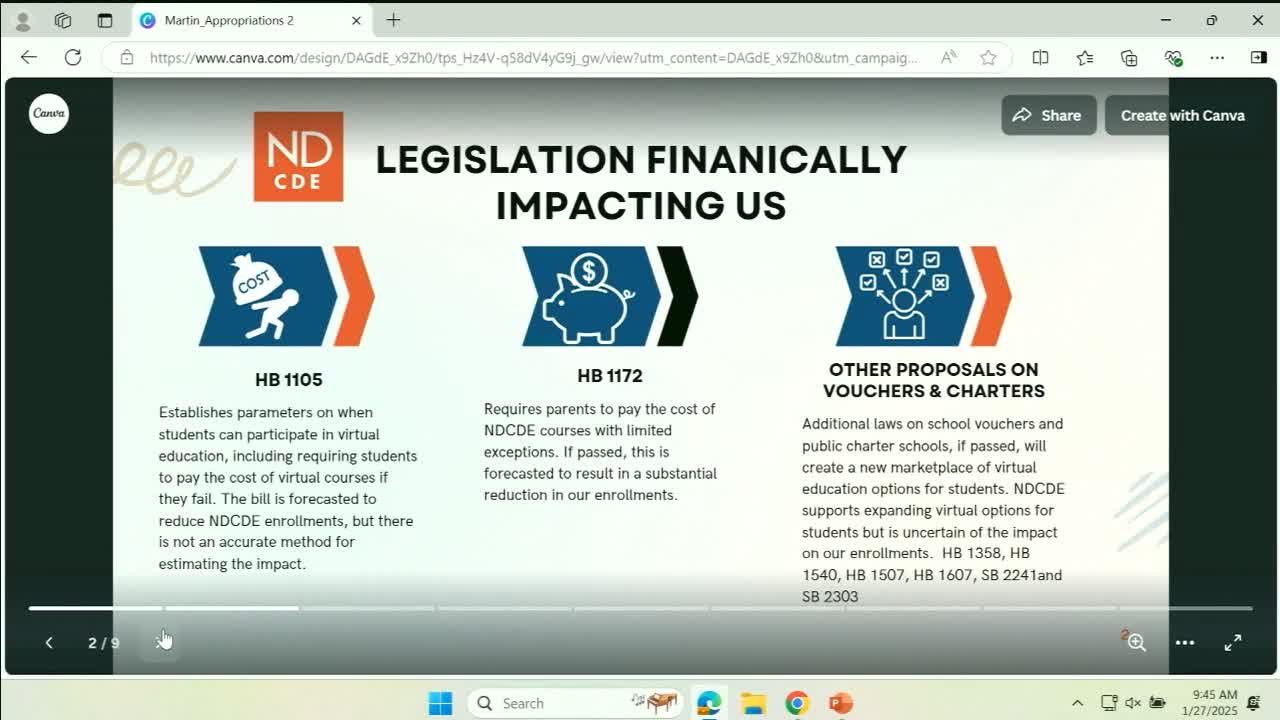
Center for Distance Education leadership told the Appropriations Education and Environment committee about growing enrollment, budget adjustments and concerns with two bills (House Bill 1105 and House Bill 1172) that would change when districts must pay for students to attend the state's virtual school.
Melissa (last name not specified), representing the Center for Distance Education (CDE), and other CDE staff testified about CDE enrollment growth, tuition revenue, staffing needs and two bills before the Legislature that would change districts’ obligations to pay for students attending the state virtual program.
CDE leaders said the center has grown rapidly and now serves tens of thousands of course enrollments. At one point testimony cited headcount of about 5,000 students this year and an overall fiscal-year enrollment tally of roughly 16,500; cumulative biennial enrollment figures cited were larger. CDE presented a budget that relies on tuition revenue and requested spending authority tied to tuition growth, additional FTEs (1.2 FTE requested, with 0.8 FTE already in an optional package), and equity adjustments to staff pay.
CDE described three primary enrollment drivers that send students to the center: scheduling conflicts, lack of course availability at the local district, and a general “issues with my local school” category the center’s intake form records. Committee members and CDE staff also discussed cases where students enroll in CDE for health reasons or to escape bullying or a conflict with a local instructor.
CDE staff testified they opposed provisions in House Bill 1172 that they said would sharply limit when districts must pay for a student to attend the Center for Distance Education and that a separate bill, House Bill 1105, may be workable if amended. Under current law (cited as chapter 1519 in the hearing), the district pays for a resident student to attend the center; HB1172 would narrow district-paid enrollment to only two reasons, the center’s representatives said, which would shift costs to parents in many other cases.
The center presented revisions to its original decision packages: removing an FTE request, reducing a tuition‑waiver request, holding off on an initial ERP transition cost, and reallocating those funds toward a proposed equity package to increase staff pay. CDE also sought funding for a new military pathway curriculum and for an ERP (enterprise resource planning) replacement project, with the center noting implementation would likely begin in the second year of the biennium.
CDE staff said adjunct instructors average about $28 per hour and noted temporary salary lines expand when tuition revenue grows; they described a need to preserve a 0.8 FTE in their base budget even if the committee does not fund additional FTEs because they are already filling that position.
Ending: Committee members asked for follow-up information on enrollment projections, the mechanics of restoring FTEs from the OMB pool, and the potential fiscal impacts of HB1105 and HB1172; CDE staff said they would provide updated enrollment and budget projections and discuss potential policy fixes (enrollment windows, MOUs) to reduce mid‑semester transfers to the center.