Get Full Government Meeting Transcripts, Videos, & Alerts Forever!
Get email alerts on the Fte Block Grant topic
No spam. Unsubscribe anytime.
DHHS officials defend FTE block grant as committee reviews vacancy report and salary accounting
Summary
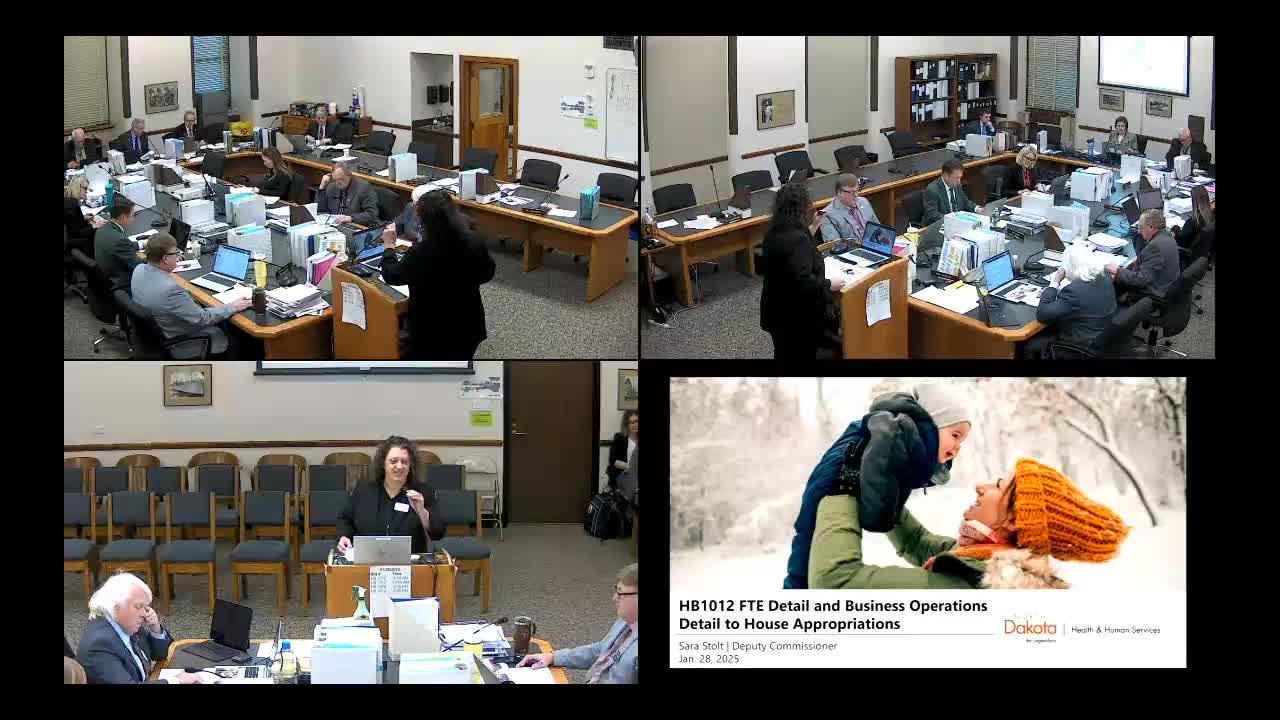
Deputy Commissioner Sarah Stolt told House appropriators the DHHS FTE block grant lets the department repurpose salary savings from long-term vacancies to meet critical needs while staying within its overall salary appropriation.
Deputy Commissioner Sarah Stolt and finance and HR officials told the House Appropriations Human Service Division that the Department of Health and Human Services has been using a salary “FTE block grant” to repurpose unfilled positions, convert long-term temporary employees to full-time status and respond to critical workforce needs — and defended the department’s accounting for vacancy roll-up.
Stolt said the block grant gives the department flexibility to manage one overall salary appropriation while changing where employee positions are assigned. “The FTE block grant allows us to address critical and emerging needs within the total salary appropriation using the salary savings that we have from turnover,” Stolt said during the hearing.
The department submitted a detailed vacancy report dated Dec. 1 showing 374.63 FTEs vacant in multiple phases of recruitment; Stolt and finance staff explained how the report distinguishes: budgeted position numbers, filled positions (actual employees working), and temporary or unbudgeted positions added during the biennium using salary churn.
Donna Ocland, a department finance official, told the committee legislative council’s roll-up calculation — which listed roughly $56 million in potential salary savings — double-counted unbudgeted positions by applying full, 24‑month salaries to position numbers that had been created and financed from turnover. Ocland said that, in the department’s view, the accurate projected salary roll-up is roughly $13.5 million to $14 million by the end of the biennium.
Committee members repeatedly asked how the department repurposed positions, whether long-open vacancies should be removed, and how contract staff such as travel nurses are budgeted. Stolt and Ocland said travel nurses and other contract labor are paid from operating lines and not the salary appropriation; the department estimates about $10 million is spent on travel nurses and contract medical staff in operating costs. Ocland added the department can move dollars between salary and operating lines under the transfer authority it has been granted, and said transfers are reported publicly when required.
Human Resources Chief Marci Wichet described the department’s process for converting long-term temporary employees to FTEs: criteria included 30+ hours per week, expectation of work continuing three years or longer, and stable funding. The department said it had converted about 108.5 long-term temporary positions to FTEs (53.5 initially and another 55 under the block-grant process). Stolt said the department also repurposed roughly 50 long-term vacancies within behavioral health to address higher-priority needs within that division.
The committee asked for greater transparency: members requested vacancy and conversion reports broken down by division and asked for monthly or quarterly standardized reports. Ocland and Stolt agreed to provide division-level and position-level detail and to work with legislative council on reconciling calculations.
No formal motion or vote occurred during the hearing. Department staff said they have paused adding any further FTEs for the remainder of the biennium while monitoring monthly payroll and vacancy reports to avoid exceeding the salary appropriation.