Get Full Government Meeting Transcripts, Videos, & Alerts Forever!
Get email alerts on the Domestic Violence Services topic
No spam. Unsubscribe anytime.
Domestic and sexual violence coalition asks lawmakers for $19 million to expand crisis, prevention and supervised‑visitation services
Summary
The North Dakota Domestic and Sexual Violence Coalition and Community Violence Intervention Center asked the House appropriations committee for a multiyear increase in state funding to address rising victim service demand, expand prevention, supervised visitation and mobile crisis responses, and strengthen workforce capacity.
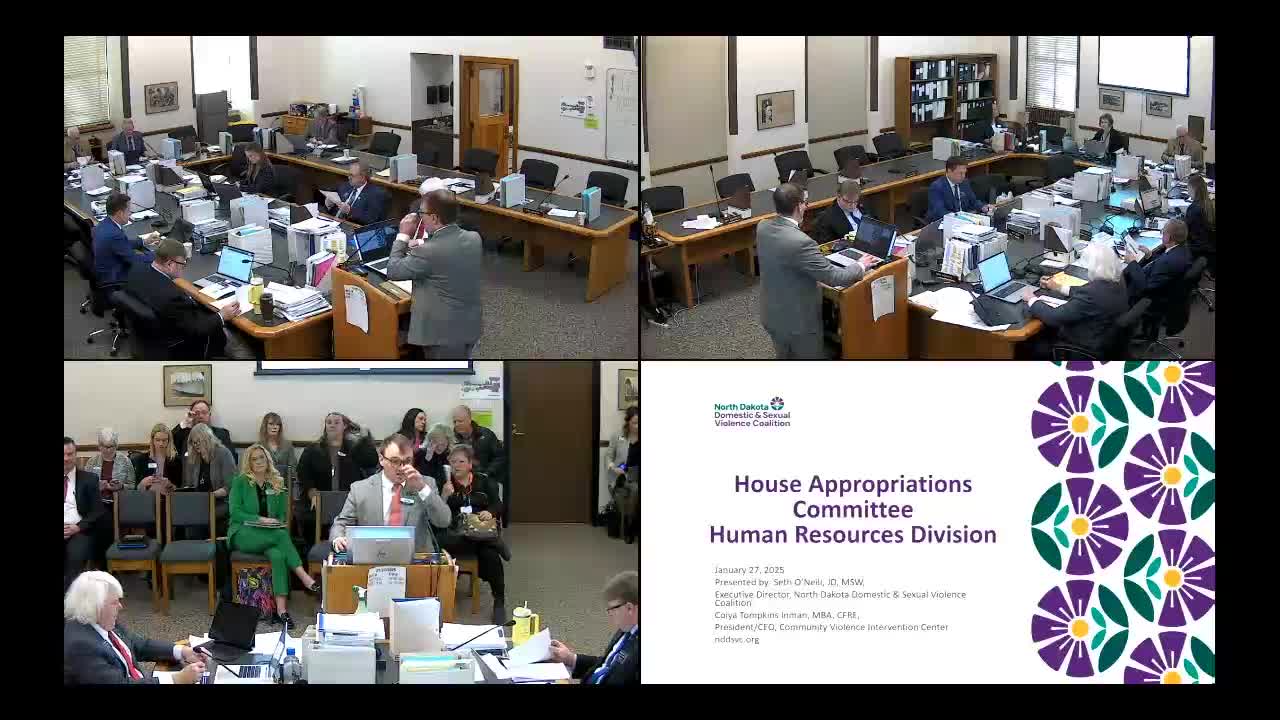
Seth O’Neil, executive director of the North Dakota Domestic and Sexual Violence Coalition, and Koya Tompkins Inman, president and CEO of Community Violence Intervention Center (CVIC) in Grand Forks, told the appropriations committee that victim services across the state are seeing increased volume and complexity and requested larger state appropriations to support crisis response, prevention, supervised visitation/exchange and programs that work with people who use violence.
O’Neil said the coalition’s 19 member programs collectively served more than 7,400 survivors of domestic violence and more than 1,200 primary victims of sexual assault in 2023; those victim-service programs also provided tens of thousands of advocacy contacts and education events. He emphasized children’s exposure to domestic violence — he said about 4,205 children were associated with newly served survivors in 2023 — and described higher lethality in recent years and greater complexity in cases since the pandemic.
Tompkins Inman described the coalition’s $19 million funding request, broken into four categories: state general funds for crisis response, counseling, housing and transitional services; an expansion of supervised visitation and exchange (safe supervision for parenting time); prevention and bystander-intervention expansion; and programs that work directly with people who use violence. She told the committee last session’s increase helped programs retain staff and add prevention specialists and that continued funding would be used to raise wages, expand prevention in schools, strengthen supervised visitation coverage and sustain crisis and transitional services.
Tompkins Inman also described program outcomes: supervised-parenting-time programs served nearly 700 children in the reporting period, and domestic-violence-intervention programs reported reductions in subsequent 911 calls (73% reduction) and criminal charges (over 90% reduction) two years after an offender completed an intervention curriculum in Grand Forks’ program, she said. She shared a client testimony (recorded) from a survivor — identified in committee remarks as Shara — who credited the local crisis center with life‑changing support including therapy and EMDR treatment and described long-term recovery progress.
Committee members asked about funding sources (federal, local, private) and how increased state funds would be distributed; O’Neil said federal and local funds make up a majority of many programs’ budgets, while state funds represent roughly 16% of the combined budgets of member programs, and explained state dollars give programs flexible capacity to respond to local needs.
Why it matters: Providers described an increasingly urgent demand for crisis response, prevention and transitional housing. Witnesses argued additional state funds could expand prevention and supervised visitation in underserved counties, raise wages to address workforce shortages, and expand mobile crisis and other evidence-based interventions.
What’s next: The coalition asked legislators to consider its $19 million request and the specific category breakdowns as the body finalizes the department and human-service funding in the 2025‑27 biennium.