Get Full Government Meeting Transcripts, Videos, & Alerts Forever!
Get email alerts on the Long Term Care Funding topic
No spam. Unsubscribe anytime.
Providers ask legislature for $6.52 million to shore up basic care rates and inflation adjustments
Summary
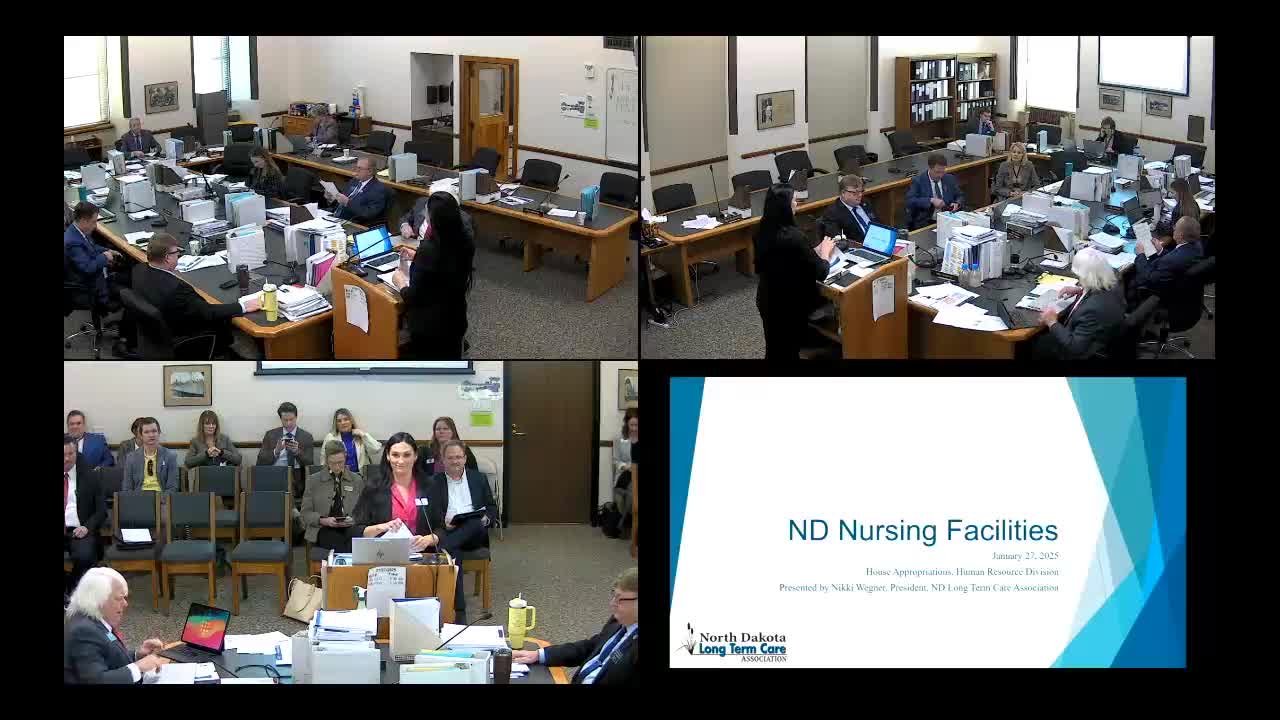
Representatives of North Dakota long-term care providers told the House Appropriations Human Resources Division that nursing homes and basic care facilities face rising costs and workforce shortages, and urged three amendments to House Bill 1012 that together would cost an estimated $6.52 million in state general funds for the next biennium.
Nikki Wagner, president of the North Dakota Long Term Care Association, told the House Appropriations Human Resources Division that nursing homes and basic care providers in the state are facing rising costs driven by inflation, higher resident acuity and workforce shortages and asked legislators to adopt three funding changes to stabilize basic care.
Wagner said nursing facilities provide “around-the-clock skilled care” and face higher regulatory and infrastructure costs than community-based services, and that North Dakota nursing facilities serve a higher share of residents with dementia and psychiatric disorders than the national average. She said the Center for Medicare & Medicaid Services’ requirement that skilled facilities provide 24/7 registered nurse coverage will take effect in 2026 and that labor costs remain the “real driver” of rate pressure.
The association asked the committee to adopt three specific measures as amendments to House Bill 1012: an inflationary rate increase (4% for the rate year beginning July 1, 2025, and 3% for July 1, 2026), a $5-per-day temporary add-on for the July 1, 2025–June 30, 2027 period to continue stop-gap property-related relief, and expansion of a 3% operating margin to apply across all rate components except property. Wagner said the three items combined would require about $6,520,000 in state general funds for the biennium.
Kiara Tuksher, administrator at Good Samaritan Society in Fargo and the association’s basic care director at large, told committee members those increases would support programs that keep residents engaged and help recruit and retain staff. Tuksher said the $5-per-day add-on has been an essential temporary measure while a study of a property component or fair rental value system was expected to be completed; she said the study did not resolve payment deficiencies.
Wagner outlined data she said should inform the request: 2,097 licensed basic care beds with average occupancy of 72 percent; a 2024 average basic care reimbursement of $164.76 per resident per day versus an average cost of $247.89 (a shortfall of $83.13 per resident per day); and an estimated $2.7 million additional state funds needed for the proposed inflators. She also described a recent decline in contract nursing spending from $73 million in 2023 to about $59.9 million in 2024, while noting providers remain about 1,257 staff short of pre-pandemic levels.
Committee members asked for the underlying calculations behind the requested percentages and for additional documentation of the consulting work supporting a 3% operating margin. Wagner said the association worked with accounting consultants (Eide Bailly) to derive the margin and offered to provide more detail to legislators.
Wagner and Tuksher framed the request as time-limited measures or steps toward a permanent property component reform, and both urged the committee to direct the Department of Human Services to work with providers and the association on a long-term solution during the 2027 session. No formal vote or committee action was recorded during the hearing.
Ending: The committee received the requests and questions about calculations and next steps; providers said they would submit supporting documentation and urged lawmakers to include the amendments in House Bill 1012 to prevent closures or service reductions for basic care residents.