Get Full Government Meeting Transcripts, Videos, & Alerts Forever!
Get email alerts on the Criminal Records topic
No spam. Unsubscribe anytime.
State Patrol-led bill would expand judges' discretion to order fingerprints and permit fingerprinting on cite-and-release
Summary
Senate Bill 5223, requested by the Washington State Patrol, would allow judges to order fingerprints in gross-misdemeanor cases at preliminary hearing or arraignment and let officers capture fingerprints for cite-and-release or summons cases; the State Patrol said the changes improve criminal record completeness; defenders opposed citing presump
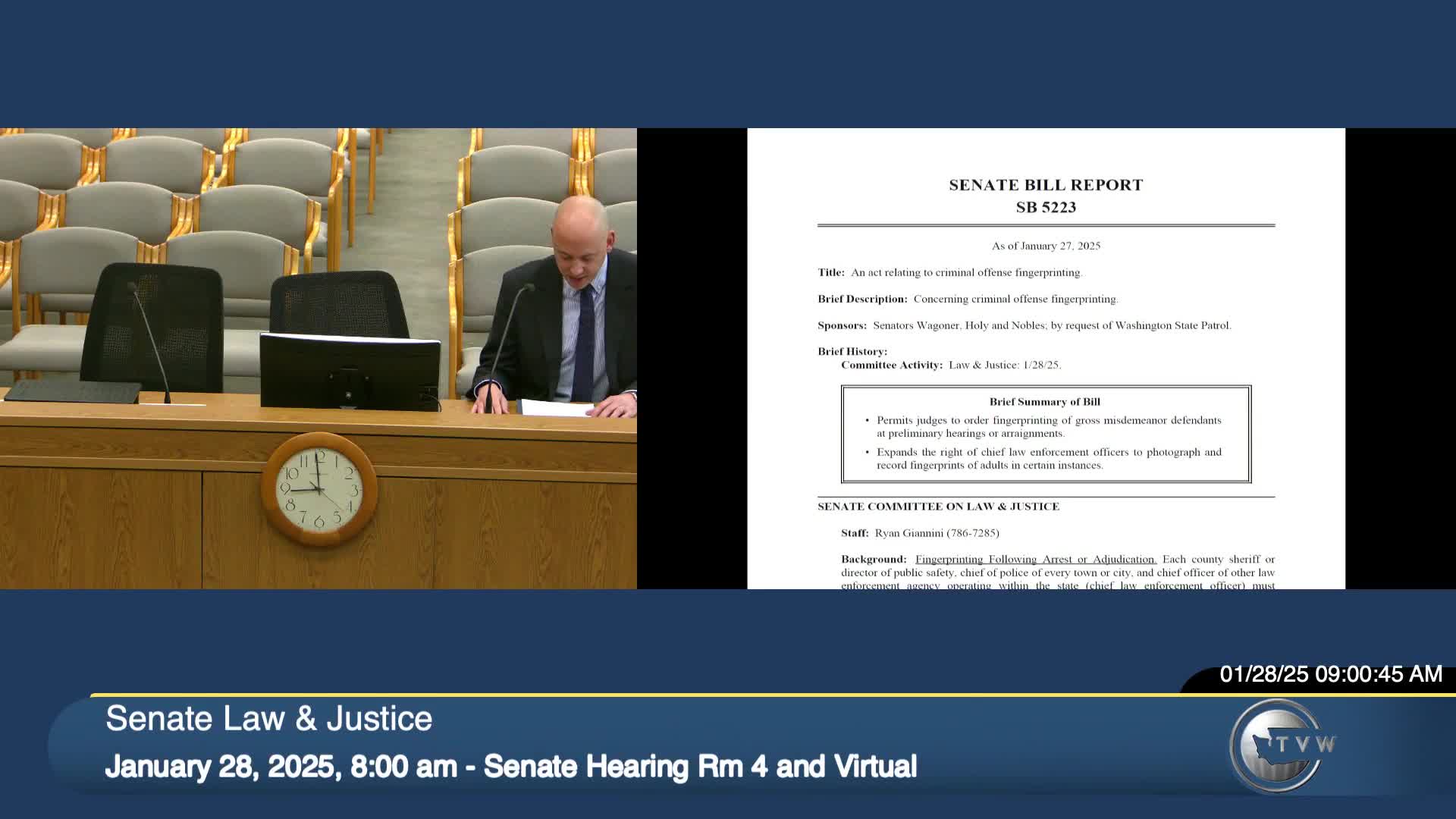
The Law & Justice Committee considered Senate Bill 5223 on Jan. 28, a State Patrol–requested bill that would expand existing fingerprinting practices by permitting judges to order fingerprinting in gross-misdemeanor cases and by allowing law enforcement to capture fingerprints during the cite-and-release or summons-to-appear processes.
Ryan Giannini, committee staff counsel, described current procedures: law enforcement must photograph and fingerprint adults lawfully arrested for felonies or gross misdemeanors and transmit identifying information to the Washington State Patrol within 72 hours. The bill would give district and municipal judges discretion to order fingerprinting in gross-misdemeanor cases at arraignment or preliminary hearing, and would allow fingerprints to be taken when an individual is cited and released so records can be updated.
Captain Dion Glover of the Washington State Patrol testified the change would improve the completeness of criminal-history records for the state and the FBI and help courts and law enforcement track arrest dispositions. “Without access to these fingerprints, the Washington State Patrol's criminal records division cannot update a person's record with the arrest disposition information at all,” Glover said.
Carrie Reardon, representing the Washington Defender Association and Washington Association of Criminal Defense Lawyers, opposed the bill and argued it risks adding people to criminal databases before convictions, raising concerns about false arrests and disparate treatment across communities.
Committee staff said a fiscal note is available. No committee action or vote occurred during the hearing.