Get Full Government Meeting Transcripts, Videos, & Alerts Forever!
Get email alerts on the Educational Interpreters topic
No spam. Unsubscribe anytime.
Committee considers two-tier certification for educational interpreters to expand qualified access
Summary
Senate Bill 5025 would create full and limited certificates for educational interpreters and set a timetable for most district interpreters to hold a certificate by the 2027–2028 school year.
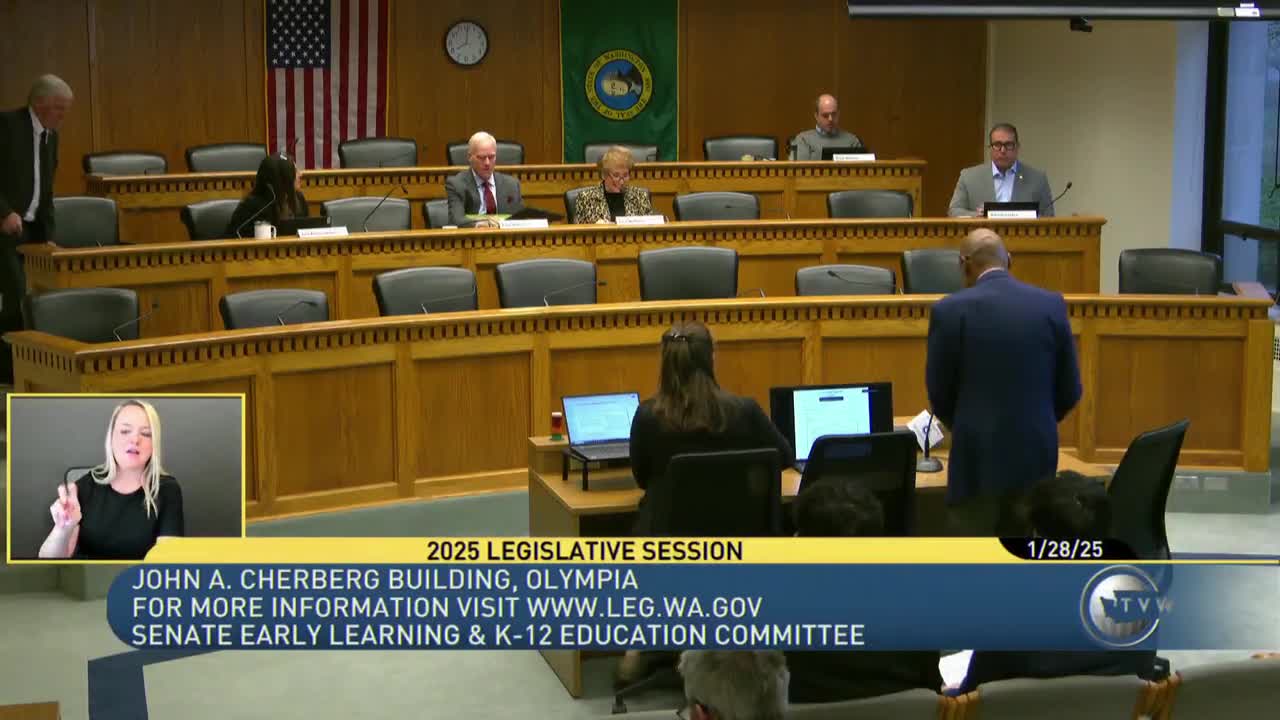
Senate Bill 5025, which would create a two-tiered certificate structure for educational interpreters who provide sign-language interpretation and transliteration in schools, was presented to the Early Learning & K-12 Education Committee.
Committee staff Elena Becker explained that the bill directs the Professional Educator Standards Board (PESB) to identify full and limited performance standards for educational interpreter assessments and to grant certificates consistent with those standards. “Limited certificates…would have a period of validity of no more than 5 years,” Becker said, and “with limited exceptions, educational interpreters employed by school districts must have obtained either a full or limited certificate by the 2027 to 2028 school year.” The bill also authorizes PESB to limit the number of times an interpreter may take an assessment while qualifying for a certificate and directs PESB to adopt separate standards for deaf and deaf-blind educational interpreters as necessary.
Why it matters: Proponents said clearer certification tiers will signal interpreter proficiency to districts and families, increase workforce capacity by allowing limited-certificate holders to work while they progress to full certification, and provide data on the number and distribution of interpreters across the state.
PESB and related testimony: Anna Karen Hoffman, representing the Professional Educator Standards Board, testified in support and noted a technical detail: OSPI, not PESB, currently grants certificates under existing practice and the bill’s language should be adjusted to reflect that separation of duties. Hoffman also told the committee PESB recently increased the minimum passing score on the educational interpreter performance assessment from 3.5 to 4.0; she said the proposed certificate structure would provide clearer indicators of proficiency and data for planning.
Deaf community witnesses and providers supported stronger standards and access. A witness who identified as deaf and associated with a Center for Deaf and Hard of Hearing services described significant access gaps for students who lack early language exposure and urged stronger interpreter qualifications and services. Seattle Council PTSA co‑president Samantha Fogg described cases where young students were placed in classrooms with inadequate interpreting arrangements and noted the importance of interpreters as language models for deaf and hard-of-hearing children.
Clarifications and limits: Testimony distinguished interpreters from interveners used with some deaf‑blind students and emphasized human interpretation and early language access over technological substitutes. Staff and witnesses noted a technical amendment to clarify that PESB sets performance standards and OSPI issues certificates under current practice.
Next steps: The bill would require PESB and OSPI coordination on standards, certification procedures, and data collection; a fiscal note had been requested. The committee concluded public testimony and will consider bill language and any technical amendments in subsequent committee action.