Get Full Government Meeting Transcripts, Videos, & Alerts Forever!
Get email alerts on the Pay Transparency topic
No spam. Unsubscribe anytime.
Committee hears bill to allow employers limited time to correct wage-posting errors; worker groups caution against weakening enforcement
Summary
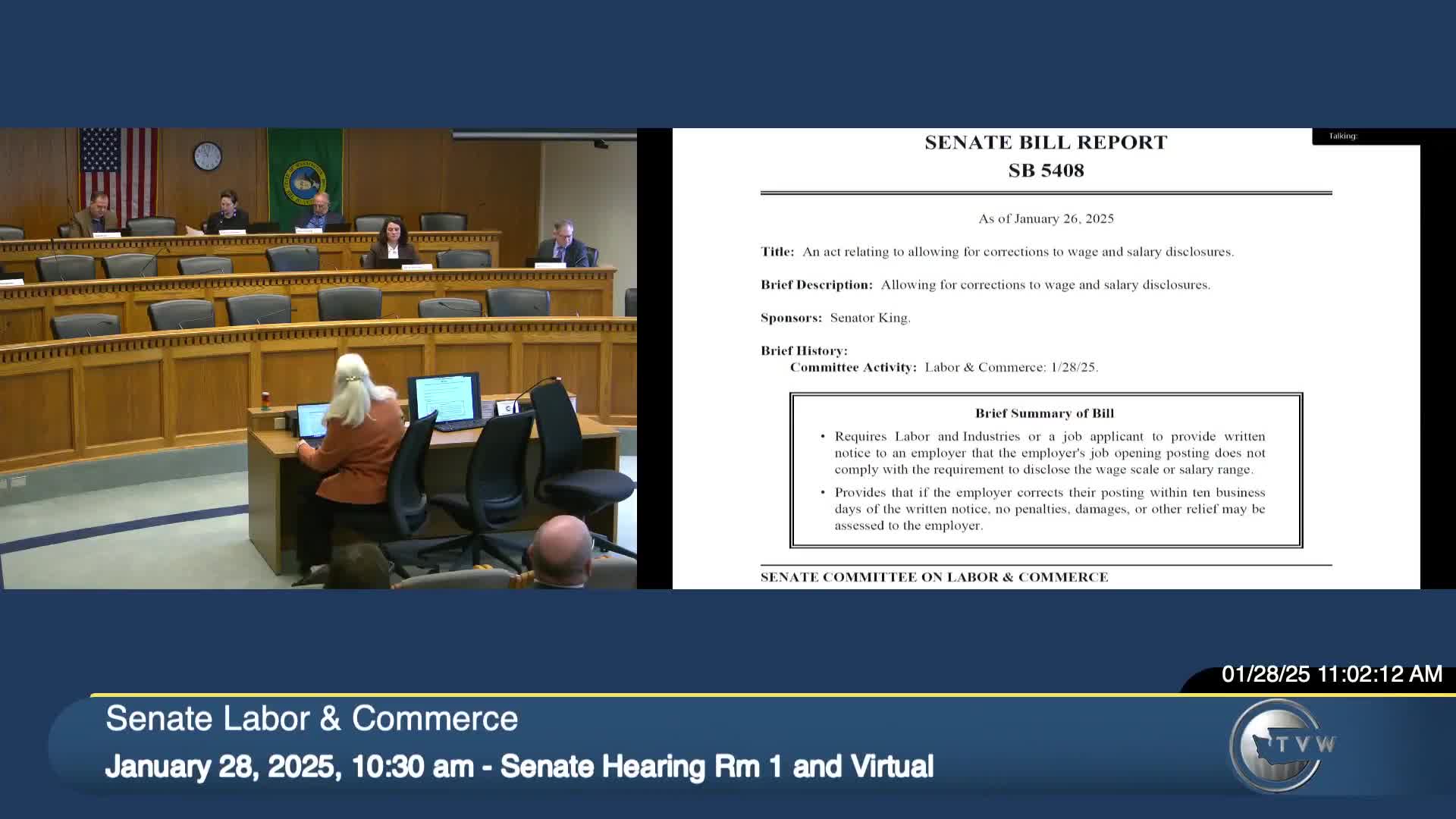
Senate Bill 5408 would require written notice to an employer of a noncompliant job posting and allow a 10-business-day correction period that, if met, removes penalties, damages and other relief. Business groups supported the 'right to cure'; worker and plaintiffs' attorneys warned it would undermine enforcement and shift burden onto applicants.
Senate Bill 5408 would permit employers a 10-business-day cure period to correct job postings that fail to disclose the wage scale or salary range, and would bar penalties, damages, or other relief if the employer corrects the posting within that period.
Committee staff summarized the law that created pay-transparency requirements: employers with 15 or more employees must disclose wage scales or salary ranges and a general description of benefits in job postings; remedies under the Washington Equal Pay and Opportunities Act (EPOA) include L&I investigation and private litigation. The staff report noted litigation and remedy questions have arisen since the law took effect.
Sponsor Senator King said the bill is intended to let employers fix inadvertent errors without immediate exposure to private-right-of-action suits that have imposed large settlements on some employers. "We need to give these companies a chance, if there was an oversight," King said, and described small businesses facing financial risk from suits over postings.
Business groups backed the change. Lindsey Huber (Association of Washington Business) and Amber Carter (Washington Retail Association) said the amendment would prevent a cottage-industry of serial filings and protect small businesses that lack outside counsel. Small-business advocates and trade groups said mistakes often stem from third-party job-posting scrapers or posting errors and that current litigation can be disproportionate to the underlying compliance failure.
Worker-advocacy groups and plaintiff-side lawyers opposed the bill as written. Kyle Mitchell, an hourly worker, described ongoing noncompliance by large employers and said private enforcement is necessary to compel adherence; Vanessa Harrold recounted a protracted example of litigation (US Foods) and described intensive discovery demands she endured after filing a claim. Washington Employment Lawyers Association and the Washington State Association for Justice said the right-to-cure proposal shifts the burden to workers to police compliance and could allow employers to ignore notice obligations for two weeks while postings remain online.
Representatives of employers and plaintiffs'side groups said they were negotiating possible compromise language; some parties indicated they would provide the committee with proposed alternative amendments.
Ending: The committee took testimony and did not act. Several stakeholders said they would continue discussions aimed at narrowing unintended consequences while preserving effective enforcement.