Get Full Government Meeting Transcripts, Videos, & Alerts Forever!
Get email alerts on the Treatment Diversion topic
No spam. Unsubscribe anytime.
Bill would let people charged with certain possession offenses seek dismissal after completing court-approved treatment; advocates and prosecutors clash
Summary
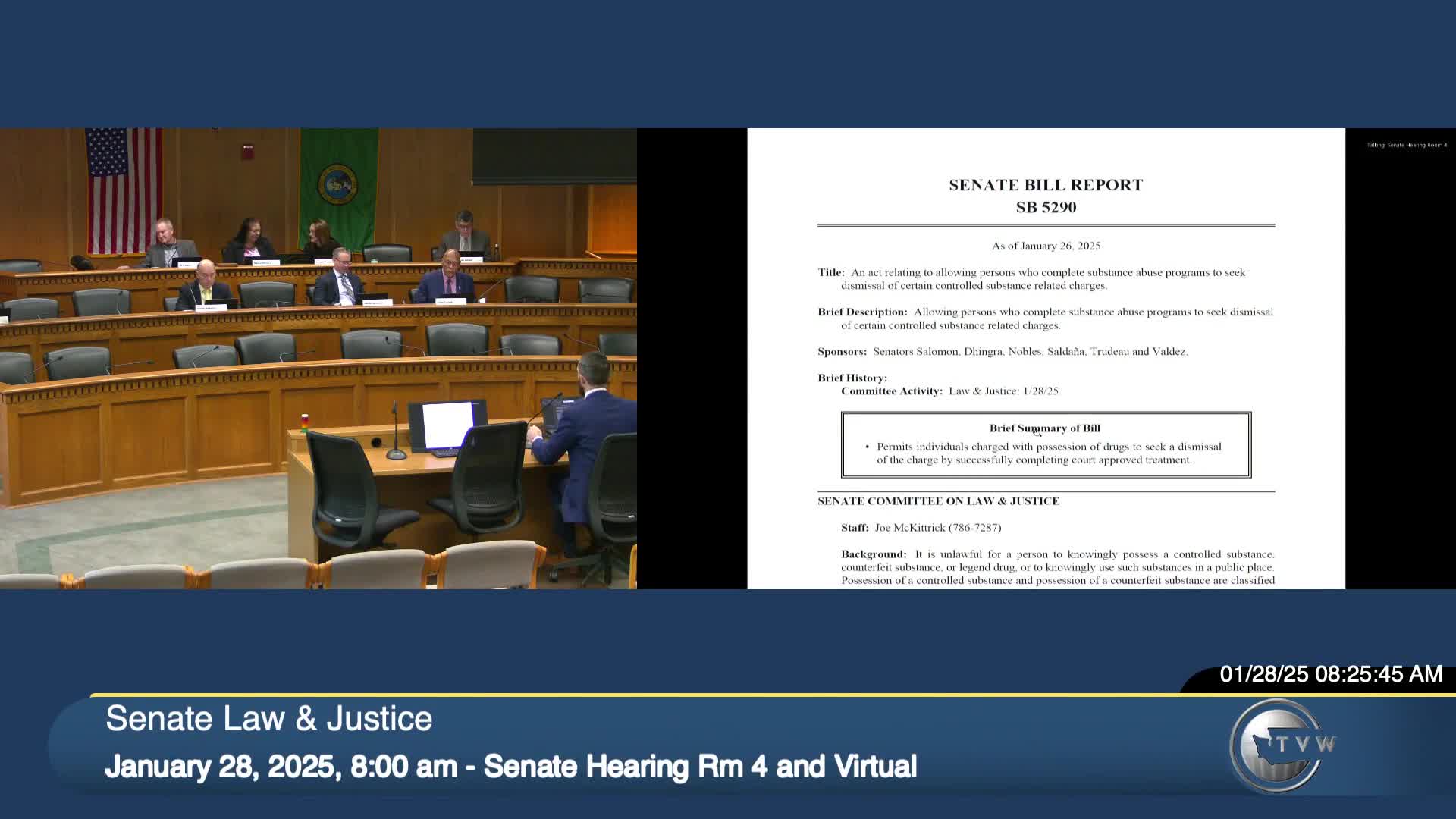
Senators on the Law & Justice Committee heard Jan. 28 on Senate Bill 5290, which would permit a person charged in a court of limited jurisdiction with possession or knowing use of certain drugs in public to seek dismissal after completing court-approved treatment.
Senators on the Law & Justice Committee heard Jan. 28 on Senate Bill 5290, which would permit a person charged in a court of limited jurisdiction with possession or knowing use of controlled, counterfeit or legend drugs in public to file an assessment and proof of completion of state-certified treatment and have the possession charge dismissed.
Committee staff described the current diversion framework: courts already may dismiss possession charges if the defendant substantially complies with treatment or diversion programs (recovery navigators, arrest-in-jail alternatives, law-enforcement assisted diversion), and the bill would create an additional route — in courts of limited jurisdiction — by which dismissal is obtained through a court-approved substance-use disorder assessment and completion of recommended treatment before the readiness hearing.
Senator Rebecca Solomon (transcript: Senator Solomon) said the measure is meant to provide an “easy off-ramp” that incentivizes treatment rather than repeated criminalization. “If you do treatment for drug possession charge, your case will be dismissed every time because that's the ultimate goal of what we're seeking in the entire court system for the use of drugs,” Solomon said.
Ramona Brandes, with the Washington Defender Association and the Washington Association of Criminal Defense Lawyers and a longtime public defender, testified in strong support, saying the legislature has already encouraged prosecutors to divert such cases and that this bill fills gaps where diversion programs are not consistently offered. Brandes said the bill requires state-certified programs and judicial monitoring of compliance.
Opponents included Russell Brown, executive director of the Washington Association of Prosecuting Attorneys, who said the bill removes prosecutorial discretion and risks separation-of-powers concerns by putting judges in the position of approving participation in diversion programs. “The party is a neutral arbiter,” Brown said; “this proposal puts the judge in a position to act like someone from the executive office to make a decision about whether or not that case moves forward.” Anne Anderson of the Washington State Narcotics Investigators Association also opposed the bill, saying current policy already provides off-ramps and that removing prosecutorial discretion could undermine deterrence.
Witnesses and the sponsor discussed program standards: state-certified treatment providers and court-approved assessments would be required under the bill, and supporters noted judges would still decline dismissal for accompanying non-possession charges if prosecutors objected. Staff said a fiscal note was requested. No committee vote took place.