Get Full Government Meeting Transcripts, Videos, & Alerts Forever!
Get email alerts on the Extended Producer Responsibility Recycling topic
No spam. Unsubscribe anytime.
Senate panel hears wide‑ranging testimony on Recycling Reform Act and proposed EPR system
Summary
SB 5284 would create an extended producer responsibility program for packaging and paper products, set statewide collection lists, and require a needs assessment. Cities and environmental groups supported shifting costs to producers, while haulers, retailers and some counties urged a thorough needs assessment and raised concerns about costs and
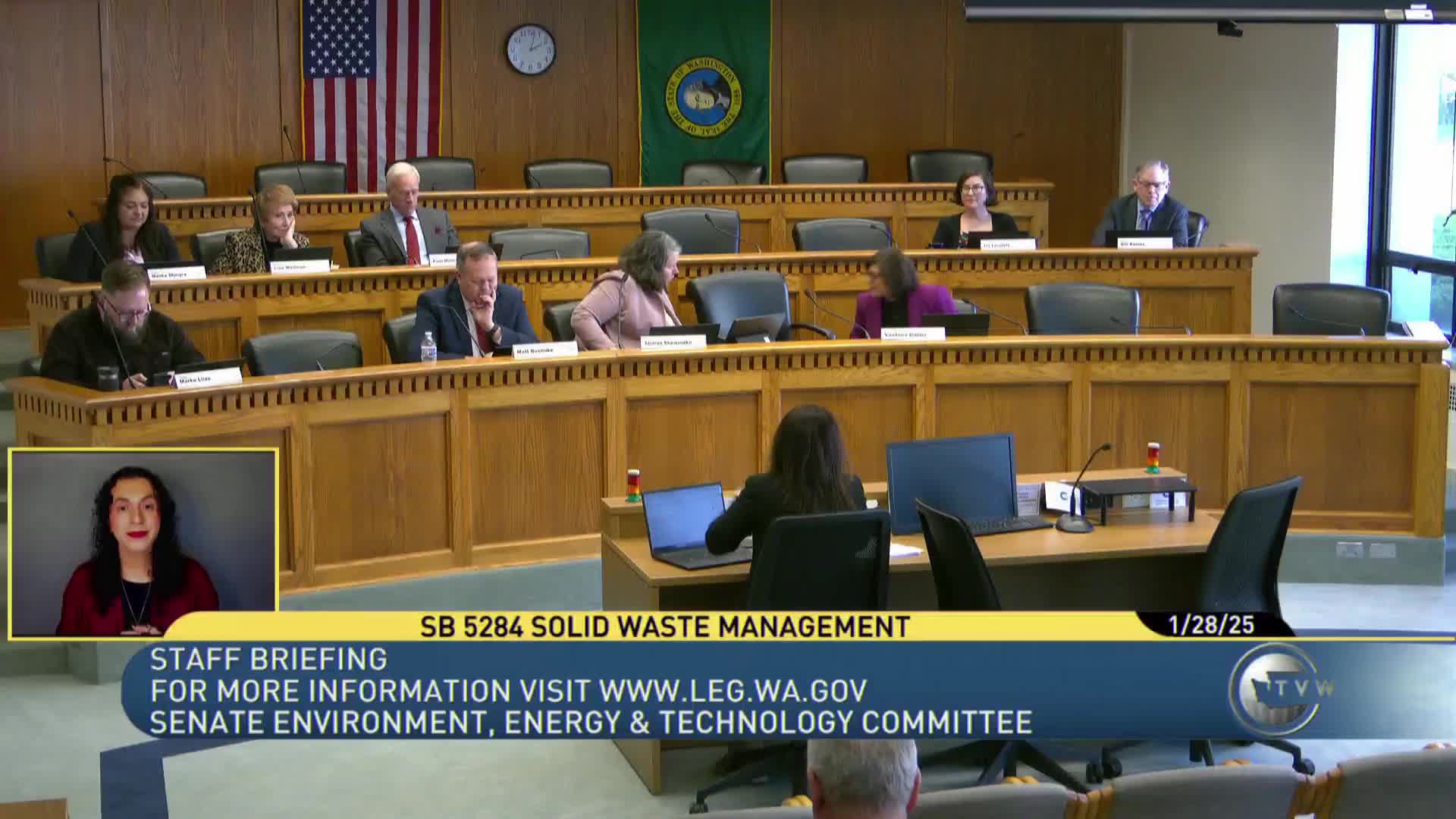
The Senate Environment, Energy & Technology Committee conducted an extensive public hearing on SB 5284, the Recycling Reform Act, which would create a statewide extended producer responsibility (EPR) program for packaging and paper products and change solid waste planning and collection requirements.
The bill would require producers of covered packaging and paper products to form or appoint a producer responsibility organization (PRO) to prepare and implement a recycling plan approved by the Department of Ecology. Ecology would develop four statewide collection lists (residential recycling, residential composting, public‑place collection and alternative/drop‑off collection) and complete a preliminary needs assessment in 2026 and a full needs assessment in 2027. The bill also directs local comprehensive solid waste plans to provide curbside source‑separated recycling collection wherever curbside garbage is provided beginning Jan. 1, 2030.
Why it matters: The proposal shifts the costs of collection and infrastructure from ratepayers and local governments to producers, aims to standardize recycling lists statewide, and would create targets and funding to build recycling and reuse infrastructure — a structural change to how Washington finances and manages recycling.
Staff summary: Alicia Kinney Clausen, staff to the committee, told members that SB 5284 “establishes an extended producer responsibility program for covered packaging and paper products,” explained the PRO fee and plan process and summarized the needs‑assessment and statewide collection list requirements. She also outlined additional provisions in the bill such as a reuse financial assistance program, minimum compensation requirements for material recovery facility owners/operators and studies on litter tax and equity.
Supporters: Environmental and public‑health groups and many city and county elected officials testified in favor. Peter Steelquist of the Surfrider Foundation urged action to reduce single‑use plastic and require sellers to use “responsible markets.” Mark Johnson of the Washington Retail Association and large retailers urged caution and a detailed needs assessment but indicated the retail sector would engage in rulemaking discussions. Dylan DeThomas of the Recycling Partnership and Kelsey Hulse of the EPR Leadership Forum said the bill aligns Washington with other EPR approaches and would enable investment in recycling infrastructure; they argued the bill’s needs assessment is sufficient and that well‑designed EPR does not necessarily raise consumer prices.
Local government and hauler concerns: Counties and private haulers raised several objections. Travis Dutton of the Washington State Association of Counties said Washington’s current funding for solid waste depends heavily on landfill fees that support hazardous waste, methane monitoring and other fixed costs, and worried an EPR program could undercut local financing models. Waste Management, Waste Connections and other large haulers said the bill shifts control from locally accountable public oversight to producers and a PRO that may lack the same transparency; they urged a county‑by‑county needs assessment before forming a PRO. Waste haulers also warned that producers could pass program costs through to consumers via higher prices.
Business and retail concerns: Representatives for retailers, consumer packaged goods companies and distributors asked for additional safeguards. The Washington Beer & Wine Distributors Association and other beverage stakeholders asked for clearer limits so producers cannot shift obligations to distributors and retailers. Several trade groups and manufacturers supported elements of the bill but requested changes on timing, fee methodology and flexibility for durable goods packaging.
Municipal and labor support: Mayors and city public‑works directors — including the mayors of Bellevue and others — testified for the bill, saying it would expand curbside recycling access and shift costs away from cities and residents. Christophe Mayer of the Washington State Labor Council said the bill would create new local jobs and include labor standards for sorting facilities. Seattle Public Utilities told the committee the program would reduce the burden on ratepayers who currently pay monthly recycling charges and that an EPR program need not be duplicative of existing data and studies.
Implementation questions and next steps: Witnesses debated whether the bill should proceed now or wait for full needs assessments and for other states’ implementation experience. Several participants urged additional amendments on consumer cost protections, PRO transparency and mandatory recycled content targets; supporters argued a coordinated EPR and potential deposit‑return system (bottle bill) will yield better outcomes. Committee staff closed public testimony on SB 5284; no committee vote was taken at the hearing.
If advanced, the bill would lead to rulemaking and plan submissions from a PRO and further stakeholder negotiation on fee setting, performance targets and program governance.