Get Full Government Meeting Transcripts, Videos, & Alerts Forever!
Get email alerts on the Memory Care topic
No spam. Unsubscribe anytime.
Bill seeks statewide certification for memory-care units; families and advocates urge standards
Summary
Senate Bill 5337 would require assisted living memory-care units to obtain certification and meet building, staffing and training requirements; advocates called for transparency and oversight while providers urged careful implementation to avoid displacing residents or duplicating rules.
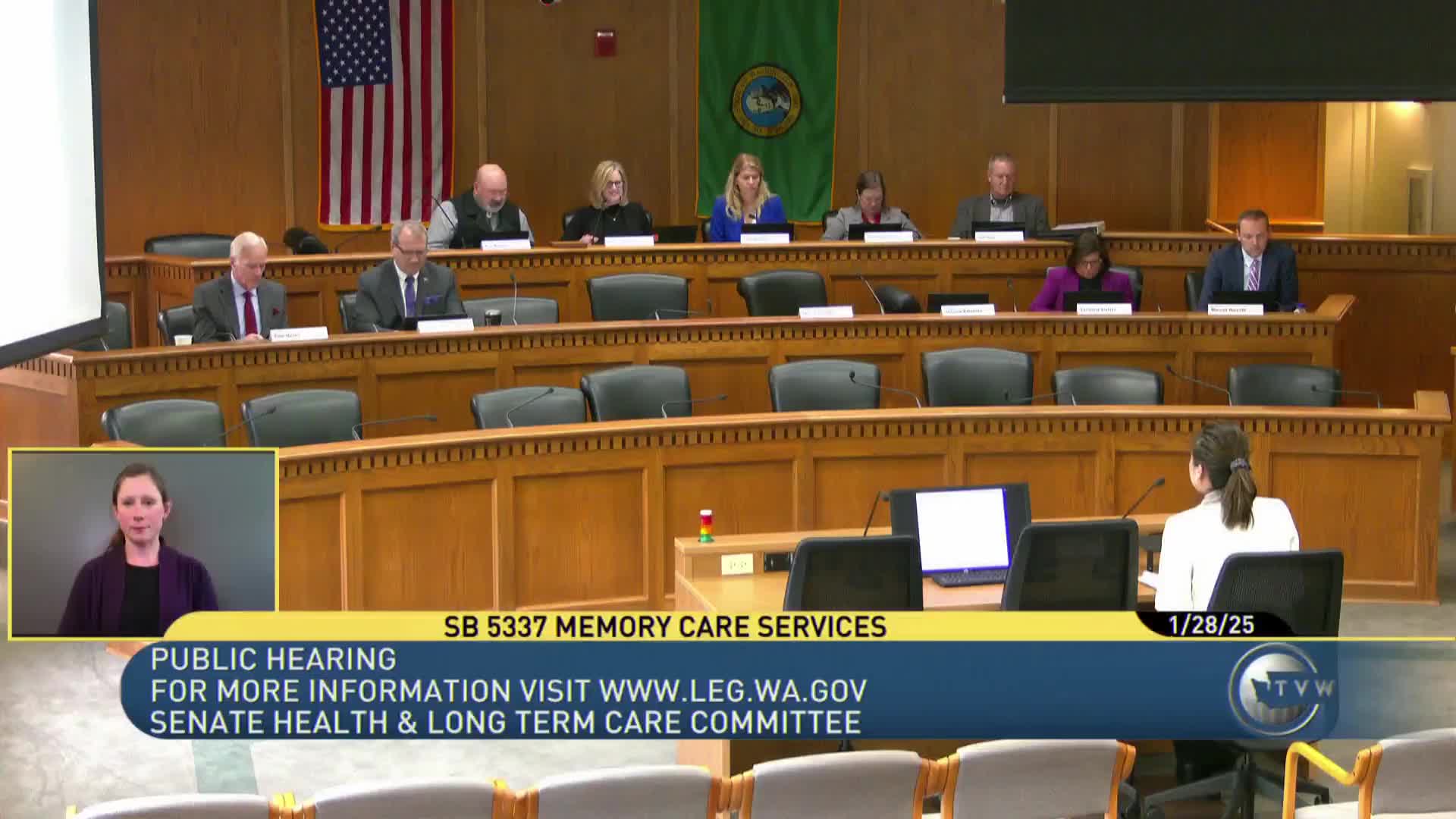
Senate Health and Long Term Care Committee members heard testimony Jan. 28 on Senate Bill 5337, sponsored by Vice Chair Senator Orwell, which would create a certification requirement for memory-care facilities or units in Washington after July 1, 2026.
Committee staff explained that the bill requires memory-care units to be certified and listed on a DSHS registry, and DSHS must adopt rules governing how existing facilities transition during certification. The certification would require proof of a valid DSHS contract to provide dementia care services or a valid assisted living license and additional building and staffing requirements described in the bill report. DSHS would also conduct inspections and may remove certification for noncompliance.
Supporters including AARP, the Alzheimer's Association, the Long Term Care Ombuds Program and family members said the absence of a standard definition for "memory care" allows wide variation in services and serious out-of-pocket costs for consumers. Joanna Grist of AARP noted families sometimes pay private rates (testimony cited "sometimes $10,000 a month") but find inconsistent services; the association asked for amendments to avoid segregation and to focus certification on services delivered rather than just a diagnosis label.
The Alzheimer's Association asked for required annual staff training and consumer protections; Brad Forbes described a proposed six-hour annual training requirement covering dementia-related behaviors, person-centered care, purposeful activities, and de-escalation.
Provider groups, including the Washington Health Care Association and LeadingAge Washington, said they support the general intent but raised practical concerns about initial certification causing displacement of residents if facilities fail to meet requirements, potential overlap with existing rules, and the need for a clearer public disclosure form for staffing levels. LeadingAge asked for refinements to the definition of memory care so the rule captures specialized communities without unintentionally including units where residents have incidental dementia diagnoses.
Family members described low staffing ratios and locked units that made visitation and oversight difficult. One family member, Theresa Matthews, described daily visits to a memory-care unit and urged the committee to require public disclosure of staffing ratios and stronger enforcement tools.
Testimony concluded with advocates and providers indicating willingness to continue stakeholder work on amendments. No committee vote was taken; the hearing was closed after testimony.